
You have an idea for a product. You’ve seen others do it—people launch brands selling phone cases, supplements, clothing, and gadgets, all sourced from China. They seem to be making money. But the process feels overwhelming. Where do you even start? How do you find suppliers? What about minimum orders? How do you handle shipping? What if the products are bad quality?
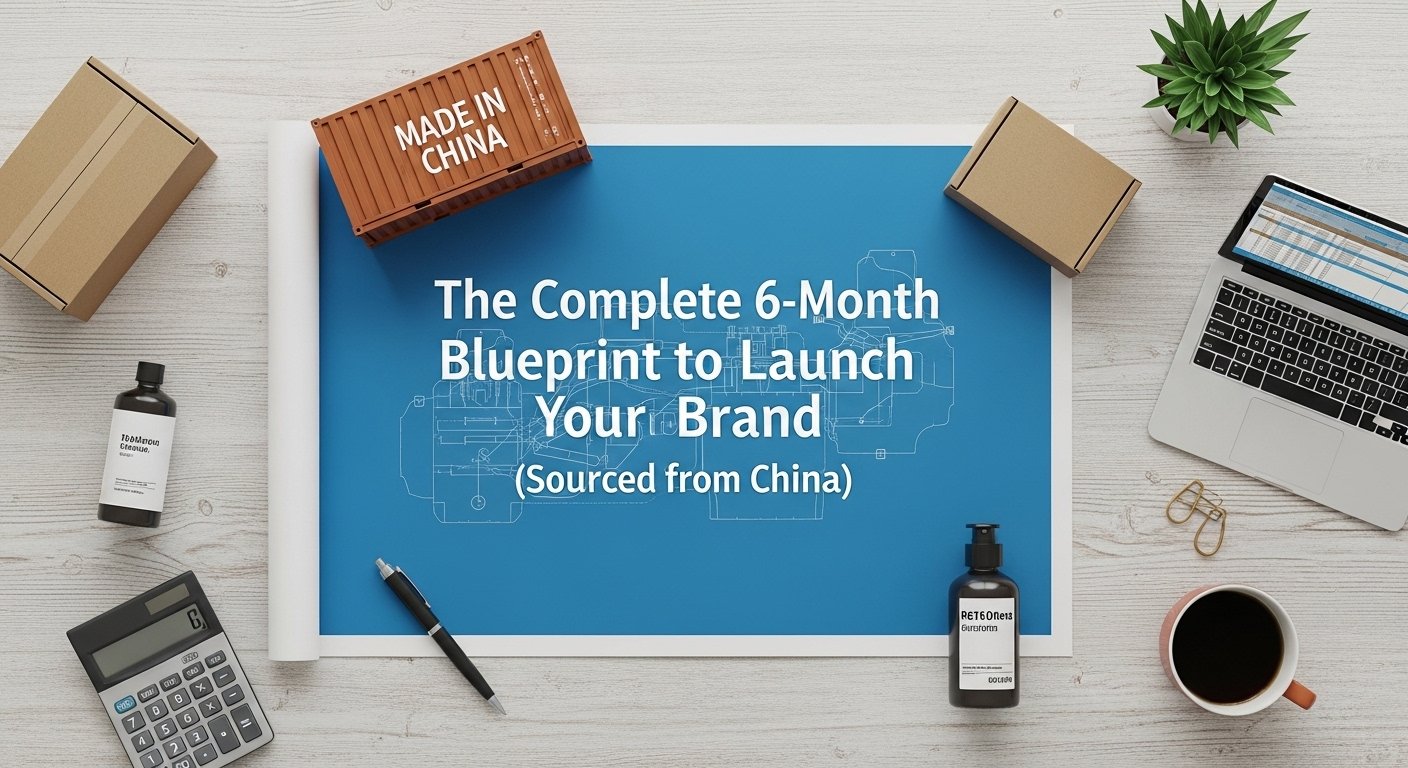
This guide answers all those questions. Over the next six months, you’ll transform from someone with an idea into someone with a brand. Let’s break it down phase by phase.
What You’re Building: A consumer product brand where you design products, source manufacturing from China, and sell directly to customers. This isn’t about becoming a middleman—it’s about controlling your supply chain and building a brand that can compete with established players.
The 6-Month Timeline: At a Glance
| Month | Phase | Key Activities |
|---|---|---|
| Month 1 | Research & Validation | Product research, competitor analysis, supplier discovery |
| Month 2 | Sample & Negotiation | Order samples, negotiate MOQs, finalize pricing |
| Month 3 | Branding & Legal | Trademark, LLC, brand identity, packaging design |
| Month 4 | Production | Place first order, quality control, packaging |
| Month 5 | Logistics | Shipping, customs, warehousing |
| Month 6 | Launch | Store launch, marketing, customer acquisition |
MONTH 1: Research and Validation
The foundation of your brand starts with knowing your market, your product, and your competition. Don’t skip this phase—most failed product launches start with “I didn’t research enough.”
Week 1: Product Research
Your Goal This Week: Validate that your product idea has demand and understand the competitive landscape.
- Search Amazon for your product category: What already exists? What are the bestsellers?
- Use Jungle Scout or Helium 10: Analyze sales volume, pricing, and competition for similar products
- Check Google Trends: Is demand growing or declining?
- Browse AliExpress: What do similar products look like? What are the price ranges?
- Read Reddit communities: r/Entrepreneur, r/SideProject, r/Ecommerce
Tools to Use:
- Jungle Scout: jungle.scot (Amazon product research)
- Helium 10: helium10.com (Amazon analytics)
- Google Trends: trends.google.com (search demand)
- Keepa: keepa.com (price history tracking)
Week 2: Competitor Analysis
You need to understand what’s already working in your market. Study at least 10 competitors:
- What are their bestsellers? Learn from what’s already selling
- What are their weaknesses? Reviews often reveal complaints you can address
- What are their prices? Understand the pricing sweet spot
- How do they present their brand? Branding, packaging, messaging
- Where do they advertise? Facebook ads, Google, influencer marketing?
Pro Tip: Read 1-star reviews on competitor products. These reveal exactly what’s wrong with existing solutions—and that’s your opportunity.
Week 3: Supplier Discovery
Time to find potential manufacturing partners. China has several types of suppliers:
| Supplier Type | Pros | Cons | Best For |
|---|---|---|---|
| Trading Companies | English-speaking, handle logistics | Higher prices, less control | Beginners, small orders |
| Manufacturers | Lowest prices, full control | Language barriers, MOQ requirements | Established businesses |
| Alibaba Suppliers | Easy to find, escrow protection | Quality varies, middlemen | Most beginners |
| 1688.com Direct | Factory prices, huge selection | Chinese language, complex | Experienced sourcers |
Where to Find Suppliers:
- Alibaba.com: alibaba.com (largest B2B platform)
- Made-in-China.com: made-in-china.com (verified manufacturers)
- Global Sources: globalsources.com (trade show backed)
- Hunter: alibaba.com (AI-powered supplier discovery)
- 1688.com: 1688.com (factory prices, Chinese interface)
Week 4: Supplier Outreach
Contact at least 20 suppliers with a template message:
Subject: Wholesale Inquiry - [Product Category]

Hello,

I'm looking to source [product type] for a new brand launching in [month/year].

Can you please provide:
1. Product catalog and pricing (FOB)
2. Minimum order quantities (MOQ)
3. Sample costs and shipping time
4. Lead times for bulk orders
5. Custom packaging options
6. Your factory location and certifications

Looking forward to your response.

Best regards,
[Your Name]- Response rate: Expect 30-50% to respond
- Questions to ask: Production capacity, export experience, quality control process
- Red flags: Refusing to send samples, unusually low prices, poor English
MONTH 2: Sample Testing and Negotiation
This is where ideas meet reality. You’ll order samples, test quality, and negotiate terms with your top supplier candidates.
Week 1-2: Ordering Samples
Order samples from at least 5 different suppliers. This is non-negotiable—never place a bulk order without testing samples first.
- Order 2-3 units from each supplier: $20-$100 per supplier
- Order from both top-rated and new suppliers: Sometimes new suppliers work harder
- Test everything: Build it, use it, stress test it
- Document everything: Take photos, note issues
What to Evaluate in Samples:
- Overall build quality and materials
- Packaging quality and presentation
- Consistency between units
- Any defects or quality issues
- How it compares to competitors
- Poor stitching or seams
- Incorrect colors or finishes
- Missing accessories or parts
- Weak packaging
- Safety issues
Week 3: Negotiating with Suppliers
Once you’ve identified 2-3 quality suppliers, it’s time to negotiate. China suppliers expect negotiation—it’s not rude, it’s business.
Key Negotiation Points:
- Price: Target 10-30% below initial quote
- MOQ: Negotiate lower first-order quantities
- Payment terms: 30% deposit, 70% before shipping
- Sample costs: Often refundable with bulk order
- Packaging: Custom packaging adds cost—negotiate separately
Payment Terms to Negotiate:
- Western Union: Risky, not recommended for large orders
- PayPal: Safe but 5% fees—good for samples
- Alibaba Trade Assurance: Buyer protection, recommended
- Letter of Credit: For orders over $10,000
- Wire Transfer: Most common for bulk orders
Week 4: Finalizing Your Supplier
Select your primary supplier based on:
| Factor | Weight | Questions to Ask |
|---|---|---|
| Quality | 30% | Is the sample consistent and well-made? |
| Communication | 20% | Do they respond quickly and clearly? |
| Price | 20% | Is the price competitive for your margin? |
| Reliability | 15% | How long have they exported? What’s their track record? |
| Location | 10% | Yiwu (small goods), Shenzhen (electronics), Guangzhou (fashion) |
| MOQ Flexibility | 5% | Can they accommodate your growth plans? |
Pro Tip: Consider a backup supplier even if you love your primary choice. Production issues happen. You want alternatives ready.
MONTH 3: Branding and Legal Setup
Now it’s time to build your brand identity and handle the legal foundation. Don’t launch without these in place.
Week 1: Legal Entity Formation
Before spending money on branding, protect yourself with a legal entity.
- Form an LLC: Limits personal liability, required for most business accounts
- Get an EIN: Free from IRS (US) for tax purposes
- Open a business bank account: Separates personal and business finances
- Consider trademark filing: Protects your brand name and logo
Where to Form an LLC:
- LegalZoom: legalzoom.com ($99-$299)
- Incfile: incfile.com (free LLC filing)
- Northwest Registered Agent: northwestregisteredagent.com ($39/month)
- Your state: Most states allow DIY filing online
Week 2: Trademark Registration
A trademark protects your brand name and logo from competitors. File early—it’s easier than rebranding later.
- US Trademark (USPTO): uspto.gov ($250-$350 per class)
- EU Trademark (EUIPO): euipo.europa.eu (850 euros for EU coverage)
- UK Trademark (IPO): gov.uk/check-ip-protect-your-brand
- Consider hiring an attorney: For complex filings or international protection
Warning: Don’t launch your brand without checking if your name is already trademarked. Search USPTO’s TESS database: tmsearch.uspto.gov
Week 3: Brand Identity Development
Your brand is more than a logo—it’s how customers perceive and experience your business.
Elements of Brand Identity:
- Brand Name: Unique, memorable, easy to pronounce
- Logo: Professional design, works in color and black/white
- Brand Voice: Friendly, professional, authoritative?
- Visual Style: Color palette, typography, imagery
- Tagline: Captures your unique value proposition
Where to Get Brand Design:
- Fiverr: fiverr.com ($50-$500 for logos)
- Upwork: upwork.com (hire designers directly)
- 99designs: 99designs.com (design contests)
- Canva: canva.com (DIY design tools)
- Dribbble: dribbble.com (hire top designers)
Week 4: Packaging Design
Packaging is your silent salesperson—it sells your product when you’re not there.
- Functional packaging: Protects product during shipping
- Branded packaging: Logo, colors, design elements
- Insert cards: Thank you notes, social media, warranty info
- User manual: Clear instructions for product use
Packaging Suppliers:
- Noah’s Packaging: noahspackaging.com (custom packaging)
- Packlane: packlane.com (custom boxes)
- Paper Mart: papermart.com (bulk packaging supplies)
- Alibaba: Search “custom packaging boxes” for China manufacturing
Design Tip: Your packaging should look intentional, not like you printed it at home. Even budget packaging can look premium with good design and the right materials.
MONTH 4: Production
Time to place your first real order. This is where your planning meets execution.
Week 1: Finalizing Production Specifications
Before placing your order, document everything in a production brief:
PRODUCTION BRIEF: [Product Name]
==================================

PRODUCT SPECIFICATIONS:
- Dimensions: [L x W x H]
- Weight: [grams]
- Materials: [list all materials]
- Colors: [PMS or Pantone codes]
- Finish: [matte/gloss/textured]

PACKAGING SPECIFICATIONS:
- Inner packaging: [individual poly bag/drawstring bag]
- Outer packaging: [master box dimensions]
- Units per master: [quantity]
- Master box weight: [kg]

QUALITY REQUIREMENTS:
- Inspection level: [AQL 2.5 or tighter]
- Photo approval required before shipping
- Defect rate acceptable: [percentage]

ACCESSORIES/INCLUSIONS:
- [list all items included]

LABELING:
- FNSKU/UPC barcode
- Country of origin: Made in China
- Manufacturer info
- Any required certifications

SHIPPING:
- Port of loading: [Yiwu/Shanghai/Guangzhou]
- Destination port: [your port]
- Freight forwarder: [name]
Week 2: Placing Your Order
Place your first order with your chosen supplier. Start with a manageable quantity.
- First order quantity: Balance between cash flow and unit price—300-500 units is common
- Always include extra: Order 5-10% more than you need for damaged units
- Get everything in writing: Purchase order, specifications, payment terms
- Confirm production timeline: Typically 15-45 days depending on complexity
First Order Budget Estimate:
- Product cost: $3-$15 per unit x 300-500 units
- Shipping to US: $500-$2,000 (depends on weight/volume)
- Customs duties: 5-25% of product value (depends on HS code)
- Packaging: $0.50-$2 per unit
- Total first order: $2,000-$10,000
Week 3: Quality Control
Don’t trust your supplier’s quality—inspect it yourself or hire inspectors.
- Third-party inspection services: Hire inspectors in China
- AQL inspection: Standard quality check method
- Key checkpoints: Pre-production, during production, pre-shipment
- Photo documentation: Request photos before shipping
Inspection Services:
- AsiaInspection: asiainspection.com
- Global Inspection: globalinspection.com
- Chinaeye: chinaeye.com
- QIMA: qima-inspection.com
- Local freelancer: Post on eChinabuyer or message suppliers
Week 4: Packaging and Labels
While production is happening, prepare your packaging and labeling.
- Print barcode labels: Must match Amazon/FBA requirements
- Source packaging materials: Ship to supplier for fulfillment
- Create user manuals: Professional PDF design
- Prepare inserts: Thank you cards, social media cards
- Source FNSKU labels: Amazon’s barcode system
MONTH 5: Logistics and Shipping
Getting your products from China to your warehouse is complex. Here’s how to navigate it.
Week 1: Understanding Shipping Options
| Method | Time | Cost | Best For |
|---|---|---|---|
| Air Freight | 5-10 days | $3-$8/kg | Urgent, high-value products |
| Sea Freight (FCL) | 25-35 days | $1,500-$5,000/container | Large orders (full container) |
| Sea Freight (LCL) | 25-40 days | $50-$150/cbm | Medium orders (shared container) |
| Express Courier | 5-7 days | $8-$15/kg | Samples, small orders |
| DDP (Delivered Duty Paid) | 30-45 days | Quoted price | Beginners, all-inclusive |
Shipping Terms Explained:
- FOB (Free on Board): You pay from China port onward
- CIF (Cost, Insurance, Freight): Supplier covers shipping and insurance to your port
- DDP (Delivered Duty Paid): Supplier handles everything, including customs
Week 2: Finding a Freight Forwarder
A freight forwarder handles logistics—shipping, customs clearance, delivery. They’re essential for first-time importers.
- D2D Freight: d2d-freight.com
- Freightos: freightos.com (comparison tool)
- Flexport: flexport.com
- Cargo.so: cargo.so
- Via China Freight: Search on Google for local options
What to Ask a Freight Forwarder:
- Experience with your product category?
- What are all the fees? (Shipping, customs, delivery, surprises?)
- What’s included vs extra?
- Can they handle customs clearance?
- Do they offer insurance?
Week 3: Customs and Duties
Importing means dealing with customs. Know your costs upfront.
- HS Code: Determines your duty rate—get it right
- Customs duties: 5-25% depending on product category
- Import VAT/GST: Your country’s tax on imports
- Brokerage fees: For customs clearance
- Exam fees: If customs inspects your goods
Resources for Customs:
- CBP (US): cbp.gov (duty rates, entry requirements)
- UK Trade Tariff: gov.uk/trade-tariff (UK duties)
- EU TARIC: ec.europa.eu (EU duties)
- HS Code Search: trade.gov.cn (international HS codes)
Pro Tip: Misclassifying your HS code can result in penalties. Use a licensed customs broker—they’re worth the cost.
Week 4: Warehousing
Where will your products go? Options include:
- Your home/garage: Start here, minimal cost
- Storage unit: Low cost, good for starting out
- Fulfillment by Amazon (FBA): amazon.com/fba (includes Prime)
- Third-party logistics (3PL): ShipBob, Deliverr, others
- Commercial warehouse: Once you’re selling consistently
MONTH 6: Launch
Your products are in hand (or on the way). Time to launch and start selling.
Week 1: Store Setup
Choose your sales channel(s):
| Platform | Fees | Audience | Best For |
|---|---|---|---|
| Amazon FBA | 15% + FBA fees | Mass market | Fastest launch, highest competition |
| Shopify Store | $29/month + 2.9% | Brand-focused | Brand building, higher margins |
| Shopify + Amazon | Both above | Both | Maximum reach |
| Etsy | 6.5% + listing | Handmade/unique | Creative products |
| Your own store | Hosting + payment | Loyal customers | Full control |
Store Platforms:
- Shopify: shopify.com (easiest to use)
- WooCommerce: woocommerce.com (WordPress-based)
- BigCommerce: bigcommerce.com (scalable)
- Squarespace: squarespace.com (beautiful templates)
Week 2: Product Listings
Your product listing is your salesperson. Make it compelling.
- Title: Include key features, benefits, search terms
- Images: White background + lifestyle shots + infographics
- Bullet points: Address pain points, highlight benefits
- Description: Tell your brand story, build trust
- Keywords: Research with Helium 10 or Jungle Scout
Product Photography Tips:
- Use professional white background images
- Include lifestyle images showing product in use
- Create infographics highlighting key features
- Show scale with common objects
- Include comparison charts vs competitors
Week 3: Pre-Launch Marketing
Build anticipation before you launch publicly:
- Create social accounts: Instagram, TikTok, Facebook
- Build email list: Collect interested prospects
- Launch countdowns: Create urgency
- Influencer outreach: Contact micro-influencers in your niche
- Product Hunt launch: producthunt.com (early adopter traffic)
Marketing Tools:
- Mailchimp: mailchimp.com (email marketing, free tier)
- Canva: canva.com (social media graphics)
- Later: later.com (Instagram scheduling)
- Influencity: influencity.com (influencer discovery)
Week 4: Launch Execution
Launch day! Execute your launch plan:
- Go live: Publish your product listings
- Email your list: Announce launch to subscribers
- Social media posts: Launch announcement + photos
- Paid ads: Start with $10-20/day on Facebook/Instagram
- Reach out to reviewers: Product Hunt, relevant blogs
- Monitor feedback: Respond to reviews and questions
Launch Metrics to Track:
- Sales velocity: Units sold per day
- Conversion rate: Visitors to buyers
- Customer acquisition cost: Ad spend / sales
- Review count: Building social proof
- Return rate: Quality indicator
Your 6-Month Journey: Visual Timeline
MONTH 1: RESEARCH & VALIDATION
|========================================|
| Week 1: Product Research              |
| - Analyze competitors on Amazon        |
| - Check Google Trends                 |
| - Calculate market size               |
|========================================|
| Week 2: Competitor Analysis            |
| - Study 10+ competitors              |
| - Read reviews for pain points        |
| - Identify pricing sweet spot          |
|========================================|
| Week 3: Supplier Discovery            |
| - Find suppliers on Alibaba/1688      |
| - Compile list of 20+ candidates      |
|========================================|
| Week 4: Supplier Outreach             |
| - Send 50+ inquiries                  |
| - Receive 15-25 responses             |
|========================================|

MONTH 2: SAMPLE & NEGOTIATION
|========================================|
| Week 1-2: Order Samples              |
| - Order from 5+ suppliers             |
| - Cost: $100-$300 total              |
|========================================|
| Week 3: Negotiate Terms              |
| - Discuss price, MOQ, payment        |
| - Target 15-25% below initial quote  |
|========================================|
| Week 4: Select Supplier              |
| - Choose primary + backup            |
| - Request production timeline        |
|========================================|

MONTH 3: BRANDING & LEGAL
|========================================|
| Week 1: Legal Formation              |
| - Form LLC                           |
| - Get EIN                            |
| - Open business bank account         |
|========================================|
| Week 2: Trademark Filing             |
| - Search USPTO for conflicts         |
| - File trademark application         |
|========================================|
| Week 3: Brand Identity              |
| - Design logo                        |
| - Define brand voice/style          |
|========================================|
| Week 4: Packaging Design             |
| - Design product packaging           |
| - Source packaging supplier          |
|========================================|

MONTH 4: PRODUCTION
|========================================|
| Week 1: Finalize Specs              |
| - Create production brief            |
| - Finalize all specifications       |
|========================================|
| Week 2: Place Order                 |
| - Sign purchase agreement           |
| - Pay 30% deposit                   |
|========================================|
| Week 3: Quality Control             |
| - Hire third-party inspector        |
| - Request production photos        |
|========================================|
| Week 4: Packaging Ready             |
| - Ship packaging to supplier        |
| - Print barcode labels             |
|========================================|

MONTH 5: LOGISTICS
|========================================|
| Week 1: Understand Shipping          |
| - Compare freight options           |
| - Get quotes from 3+ forwarders   |
|========================================|
| Week 2: Hire Forwarder             |
| - Book freight service            |
| - Provide shipping documents      |
|========================================|
| Week 3: Customs Preparation         |
| - Classify HS code                |
| - Calculate duties                |
|========================================|
| Week 4: Arrange Warehouse           |
| - Set up FBA or 3PL              |
| - Prepare receiving             |
|========================================|

MONTH 6: LAUNCH
|========================================|
| Week 1: Store Setup               |
| - Create listings               |
| - Upload images                |
| - Set pricing                 |
|========================================|
| Week 2: Listing Optimization    |
| - Fine-tune keywords           |
| - Complete all sections        |
|========================================|
| Week 3: Pre-Launch Campaign    |
| - Build social following      |
| - Collect emails              |
|========================================|
| Week 4: LAUNCH!               |
| - Publish products            |
| - Start ads                   |
| - Monitor and optimize        |
|========================================|
Key Milestones: At a Glance
| Milestone | Target Date | Cost | Key Actions |
|---|---|---|---|
| Start Research | Month 1, Week 1 | $0 | Product analysis, competitor research |
| First Supplier Contact | Month 1, Week 3 | $0 | Send 50+ inquiries |
| Samples Ordered | Month 2, Week 1 | $100-$300 | Order from 5+ suppliers |
| Supplier Selected | Month 2, Week 4 | $0 | Negotiate terms, select winner |
| LLC Filed | Month 3, Week 1 | $50-$300 | Legal formation |
| Trademark Filed | Month 3, Week 2 | $250-$500 | USPTO application |
| Brand Identity Complete | Month 3, Week 3 | $100-$500 | Logo, colors, voice |
| Production Order Placed | Month 4, Week 2 | $1,000-$8,000 | 30% deposit paid |
| Quality Inspected | Month 4, Week 3 | $100-$300 | Third-party inspection |
| Shipment Booked | Month 5, Week 2 | $500-$3,000 | Freight forwarder hired |
| Inventory Received | Month 5, Week 4 | $0 | Goods arrive at warehouse |
| STORE LIVE | Month 6, Week 1 | $29-$100 | First sales! |
Essential Tools and Resources
Here’s a curated list of every tool and resource mentioned in this guide:
Product Research
- Jungle Scout: jungle.scot (Amazon product research)
- Helium 10: helium10.com (Amazon analytics)
- Google Trends: trends.google.com
- Keepa: keepa.com (price tracking)
Supplier Discovery
- Alibaba: alibaba.com (largest B2B platform)
- Made-in-China: made-in-china.com
- Global Sources: globalsources.com
- 1688: 1688.com (factory direct, Chinese)
Legal and Business
- LegalZoom: legalzoom.com (LLC formation)
- Incfile: incfile.com (free LLC)
- USPTO TESS: tmsearch.uspto.gov (trademark search)
- IRS EIN: irs.gov (free EIN application)
Branding and Design
- Fiverr: fiverr.com (freelance designers)
- 99designs: 99designs.com (design contests)
- Upwork: upwork.com (hire professionals)
- Canva: canva.com (DIY design)
Quality Control
- AsiaInspection: asiainspection.com
- QIMA: qima-inspection.com
- Global Inspection: globalinspection.com
Shipping and Logistics
- Freightos: freightos.com (freight comparison)
- D2D Freight: d2d-freight.com
- CBP (US Customs): cbp.gov
- UK Trade Tariff: gov.uk/trade-tariff
Ecommerce Platforms
- Shopify: shopify.com
- Amazon Seller Central: sellercentral.amazon.com
- WooCommerce: woocommerce.com
- Etsy: etsy.com
Marketing
- Mailchimp: mailchimp.com (email)
- Later: later.com (Instagram scheduling)
- Facebook Business: business.facebook.com (ads)
- Product Hunt: producthunt.com (launch platform)
Common Mistakes to Avoid
- Skipping samples: Never place a bulk order without testing samples first
- Choosing by price alone: The cheapest supplier is rarely the best value
- Ignoring communication: If a supplier takes days to respond during negotiation, they’ll be worse during production
- Not budgeting for shipping: Product cost is only part of landed cost
- Underestimating timelines: Everything takes longer than expected
- Skipping legal: Operating without an LLC exposes personal assets
- Poor packaging: First impressions matter—damaged packaging means returns
- Ignoring reviews: Customer feedback is your best improvement guide
- Order samples from multiple suppliers
- Negotiate everything in writing
- Inspect quality before shipping
- Budget for total landed cost
- Build brand before launching
- Start with manageable quantities
Final Truth: Starting a brand from China is absolutely doable. Thousands of entrepreneurs have done it. The difference between success and failure is usually preparation, patience, and persistence. Follow this guide, adapt it to your situation, and commit to the process.
The 6-month timeline isn’t a guarantee—it’s a framework. Some people launch faster. Some take longer. What matters is moving forward consistently and learning from every step.
Your first order might not be perfect. Your first product might need tweaks. That’s normal. Every successful brand went through this process. The only way to fail is to never start.
Related Articles
- Lowest Cost Gadgets You Can Source from China
- 10 Time-Saving Gadgets Most People Don’t Know About
- Why Countries Should Not Depend on Single Technologies
- Electronic Circuit Components: Complete Guide