

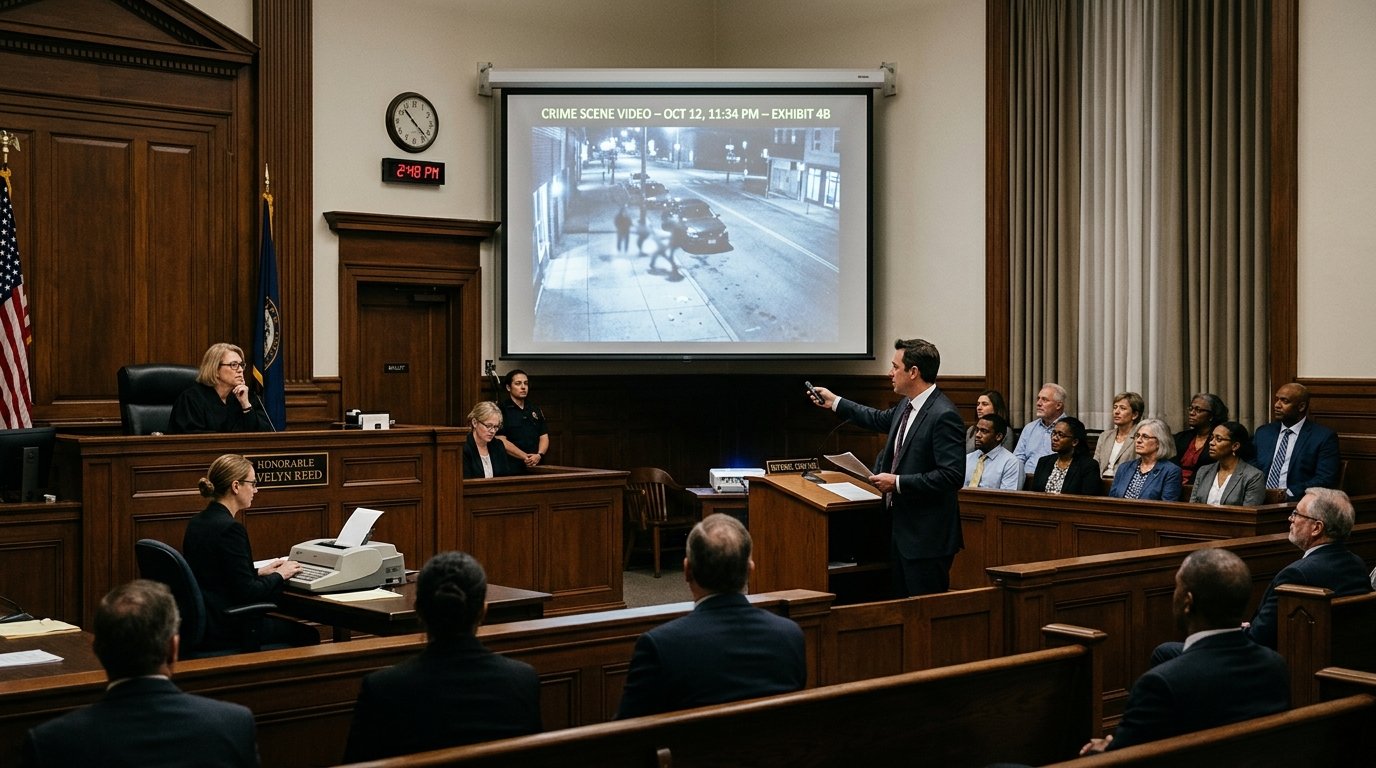
For over a century, the justice system has relied on a simple hierarchy of truth: “Seeing is believing.” A surveillance video of a robbery, a recorded confession, or a photograph from a crime scene was considered “Scientific Evidence”—a silent witness that could not lie. But as we move past 2026, the bedrock of our legal system is beginning to crack.
We are entering an era where reality can be manufactured. With the rise of sophisticated Generative AI, the “Deepfake” has moved from a curiosity to a weapon. A video of a politician accepting a bribe, a voice recording of a CEO revealing secrets, or a crime scene photo showing a specific suspect can now be generated with 99% photorealism by anyone with a high-end GPU.
This creates a **Crisis of Evidentiary Truth**. If any video can be fake, how can a jury trust anything? If “Point and shoot” no longer guarantees reality, how does the law adapt? This 1500+ word exploration dives into the impact of AI on the justice system, the technological battle for forensic verification, and how we will define “Truth” in the age of the synthetic witness.
Section 1: The Death of the “Silent Witness”
Traditionally, the justice system treats digital evidence as “Demonstrative” or “Substantive.” If the chain of custody is intact, the evidence is accepted. However, AI has introduced a new defense strategy: **The Liar’s Dividend**.
The “Liar’s Dividend” occurs when the very existence of deepfakes allows a guilty person to claim that a *real* video of them is actually a fake. “That’s not me,” the defendant says, “that’s an AI-generated mask.” Because the public (and juries) now know that AI *can* fake reality, they begin to doubt *real* reality. This skepticism is the first major blow AI has dealt to the justice system.
Case Study: The First Deepfake Defense
In the mid-2020s, we began to see the first legal cases where defendants claimed high-resolution video evidence was AI-generated. This forced courts to move from a “Visual Review” of evidence to a “Forensic Mathematical Review.” The burden of proof has shifted from the content of the image to the **Metadata of the Source**.
Section 2: The Weapons of Verification — Deepfake Detectors
To fight back, the justice system is adopting a new suite of forensic tools. Verification is no longer about looking at the screen; it’s about looking at the pixels and the timestamps.
1. Biological Sync Analysis
Human bodies have subtle signs of life that AI often fails to perfectly replicate. Detectors now look for “Photoplethysmography” (PPG)—the tiny changes in skin color as the heart pumps blood. A real video shows a “biological pulse” in the face; a deepfake often has a static or irregular pulse.
2. Frequency Domain Analysis
AI models generate images by calculating patterns. These calculations leave “Artifacts” in the high-frequency spectrum that are invisible to the eye but obvious to a computer. Forensics tools check for “Spectral Fingerprints” that match specific generative models like Midjourney or Stable Diffusion.
3. Eye & Mouth Synchronization
AI struggles with the internal geometry of the mouth and the “unsteady” movement of the eyes. Tools now analyze the “Micro-jitters” of the pupil and the light reflections on the cornea. If the reflection of the room in a person’s eye doesn’t match the environment the AI claims they are in, the video is flagged.
4. Shadows and Physics
AI is good at texture but bad at global physics. Forensic tools simulate the lighting of a scene to see if the shadows cast by the “evidence” follow the laws of gravity and light. A deepfake often has “floating” shadows or light sources that come from three different directions at once.
Section 3: The New Standard — C2PA and Proof of Origin
But “Detection” is a cat-and-mouse game. As detectors get better, AI gets better. The real solution being adopted by the justice system is **C2PA (Coalition for Content Provenance and Authenticity)**.
This is a new technical standard—a “Digital Birth Certificate” for media. When a camera (like a Leica or Nikon) takes a photo, it cryptographically signs the file with a private key. This signature records the GPS coordinates, the exact time, the sensor ID, and any edits made to the file.
In the 2026 courtroom, a video with a C2PA signature is “Real” until proven otherwise. A video *without* a signature is “Suspect.” We are moving to a world where “Anonymous Metadata” is the legal equivalent of a broken seal on a evidence bag. If the file doesn’t have a chain of cryptographic custody from the lens to the laptop, it cannot be used as scientific evidence.
“In the age of AI, the metadata is the evidence. The image is just the illustration.”
Section 4: The Impact on Scientific Evidence
AI isn’t just a threat to justice; it is also a powerful tool for finding the truth. “Scientific Evidence” is becoming more precise thanks to AI analysis:
- AI DNA Analysis: AI can now separate complex mixtures of DNA (where multiple people have touched an object) far more accurately than a human lab tech.
- Pattern Recognition: AI can scan 50 years of crime scene photos to find a “Mathematical Signature” of a serial offender that a human detective might miss.
- Audio Reconstruction: AI can “scrub” the noise from a low-quality recording, using predictive modeling to understand the syllables hidden behind a passing truck’s roar, allowing for clearer testimony.
Section 5: AI as the Judge? — The Ethical Frontier
Finally, we must address the most controversial change: **AI in Decision Making**. In some jurisdictions, AI is already used to set “Bail amounts” or predict “Recidivism” (the likelihood a person will commit another crime).
The danger here is **Algorithmic Bias**. If the data the AI was trained on has historical biases against certain neighborhoods or ethnicities, the AI will build those biases into its “scientific” recommendations. We face the risk of “Black Box Justice,” where a person is denied freedom because of a computer calculation that even their lawyer cannot explain.
Conclusion: The Human Verdict
The justice system is the shield we use to protect the truth. As AI makes the truth more “liquid,” we must reinforce the shield with new technology. We will see the Rise of the **Expert AI Witness**—specialized scientists whose only job is to testify about a video’s metadata and spectral artifacts.
Ultimately, a courtroom is a human space. A jury is 12 human hearts. While AI can verify the pixels and the DNA, it cannot understand **Intent**. It cannot feel “Justice.” As we move into the 2030s, the role of the judge and jury will shift from “What happened?” to “Why did it happen?”
The battle for truth is just beginning. By adopting standards like C2PA and utilizing forensic AI detection, we can prevent a world where “The Liar’s Dividend” rules the court. The lens might not be a silent witness anymore, but the pixels will always have a story to tell—if we know how to listen.
This article explored the intersection of law and technology. Read our next feature on “Digital Shadows: The New Era of Cyber-Sovereignty.”