


1. Introduction: The Death of the Gig
In the the early 2020s, the dream was the “Gig Economy.” We were told that freedom meant being able to drive a car for an app, write a freelance article on command, or deliver food whenever we felt like it. But by 2026, that dream has soured. The “Gig Economy” was just manual labor with a digital interface. It required your **Time** to generate **Value**. If you stopped working, the money stopped flowing. It was a trade: your life for their currency.
But a new door has opened. We are entering the **Automation Economy**.
This is not about the “side hustle.” It is about the transition from being a digital worker to becoming a **System Architect**. In this new economy, wealth is not generated by your effort; it is generated by your **Infrastructure**. While the world is worried about AI taking their jobs, the sovereign individuals of 2026 are building the AI systems that handle the work of ten companies simultaneously. They are not looking for permission to earn; they are building machines that profit without permission.
2. The Paradigm Shift: Task vs. System
The most important part of this series is the mental shift from “Doing a Task” to “Building a System.”
When you use ChatGPT to write a single blog post, you are performing a **Task**. You are still the bottleneck. You have to prompt, you have to read, you have to edit, and you have to post. This is essentially “Enhanced Manual Labor.” You are faster than you were in 2020, but you are still limited by the number of hours in your day.
A **System**, however, is a self-sustaining loop. A system doesn’t wait for you to prompt it. It watches a news feed, identifies a trend, writes the post, optimizes the SEO, generates the header image, and schedules the publication—all while you are asleep.
The Principle of Leverage
In the physical world, a lever allows a small force to move a massive weight. In the 2026 economy, **Automation is the Lever**. The amount of wealth you can generate is no longer tied to your IQ or your “Hustle.” It is tied to the **Magnitude of your Orchestration**. A person who can manage 50 autonomous systems is mathematically more powerful than a person who can work 100 hours a week.
3. The Three Layers of the Automation Stack
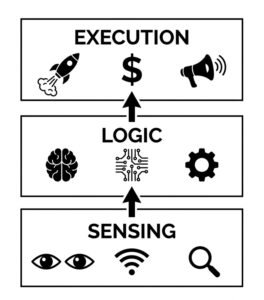
To build these systems, you need to understand the “Sovereign Stack.” Real automation—the kind that handles “Multiple works at one place”—consists of three distinct layers.
Layer 1: The Sensing Layer (The Eyes)
A system must be aware of its environment. This is handled through **APIs, Webhooks, and Scraping**. Whether it is a Google News RSS feed, a stock market ticker, or a social media trend-tracker, the sensing layer tells the system *when* it is time to act. It removes the human need to “Search” for work.
Layer 2: The Logic Layer (The Brain)
This is where the Large Language Models live. But in 2026, we don’t just use one LLM. We use **Agentic Workflows**. The logic layer takes the data from the Sensing Layer and passes it through a chain of reasoning. “If the trend is about AI, use the Tech Model; if it is about Health, use the Medical Model.” This layer handles the decisions, not just the text.
Layer 3: The Execution Layer (The Hands)
This is the most neglected part of the stack. Content is useless if it stays in a chat window. The execution layer uses automation tools (like Make.com, Zapier, or custom Python scripts) to *do* the thing. It uploads to YouTube, it sends the email, it updates the database, or it pings a potential client. This is the part that actually generates the profit.
4. The “New Gold” Earning Methods
What does this look like in practice? In this 10-part series, we will deep-dive into the following high-revenue systems. For now, let’s look at the “Wealth Map” of 2026.
- Content Arbitrage: Building automated news channels that summarize complex events into viral short-form videos. The “Profit” is the ad revenue and sponsorships earned at 1/1,000th the human cost of a traditional media house.
- Micro-SaaS “Wrappers”: Creating tiny, focused tools that solve one specific problem (e.g., “AI Legal Document Simplifier for Freelancers”) and charging a monthly subscription. The system handles the updates and the billing automatically.
- Niche Data Cleaning: Using AI to scrape raw, messy data from the web (e.g., real estate listings or job boards), cleaning it using an LLM, and selling it as a “Cleaned Feed” to corporations. This is the **Data-as-a-Service (DaaS)** model.
- The “Agent” Freelancer: Using an automated system to search for leads on LinkedIn, write custom-tailored proposals based on the client’s recent posts, and initiate the onboarding. You only step in once the contract is signed.
5. Research Insight: The Efficiency Frontier
Recent economic research from the *Global AI Institute* in 2025 suggests that we are hitting the **Efficiency Frontier**. As AI models become cheaper and faster, the barrier to entry for content and software creation is dropping to near zero.
This means that “Being a Creator” is no longer a viable career path on its own—there will be too much competition. However, “Being an **Orchestrator**” is becoming the most lucrative role of the century. The research shows that companies are shifting their budgets away from “paying for work” and toward “paying for systems.” If you can provide a system that solves a problem indefinitely, you capture the recurring value of that problem.
6. The Architect Mindset: Scaling to Infinity
To succeed in the Automation Economy, you must stop being proud of your “Work” and start being proud of your “Pipeline.”
The **Architect Mindset** is cold and calculated. It asks: “How can I make this happen without me?” If a task requires you to click a button every day at 9 AM, the architect sees that as a bug in the code. They spend 20 hours building a script to click that button for them, even if clicking it manually takes only 5 seconds. Why? Because the script can click that button for 10,000 different clients simultaneously. A human cannot.
The Law of Scaling
1 human + 1 AI tool = 1x output.
1 human + 1 Automated System = 100x output.
1 human + 10 Automated Systems = 1,000x output.
The math of wealth has changed. Success is now a function of **Complexity Management**, not effort.
7. Conclusion: Your Sovereign Future
This is the first step in your journey to **Digital Sovereignty**. Over the next nine articles, we are going to get very technical. We will build the scripts. We will look at the APIs. We will analyze the monetization strategies that are working *right now* in 2026.
But before we build the machine, you must accept the philosophy. You are no longer a worker. You are a designer of digital intelligence. You are building an empire of silicon and code. The internet is a vast ocean of data and money—your systems are the nets that catch it while the rest of the world is busy arguing with the waves.
Welcome to the New Economy of Systems. Let’s get to work—so you don’t have to.
In our next article: **Part 2: YouTube Automation 2.0**. We will build the “One-Place” system that handles everything from niche research to final upload.