
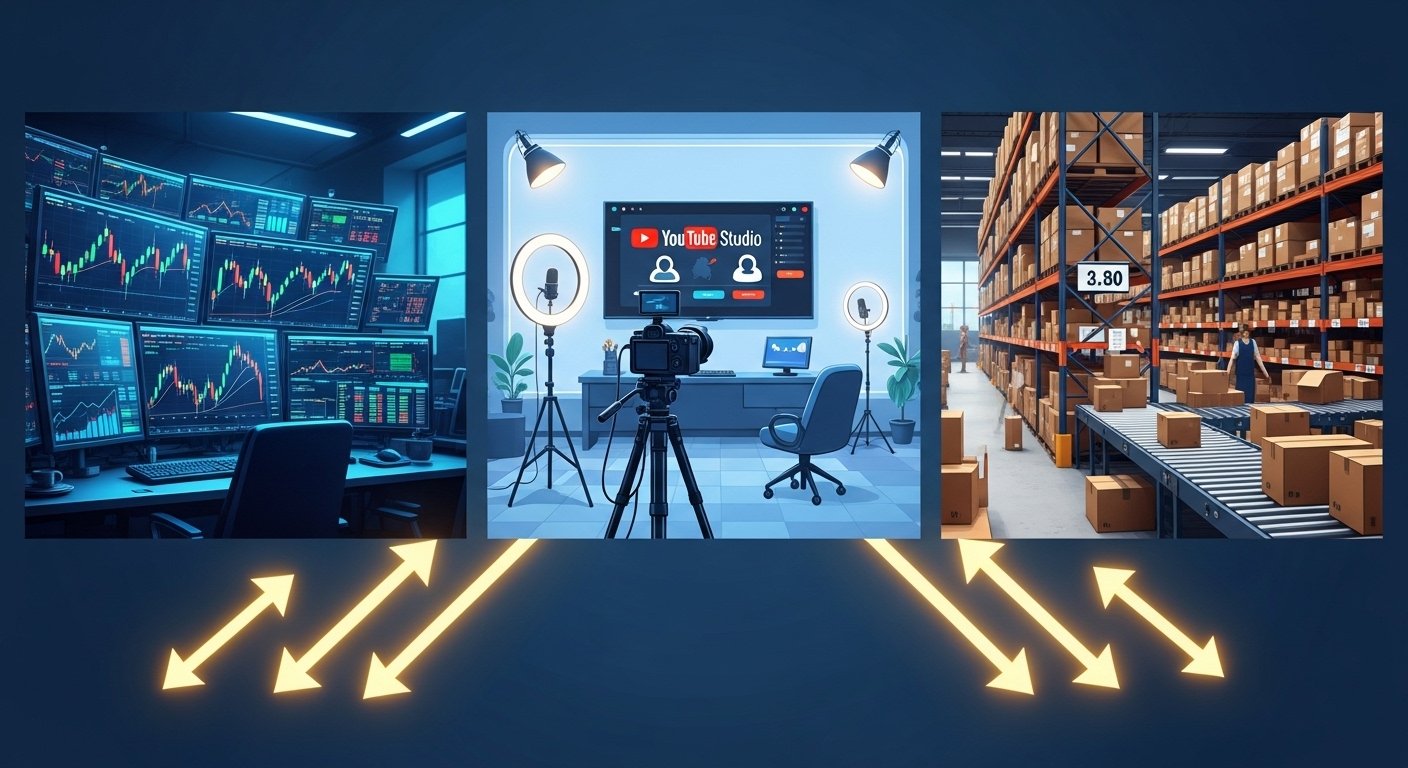
The eternal question facing aspiring entrepreneurs in 2026: Should I learn trading, start a YouTube channel, or launch an e-commerce store? Each path promises financial freedom, location independence, and unlimited upside. But which actually delivers? And here’s the real secret—what if you could combine all three?
Critical Reality Check: This isn’t about choosing one. The wealthiest digital entrepreneurs of 2026 don’t pick—they stack. They trade with profits from their e-commerce brand, document the journey on YouTube, and sell products to their audience. This guide shows you exactly how.
Executive Summary: The Three Paths Compared
Before diving into exhaustive detail, here’s the 30,000-foot view:
| Factor | Trading | YouTube Channel | Ecommerce | Winner |
|---|---|---|---|---|
| Average Startup Cost | $5K-$50K | $500-$5K | $1K-$50K | YouTube (lowest) |
| Time to First $1K/Month | 6-24 months | 12-24 months | 3-12 months | Ecommerce (fastest) |
| Time to $10K/Month | 2-5 years | 2-4 years | 1-3 years | Ecommerce |
| Income Ceiling | Unlimited | Unlimited | Unlimited | Tie |
| Passive Income Potential | High | Medium-High | Medium | Trading |
| Work-Life Flexibility | Very High | Medium | Medium-High | Trading |
| Risk Level | Very High | Low-Medium | Medium | YouTube (safest) |
| Failure Rate (First 2 Years) | 90% | 95% | 80% | Ecommerce |
| Scalability | Excellent | Excellent | Excellent | Tie |
| Skill Transferability | Medium | High | High | YouTube/Ecommerce |
Strategic Insight: Ecommerce generates cash flow fastest. YouTube builds audience and authority. Trading multiplies capital. Combined, they create an unstoppable flywheel. We’ll show you how in Section 5.
Trading: The High-Risk, High-Reward Path
What Trading Actually Involves:
Trading encompasses multiple markets and strategies:
- Stock Trading: Buying/selling individual stocks. Day trading (same day), swing trading (days/weeks), position trading (months/years).
- Forex Trading: Currency pair speculation. $7.5 trillion daily volume. 24/5 market. Highest leverage available (up to 500:1).
- Crypto Trading: Bitcoin, Ethereum, altcoins. Extreme volatility. 24/7 market. Unregulated exchanges.
- Options Trading: Contracts giving right to buy/sell at specific price. Leverage without margin. Complex strategies (spreads, iron condors).
- Futures Trading: Commodities, indices, bonds. Standardized contracts. High leverage. Expiration dates.
Real Income Data (What Traders Actually Make):
| Experience | Account Size | Avg. Monthly Return | Monthly Income | Success Rate |
|---|---|---|---|---|
| Beginner (0-1 year) | $5K-$10K | -50% to +10% | -$5K to +$1K | 10% profitable |
| Intermediate (1-3 years) | $20K-$50K | 3-8% | $600-$4K | 30% consistently profitable |
| Advanced (3-7 years) | $100K-$500K | 5-15% | $5K-$75K | 60% consistently profitable |
| Professional (7+ years) | $1M+ | 10-20% | $100K-$200K+ | 85%+ consistently profitable |
Brutal Truth: 90% of day traders lose money. 80% quit within first year. Of remaining 10%, only 10% make enough to live on. That’s 1% overall success rate. Compare this to e-commerce (20% failure) and YouTube (5% success).
Startup Costs & Requirements:
- Trading Capital: Minimum viable: $5K (stocks), $500 (forex micro lots), $1K (crypto). Recommended: $25K+ (pattern day trader rule), $50K+ (living income potential).
- Education: Free (YouTube, Investopedia) to $5K (mentorship programs). Average serious student: $1K-$3K on courses/books.
- Software/Tools: Charting platform (TradingView $15-$60/mo), broker commissions ($0-$10/trade), news service (Benzinga Pro $177/mo), scanner software ($50-$300/mo).
- Hardware: Computer ($1K-$3K), monitors ($500-$2K), fast internet ($100/mo). Optional: Trading desk, backup power.
- Data Feeds: Real-time market data: $0-$150/mo depending on exchanges.
- Total Startup Cost: $7K-$15K minimum for serious attempt with education, tools, and adequate capital.
Time Commitment:
- Learning Phase (Months 1-12): 20-40 hours/week studying. Paper trading. Building watchlists. Journaling every trade.
- Live Trading Small (Months 6-18): 10-20 hours/week actual trading + 10 hours review/journaling. Focus on process over profits.
- Scaling Up (Years 2-5): 20-40 hours/week. Multiple setups. Managing larger positions. Continuous education.
- Professional Level (Years 5+): 30-60 hours/week if actively managing portfolio. Or 5-10 hours/week if systematic/algorithmic.
Pros of Trading:
- Unlimited Income Potential: No ceiling. Compound returns turn small accounts into millions over time.
- Complete Location Freedom: Trade from anywhere with laptop + internet. Beach, mountain cabin, different countries.
- No Inventory/Employees: Pure digital business. No shipping, no customer service, no physical overhead.
- Instant Liquidity: Can withdraw profits same day. No waiting for customers, no accounts receivable.
- Market Independence: Can profit in bull markets (long) and bear markets (short). Volatility = opportunity.
- Meritocratic: Market doesn’t care about your degree, connections, or background. Only your results matter.
Cons of Trading:
- Extreme Risk: Can lose 100% of capital (or more with leverage). No guarantees, no safety net.
- Emotional Toll: Stress, anxiety, sleepless nights. Watching life savings evaporate in minutes. Requires iron psychology.
- No Guaranteed Income: Some months down 20%. Can go weeks without valid setups. Irregular cash flow.
- Steep Learning Curve: Takes 3-7 years to become consistently profitable. Most quit before reaching profitability.
- Opportunity Cost: Time spent learning trading could be spent building other skills/businesses.
- Addictive Nature: Dopamine hits from wins, devastation from losses. Can become gambling-like behavior.
Best Platforms for Getting Started:
- Stock Trading: Interactive Brokers (professional-grade), TD Ameritrade/Charles Schwab (beginner-friendly), Webull (zero commissions).
- Forex Trading: Forex.com, OANDA, IG Markets. Regulated brokers with tight spreads.
- Crypto Trading: Coinbase (beginner), Binance (advanced), Kraken (security-focused).
- Charting/Analysis: TradingView (best overall), TrendSpider (automated analysis).
- Education: BabyPips (free forex course), Investopedia (general finance), paid mentors (vet carefully—95% are scammers).
Warning: Avoid “guru” selling get-rich-quick trading courses. If they’re so good at trading, why sell courses? Real traders compound quietly. Education is valuable, but verify track records independently.
YouTube Channel: The Audience-Building Powerhouse
What Building a YouTube Channel Actually Involves:
YouTube is a long-term audience-building play with multiple monetization paths:
- Content Creation: Research topics, script writing, filming, editing, thumbnail design, SEO optimization, upload consistency.
- Audience Engagement: Responding to comments, community posts, social media cross-promotion, collaborations.
- Analytics & Optimization: Studying retention graphs, A/B testing thumbnails, analyzing traffic sources, adjusting strategy based on data.
- Monetization: AdSense, sponsorships, affiliate marketing, merchandise, memberships, Super Chats, selling own products.
Real Income Data (What Creators Actually Make):
| Subscribers | Monthly Views | AdSense Revenue | Sponsorships | Affiliates/Products | Total Monthly |
|---|---|---|---|---|---|
| 0-1K | 100-5K | $0-$50 | $0 | $0-$100 | $0-$150 |
| 1K-10K | 5K-50K | $50-$500 | $0-$500 | $100-$1K | $150-$2K |
| 10K-100K | 50K-500K | $500-$5K | $500-$5K | $1K-$10K | $2K-$20K |
| 100K-1M | 500K-5M | $5K-$50K | $5K-$20K | $10K-$50K+ | $20K-$120K+ |
| 1M+ | 5M+ | $50K+ | $20K+ | $50K+ | $120K-$1M+ |
Key Insight: AdSense is the smallest revenue stream for smart creators. Top earners make 70%+ from sponsorships, affiliates, and own products. Diversification is critical.
Startup Costs & Requirements:
- Camera: Smartphone ($0 if you have one) to $3K (Sony A6400). Sweet spot: $500-$800.
- Microphone: USB mic ($50-$150 like Blue Yeti), XLR setup ($300-$600 like Shure SM7B + interface).
- Lighting: Natural light (free) to softbox kit ($100-$300) to professional LED panels ($500-$2K).
- Editing Software: Free (DaVinci Resolve, iMovie) to $21/month (Adobe Premiere Pro).
- Thumbnails: Free (Canva) to $13/month (Canva Pro) to outsourcing ($5-$50/thumbnail on Fiverr).
- Other Equipment: Tripod ($50-$200), backdrop ($50-$300), teleprompter ($100-$500 optional).
- Total Startup Cost: $500-$5K. Can start with smartphone + free software. Upgrade as you grow.
Time Commitment:
- Months 1-6 (Grind Phase): 20-40 hours/week. Filming, editing, optimizing. Posting 1-3 videos weekly. Minimal views/income.
- Months 6-18 (Growth Phase): 15-30 hours/week. Finding what works. Building audience. Starting to monetize.
- Months 18-36 (Monetization Phase): 20-40 hours/week. Sponsorships rolling in. Launching products. Hiring editor ($500-$2K/month).
- Years 3+ (Scale Phase): 10-30 hours/week if solo. Or 5-10 hours managing team. Multiple revenue streams firing.
Pros of YouTube:
- Low Barrier to Entry: Anyone with smartphone can start. No degree, certification, or approval needed.
- Compound Growth: Old videos keep earning forever. Library of 100+ videos generates passive income while you sleep.
- Multiple Revenue Streams: Not dependent on single income source. Ads, sponsors, affiliates, products, memberships.
- Authority & Credibility: YouTube channel establishes you as expert. Opens doors to speaking, consulting, partnerships.
- Network Effects: Collaborations expose you to new audiences. One viral video can add 10K+ subscribers overnight.
- Creative Fulfillment: Build something from nothing. Connect with like-minded people globally. Express creativity.
- Exit Opportunities: Sell channel (30-40x monthly profit), launch product lines, write books, speak at events.
Cons of YouTube:
- Oversaturated Market: 500 hours uploaded every minute. Standing out requires exceptional quality or unique angle.
- Algorithm Dependency: YouTube can change algorithm overnight. Channels die when recommendations stop.
- Long Ramp-Up: 12-24 months before meaningful income. Most quit before seeing traction.
- Public Scrutiny: Comments can be brutal. Cancel culture is real. One mistake can destroy years of work.
- Inconsistent Income: Ad rates fluctuate (January = low RPM). Sponsorships irregular early on.
- Burnout Risk: Constant content treadmill. Editing is time-consuming. Creative exhaustion common.
- Platform Risk: YouTube can demonetize, strike, or terminate channel. No recourse, no warning sometimes.
Best Tools for Getting Started:
- Video Editing: DaVinci Resolve (free professional), Premiere Pro ($21/mo), Final Cut Pro ($299 one-time).
- Thumbnails: Canva (free/pro), Photoshop ($21/mo).
- SEO/Research: TubeBuddy (free-$49/mo), VidIQ (free-$49/mo), AnswerThePublic (topic research).
- Music/SFX: Epidemic Sound ($15/mo), Artlist ($199/year), YouTube Audio Library (free).
- Analytics: YouTube Studio (free), Social Blade (free tracking), Playboard (advanced analytics).
- Outsourcing: Fiverr, Upwork (editors, thumbnail designers).
Ecommerce: The Product-Selling Juggernaut
What Ecommerce Actually Involves:
Ecommerce spans multiple business models:
- Dropshipping: List products, customer orders, supplier ships directly. You keep margin. No inventory risk.
- Print-on-Demand: Custom designs on t-shirts, mugs, etc. Printful/Printify print and ship. You market.
- Amazon FBA: Send inventory to Amazon warehouses. They fulfill orders. Access to Prime customers.
- Shopify DTC Brand: Build your own branded store. Control customer experience, pricing, branding.
- Wholesale/Manufacturing: Create or source products, sell wholesale to retailers or direct to consumers.
- Digital Products: Ebooks, courses, templates, software. Near-100% margins. Instant delivery.
Real Income Data (What Ecommerce Sellers Actually Make):
| Stage | Monthly Revenue | Profit Margin | Monthly Profit | Time to Reach |
|---|---|---|---|---|
| Pre-Launch | $0 | N/A | -$500 to -$2K | Months 1-3 |
| Early Traction | $1K-$10K | 15-30% | $150-$3K | Months 3-9 |
| Growth Stage | $10K-$100K | 20-40% | $2K-$40K | Months 9-24 |
| Established Brand | $100K-$1M+ | 25-50% | $25K-$500K+ | Years 2-5 |
| Exit (Acquisition) | Varies | Varies | 2-4x annual profit | Years 3-7 |
Wealth Creation Secret: Ecommerce businesses sell for 2-4x annual profit. A brand making $200K/year profit can exit for $400K-$800K. This is how generational wealth is built.
Startup Costs & Requirements:
- Dropshipping: Shopify ($29/mo), domain ($12/year), apps ($50-$200/mo), initial ads ($500-$2K). Total: $1K-$5K.
- Print-on-Demand: Same as dropshipping. No inventory costs. Total: $500-$3K.
- Amazon FBA: Inventory ($3K-$20K), Amazon fees ($800-$3K/mo), PPC ads ($500-$5K/mo), product photography ($500-$2K). Total: $5K-$30K.
- Shopify DTC: Inventory ($5K-$50K), Shopify ($29-$299/mo), website theme ($0-$200), apps ($100-$500/mo), marketing ($1K-$20K/mo). Total: $10K-$100K+.
- Digital Products: Course creation equipment ($1K-$5K), platform ($119-$399/mo for Teachable/Kajabi), or sell on Gumroad (free + fees). Total: $500-$10K.
Time Commitment:
- Months 1-3 (Setup & Launch): 30-60 hours/week. Product research, supplier vetting, store build, initial marketing.
- Months 3-12 (Grind Phase): 40-80 hours/week. Customer service, order fulfillment, ad optimization, product iteration.
- Year 2 (Systematization): 30-50 hours/week. Hire VA ($500-$1K/mo), automate processes, focus on growth.
- Years 3+ (Scale or Exit): 20-40 hours/week managing team. Or prepare for acquisition (financials, operations cleanup).
Pros of Ecommerce:
- Tangible Business: Building real brand with valuation. Can sell for life-changing exit.
- Proven Demand: People already buying online. E-commerce grew 43% since 2020. Trend accelerating.
- Multiple Models: Start with dropshipping (low risk), transition to private label (higher margins), launch DTC brand (maximum value).
- Asset Building: Customer list, brand recognition, supplier relationships, proprietary products—all valuable assets.
- Scalability: Systems handle 10 orders/day or 10,000 orders/day. Add staff/processes as you grow.
- Global Market: Sell worldwide from day one. Not limited by geography.
- Cross-Promotion Opportunities: YouTube channel drives traffic. Trading profits fund inventory. Synergies with other businesses.
Cons of Ecommerce:
- Inventory Risk: Unless dropshipping, you buy upfront. Unsold inventory = lost capital.
- Customer Service Burden: Returns, complaints, shipping issues. Can consume 20-40% of your time.
- Cash Flow Challenges: Pay suppliers upfront, wait 30-90 days for payment processors to release funds. Growth requires working capital.
- Competition: Low barriers mean saturated niches. Price wars common. Differentiation critical.
- Platform Dependencies: Shopify can ban stores. Amazon can suspend accounts. Facebook/Google can ban ad accounts. Diversify traffic sources.
- Operational Complexity: Shipping logistics, inventory management, supplier relationships, quality control. More moving parts than trading/YouTube.
- Slower Wealth Accumulation: Reinvest profits into inventory/growth. Can take 2-5 years before large personal withdrawals.
Best Platforms for Getting Started:
- Ecommerce Platforms: Shopify (best overall), WooCommerce (free WordPress plugin), BigCommerce (enterprise features).
- Dropshipping Suppliers: AliExpress (largest selection), SaleHoo (vetted suppliers), Spocket (US/EU suppliers).
- Print-on-Demand: Printful (highest quality), Printify (largest network), Gelato (global production).
- Amazon FBA: Amazon Seller Central. Use Jungle Scout, AMZScout for product research.
- Payment Processing: Stripe, PayPal, Shopify Payments. Compare fees (2.9% standard).
- Email Marketing: Klaviyo (ecommerce-focused), Mailchimp (beginner-friendly), ActiveCampaign (advanced automation).
- Ads Management: Facebook Ads Manager, Google Ads, TikTok Ads. Consider agencies once spending $10K+/month.
The Ultimate Strategy: Combining All Three
Here’s where it gets exciting. The wealthiest digital entrepreneurs don’t choose one—they combine all three into a synergistic wealth engine.
The Flywheel Effect: Ecommerce generates cash flow. YouTube builds audience and authority. Trading multiplies capital. Together, they accelerate wealth creation exponentially.
Real-World Example: The Perfect Stack
Meet Alex (composite of successful entrepreneurs):
- Ecommerce Brand: Sells fitness supplements via Shopify. $80K/month revenue, 30% margins = $24K/month profit.
- YouTube Channel: Documents fitness journey, supplement education, business building. 250K subscribers. $15K/month (ads + sponsors + affiliates).
- Trading Account: Takes $20K/month from ecommerce + YouTube profits, compounds in swing trades. 8% average monthly return. Account now worth $800K after 4 years.
- Total Monthly Income: $24K (ecommerce) + $15K (YouTube) + $64K (trading gains, unrealized) = $103K/month wealth creation.
Key Insight: Alex didn’t start all three at once. Started ecommerce (Month 1), launched YouTube (Month 6), began trading (Year 2). Sequential stacking beats parallel overwhelm.
How to Combine All Three (Step-by-Step):
- Phase 1 (Months 1-12): Launch Ecommerce
Focus 100% on getting ecommerce to $10K-$50K/month. This funds everything else. Document entire journey on YouTube (even if channel small initially). - Phase 2 (Months 12-24): Scale YouTube
Once ecommerce systems run smoothly (hire VA, automate fulfillment), shift focus to YouTube. Aim for 10K-50K subscribers. Monetize through ads, sponsors, and promoting your ecommerce products. - Phase 3 (Years 2-3): Begin Trading
With consistent $20K+/month profits from ecommerce + YouTube, allocate 20-30% to trading account. Start small ($50K-$100K). Learn systematically. Scale as you prove competency. - Phase 4 (Years 3-5): Optimize & Automate
All three businesses firing. Ecommerce: hire general manager. YouTube: hire editor/thumbnail designer. Trading: systematize or hire analyst. You focus on strategy. - Phase 5 (Years 5+): Exit or Compound
Option A: Sell ecommerce brand for 3-4x profit ($500K-$2M exit). Option B: Continue compounding all three. Either way, you’ve achieved financial freedom.
Synergies Between the Three:
| Combination | Synergy | Example |
|---|---|---|
| Ecommerce + YouTube | YouTube drives free traffic to ecommerce store. Higher conversion (trust built through content). | Fitness YouTuber sells supplements to engaged audience. 5-10x higher conversion than cold traffic. |
| Ecommerce + Trading | Ecommerce cash flow funds trading account. Trading profits reinvested in ecommerce inventory/growth. | Use Q4 ecommerce profits ($100K) to trade Q1. Compound gains, reinvest in spring inventory. |
| YouTube + Trading | Document trading journey on YouTube. Build audience interested in trading. Monetize through education/products. | “Watch me turn $50K into $500K” series. Sell course, signals, or community access. |
| All Three Combined | Maximum diversification. If one struggles, others compensate. Accelerated wealth through compounding. | Ecommerce slow month? YouTube sponsorships cover expenses. Trading bad quarter? Ecommerce profits sustain lifestyle. |
Critical Warning: Don’t try launching all three simultaneously. You’ll fail at all of them. Master one (reach consistent $10K+/month), systematize it, then add next. Sequential > Parallel.
Alternative Combination Strategies:
- Strategy A: YouTube First
Build audience (100K+ subs), launch ecommerce products to audience, invest ad revenue in trading. Lower risk (audience validates products). - Strategy B: Trading First
Learn trading with small account, document journey on YouTube, use trading profits to fund ecommerce. Fastest path if trading clicks early. - Strategy C: Ecommerce Only (Focused Approach)
Some entrepreneurs prefer deep focus. Build ecommerce to $1M+, sell, retire. No need to combine if one makes you wealthy.
Decision Framework: Which Should YOU Start With?
Answer these questions honestly:
| If This Describes You | Start With | Why |
|---|---|---|
| Risk-tolerant, analytical, patient | Trading | Can handle drawdowns, enjoy data analysis, willing to learn 3-5 years before big returns. |
| Creative, consistent, comfortable on camera | YouTube | Enjoy content creation, can commit to long-term grind, want to build personal brand. |
| Action-oriented, sales-minded, pragmatic | Ecommerce | Want fastest path to $10K/month, comfortable with operations, think in systems. |
| Limited capital (<$5K) | YouTube | Lowest startup cost. Can begin with smartphone. Fund other ventures with ad revenue. |
| Moderate capital ($5K-$25K) | Ecommerce (Dropshipping/POD) | Enough to test products, run ads. Faster ROI than trading/YouTube. |
| Significant capital ($25K+) | Trading + Ecommerce | Can fund trading account adequately AND launch ecommerce. Diversify from start. |
| Need income within 90 days | Ecommerce | Fastest path to first dollar. Dropshipping can generate sales week one. |
| Can wait 12-24 months for income | YouTube | Longest ramp-up but highest compound potential. Library effect creates passive income. |
| Have specialized knowledge/skills | YouTube + Digital Products | Teach what you know. Monetize through courses, coaching, consulting. |
| Want completely passive income | Trading (eventually) | Once systematic/algorithmic, truly passive. Ecommerce/YouTube always require some involvement. |
Best Overall Strategy: Start ecommerce ( Months 1-12), add YouTube (Months 12-24), begin trading (Year 2+). This sequence optimizes for cash flow, audience building, then capital multiplication.
The Abundance Mindset
The question isn’t “trading vs YouTube vs ecommerce.” The question is “which one do I start first, and how do I eventually combine all three?”
Final Wisdom: Wealth isn’t built from a single income stream. It’s built from multiple streams feeding each other, compounding over time. Start with one. Master it. Systematize it. Add the next. Repeat. Within 5-7 years, you’ll have created what most consider impossible.
The tools have never been more accessible. The opportunities have never been larger. The only variable is your commitment to start and persist through the inevitable challenges.
Choose your path. Take action today. Your future self is counting on you.
Stay Informed: Markets, platforms, and algorithms evolve. Follow Forbes, Entrepreneur, TechCrunch, and industry-specific blogs for latest trends and regulations.