
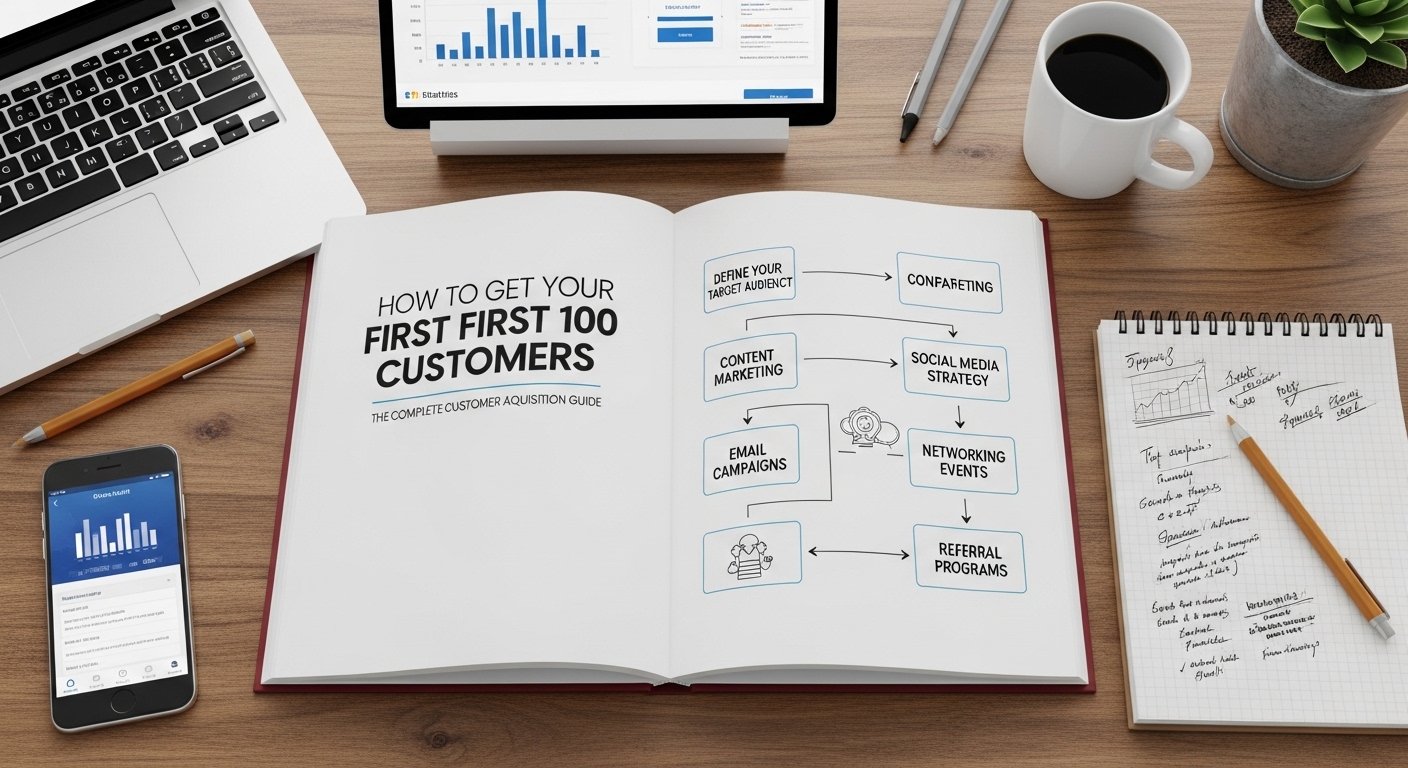
You’ve built a product. You’ve validated that people want it. Now comes the hardest part: getting actual customers.
Getting your first customers is different from scaling acquisition to thousands. At this stage, you don’t have social proof, brand recognition, or large marketing budgets. You have something more powerful: the ability to be personal, scrappy, and relentless.
This guide covers 20+ strategies specifically designed for early-stage businesses. Some require time; others require money; all require effort. The key is testing multiple channels quickly, doubling down on what works, and never giving up.
The Key Insight: Your first 100 customers aren’t just revenue—they’re validation, feedback, case studies, and referrals. They transform your business from a hypothesis into a reality. Getting them requires treating each customer as precious, not just a transaction. Every early customer should feel like a co-founder of your journey.
The Right Mindset for Customer Acquisition
Before diving into tactics, you need the right mental framework. Most founders fail at customer acquisition because of mindset issues, not tactical ones.
The Founder’s Customer Acquisition Beliefs
| Wrong Belief | Right Belief |
|---|---|
| “I need a big marketing budget” | Early-stage, creativity beats budget. Personal outreach is more effective than paid ads. |
| “I’ll build it and they’ll come” | No one knows you exist. You must actively reach out to every potential customer. |
| “One channel will be my silver bullet” | You’ll need multiple channels. Test fast, double down on what works. |
| “I should wait until it’s perfect” | Get early feedback now. Imperfect products with real users beat perfect products with none. |
| “Rejection means failure” | Rejection is data. Every “no” gets you closer to “yes.” |
The 100 Customer Timeline
Week 1-2: Foundations
- Set up tracking (Google Analytics, Mixpanel)
- Build social profiles
- Create basic marketing assets
- Identify first 50 potential customers

Week 3-4: Outreach Sprint
- Cold emails (200+ sent)
- Social media engagement
- Direct messages
- Network introductions

Week 5-8: First Customers
- Convert early adopters
- Collect testimonials
- Iterate based on feedback
- Document case studies

Week 9-12: Scale What Works
- Double down on best channel
- Start second channel
- Build referral system
- Reach 100 customers
The Math: To get 100 customers, you might need to reach 1,000 prospects (10% conversion is excellent for cold outreach). If you’re reaching 10 prospects per day, that’s 100 days. If you reach 50 per day, that’s 20 days. Speed depends on volume and conversion rate—which improves with practice.
Strategy #1: Cold Outreach (Your Most Powerful Early Channel)
When you have no customers, you must become a master of cold outreach. This means cold emails, LinkedIn messages, DMs, and direct contact with strangers.
Cold Email That Converts
The key to cold email success is personalization, value first, and clear ask:
Subject: Quick question about [specific challenge]

Hi [Name],

I noticed [specific detail about them or their business].

I'm helping [similar companies/people] solve [their problem] and
[wondering/curious] if [specific challenge they're likely facing]
is something you're currently dealing with.

[One sentence about how you help] + [specific result you've achieved].

Would you be open to a quick 15-minute call this week?

Best,
[Your name]
Cold Email Tools
- Mailshake: Cold email outreach and automation
- Lemlist: Personalized cold email at scale
- Outreach: Sales engagement platform
- Woodpecker: Cold email for agencies and startups
- Mailtrack: Email tracking for Gmail
Finding Email Addresses
- Hunter.io: Find and verify email addresses by domain
- Snov.io: Email finder and verifier
- Apollo: B2B data and outreach platform
- Clearbit: Email discovery and enrichment
- RocketReach: Professional contact information
LinkedIn Outreach
LinkedIn is powerful for B2B customer acquisition:
- Personalized connection requests: “I saw you’re [role] at [company]. I help [type of businesses] with [problem]. Would love to connect.”
- Engage before pitching: Comment on their posts, share valuable content
- Use LinkedIn Sales Navigator: Advanced filtering to find your ideal customers
- Direct messages: After connecting, follow up with value proposition
- Content marketing: Post valuable content to attract inbound leads
Warning: Don’t spam. Mass outreach without personalization leads to low response rates, damaged sender reputation, and potential account restrictions. Always add personal touches—even if sending at scale.
Strategy #2: Content Marketing (Attract Customers Organically)
Content marketing builds long-term organic growth. One great piece of content can generate leads for years—but it takes time to build momentum.
Content Types That Drive Customers
| Content Type | Effort | Time to Results | Best For |
|---|---|---|---|
| Blog Posts | Medium | 3-6 months | SEO, evergreen traffic |
| YouTube Videos | High | 3-9 months | Visual explanations, search |
| Podcasts | Medium | 3-12 months | Authority building, interviews |
| Social Media | Low-Medium | 1-3 months | Community, quick wins |
| Email Newsletter | Low | 1-3 months | Direct audience, nurture |
Content Marketing Platforms
- Medium: Easy publishing, built-in audience
- Substack: Newsletter-first platform
- WordPress: Full SEO control and flexibility
- Ghost: Clean publishing for creators
- HubSpot: Inbound marketing suite
SEO Tools for Content Optimization
- Ahrefs: Complete SEO toolkit
- SEMrush: Competitive research and content
- Surfer SEO: Content optimization
- AnswerThePublic: Content idea generation
- BuzzSumo: Content research and analysis
The Content-to-Customer Funnel
Step 1: Choose topics your customers search for
        - Use AnswerThePublic, Quora, Reddit for questions
        - Target problem-solution keywords

Step 2: Create genuinely helpful content
        - Answer questions thoroughly
        - Include specific examples
        - Make it better than anything else out there

Step 3: Capture leads
        - Email opt-in for deeper guide
        - Free tool or template
        - Newsletter subscription

Step 4: Nurture to purchase
        - Follow-up emails
        - Soft sell through content
        - Clear call-to-action
The Content Math: 1 in 100 blog visitors becomes an email subscriber. 1 in 10 email subscribers becomes a customer. Publish 50 posts, get 10,000 visitors, 100 subscribers, 10 customers. It compounds—but requires patience.
Strategy #3: Referral System (Turn Customers Into Salespeople)
Your existing customers are your best salespeople. A well-designed referral system can turn your first customers into your best marketing channel.
How to Ask for Referrals
- Ask at the right moment: Right after a success, when they’re happy
- Be specific: “Do you know anyone else who might benefit from this?”
- Make it easy: Provide email templates, social share buttons, referral links
- Offer incentives: Discounts, credits, or cash for successful referrals
- Follow up: If they say “yes,” follow up to get the introduction
Referral Tools
- ReferralCandy: Automated referral programs for e-commerce
- Ambassador: Enterprise referral marketing platform
- Post Affiliate Pro: Full-featured affiliate software
- Gleam: Contests and referral campaigns
- Rewardful: Affiliate tracking for SaaS
Referral Incentive Structures
| Incentive Type | For Referrer | For Referred | Best For |
|---|---|---|---|
| Discount | 20-30% off next purchase | 15-20% off first order | E-commerce, services |
| Credit | $10-50 account credit | $5-25 credit | SaaS, subscriptions |
| Cash | 10-20% of referred revenue | None or small bonus | High-ticket items |
| Free product | Free item after X referrals | Free item on signup | Physical products |
Dropbox’s Referral Story: Dropbox grew from 100,000 to 4 million users in 15 months through a simple referral program. They gave both referrer and referee 500MB of free storage. The cost was minimal; the growth was explosive.
Strategy #4: Strategic Partnerships (Borrow Existing Audiences)
Instead of building your audience from scratch, partner with businesses that already serve your target customers.
Partnership Types
- Co-marketing: Joint webinars, content, promotions
- Affiliate partnerships: They promote, you pay commission
- Reseller agreements: They sell your product to their customers
- Integration partnerships: Integrate with complementary tools, cross-promote
- Influencer partnerships: Pay or product-seeding for promotion
Finding Potential Partners
- Complementary businesses: Sell to same customer, different problem
- Non-competing services: Agencies, consultants in your space
- Tool integrations: Tools your customers already use
- Industry associations: Trade groups, communities, conferences
- Social listening: Who do your target customers follow and trust?
How to Approach Partners
Cold outreach to potential partner:

Subject: Partnership idea - [Mutual benefit]

Hi [Name],

I've been following [their company/content] and noticed
[specific observation that shows you understand them].

I run [your company], and I think there's a great opportunity
for us to work together.

[Specific partnership idea - be concrete]:
"We could do a joint webinar where I present on [topic]
to your audience, and you could present on [related topic]
to my audience."

Here's what I'd propose:
- [Specific benefit for them]
- [Specific benefit for you]
- [Timeline/next steps]

Would you be open to a quick call to explore?

[Your name]
Strategy #5: Social Media Marketing
Social media is where your potential customers hang out. Choose platforms based on where your customers are, not where you’re most comfortable.
Platform Selection Guide
| Platform | Audience | Content Type | Best For |
|---|---|---|---|
| B2B professionals | Articles, short posts | B2B services, SaaS | |
| Twitter/X | Tech, media, founders | Short text, threads | Startups, tech, news |
| Millennials, Gen Z | Images, Reels, Stories | Consumer, lifestyle, visual | |
| TikTok | Gen Z, young millennials | Short videos | Broad reach, viral potential |
| Adults 25-54 | Videos, Groups, Posts | Local, communities |
Social Media Management Tools
- Buffer: Simple scheduling and analytics
- Later: Visual Instagram scheduler
- Hootsuite: Enterprise social management
- Sprout Social: All-in-one social suite
- Canva: Create graphics without designers
Social Media Tactics That Work
- Engage first: Comment on others’ posts before posting your own
- Reply to every comment: Builds community and shows you’re active
- Post consistently: 3-5x per week minimum on chosen platforms
- Use hashtags: Research which ones your audience follows
- Share behind-the-scenes: Humanize your brand
- Post at peak times: Schedule when your audience is active
Strategy #6: Paid Advertising (Speed Up with Budget)
While organic growth is valuable, paid advertising can accelerate customer acquisition when you have budget to test.
Paid Ad Platforms
| Platform | Cost Range | Best For | Website |
|---|---|---|---|
| Google Ads | $1-10/click | High-intent search traffic | ads.google.com |
| Facebook/Instagram Ads | $0.50-5/click | Targeting, brand awareness | facebook.com/business |
| LinkedIn Ads | $5-15/click | B2B targeting | business.linkedin.com |
| Twitter Ads | $0.50-3/engagement | Tech, media audiences | ads.twitter.com |
| TikTok Ads | $0.10-2/click | Younger demographics | ads.tiktok.com |
Advertising Tools
- AdEspresso: Facebook/Instagram ad optimization
- Optmyzr: Google Ads automation
- WordStream: Small business ad management
- AdRoll: Retargeting across platforms
- Quora Ads: Intent-based advertising
The $1,000 Ad Test Budget
If you have $1,000 to spend on ads:

Week 1: Test ($500)
- Run 3 different ad variations
- Target 3 different audiences
- $166 per test

Week 2: Analyze
- Which ad/audience had lowest cost per result?
- Double down on winner

Week 3: Scale ($500)
- Put entire budget into winning ad/audience
- Optimize based on learnings

Goal: Learn what works before spending more.
Warning: Don’t start with paid ads unless you have product-market fit. Spend $100-500 on ads to test conversion, not to find product-market fit. Get your first 10-20 customers through organic methods first.
Strategy #7: Offline Tactics (The Human Touch)
Digital strategies are powerful, but offline tactics—especially for local or relationship-based businesses—remain highly effective.
Offline Customer Acquisition Methods
- Attend networking events: Meetups, conferences, trade shows
- Join local business groups: Chamber of commerce, BNI, networking groups
- Offer free workshops: Teach something valuable, demonstrate expertise
- Speak at events: Position yourself as an authority
- Coffee meetings: One-on-one conversations with potential customers
- Cold calls: Old school, but still works for B2B
- Local partnerships: Cross-promote with complementary local businesses
Event Discovery Platforms
- Meetup: Local networking and events
- Eventbrite: Classes, workshops, conferences
- Startup Grind: Startup community events
- BNI: Business networking referrals
- Local Chambers: Local business connections
Strategy #8: Online Communities (Where Your Customers Hang Out)
Find where your target customers discuss their problems and insert yourself into those conversations—helpfully, not spammily.
Where to Find Your Customers Online
- Reddit: Niche communities with engaged users
- Facebook Groups: Industry and interest groups
- Discord: Communities, especially in tech/gaming
- Slack communities: Professional and niche communities
- Quora: Q&A platform where people ask for help
Community Marketing Tactics
- Answer questions: Provide genuine help without pitching
- Share valuable content: Articles, resources, tools that help
- Build reputation: Become known as the helpful expert
- Subtle promotion: When relevant, mention your product
- Direct messages: After being helpful, offer to help more
The Reddit Playbook: Find subreddits where your target customers discuss problems. Answer questions genuinely for 2-3 months. Build karma and reputation. When you do mention your product, it won’t feel spammy because you’ve already proven value. Tools like Later for Reddit can help manage posting.
Building Your Acquisition Machine
Once you find what works, systematize it. Turn one-time tactics into repeatable processes.
The Customer Acquisition Stack
| Function | Tool | Website |
|---|---|---|
| CRM | HubSpot, Pipedrive | hubspot.com |
| Email Marketing | Mailchimp, ConvertKit | mailchimp.com |
| Landing Pages | Unbounce, Leadpages | unbounce.com |
| Analytics | Google Analytics, Mixpanel | analytics.google.com |
| Automation | Zapier, Make | zapier.com |
Metrics to Track
- Cost per lead: How much to generate one interested prospect
- Conversion rate: % of leads who become customers
- Customer acquisition cost (CAC): Total cost to acquire one customer
- Time to conversion: How long from first touch to purchase
- Channel ROI: Which channels are most cost-effective
Conclusion: Get Your First 100 Customers This Month
Getting your first 100 customers isn’t about having the perfect product, massive budget, or viral hit. It’s about consistent effort, testing multiple channels, and never giving up.
The strategies in this guide work. Not all of them—different businesses have different optimal channels. Your job is to test quickly, measure results honestly, and double down on what works.
Remember: your first customers are the hardest to get. Each one after that becomes slightly easier because you’ll have more proof, more testimonials, and more momentum. Getting to 100 is the hardest part—and the most important.
Your Action Steps: 1) Choose 3 acquisition channels from this guide. 2) Spend one week testing each channel with small experiments. 3) Pick your best channel and go all-in for 4 weeks. 4) Collect testimonials and case studies from every customer. 5) Build referral system to turn customers into salespeople. 6) Repeat until you hit 100 customers.
The businesses that succeed aren’t the ones with the best products—they’re the ones that get really good at getting customers. Master customer acquisition, and you can sell anything.
Frequently Asked Questions
What’s the fastest way to get my first 10 customers?
Direct outreach to your personal network combined with cold emails to 50-100 people in your target market. Your network already trusts you; strangers need convincing. Start with warm introductions, then move to cold outreach. Tools like Hunter.io help find email addresses for cold outreach.
Should I offer free products/services to get early customers?
Sometimes yes, sometimes no. Free works when you need testimonials, case studies, or feedback to improve. But beware of “customers” who expect everything free forever. Better approach: offer significant discounts (50-75% off) in exchange for honest reviews and testimonials. Paid customers take you more seriously than free ones.
How do I get customers if I have no budget for marketing?
Focus on high-effort, zero-cost channels: cold outreach, community participation (Reddit, Facebook Groups, Quora), content marketing, and networking. These require time, not money. The trade-off is effort vs. budget—you’ll work harder but spend nothing. Platforms like LinkedIn and Reddit are free to use and can generate significant leads.
How do I know which acquisition channel is right for my business?
Test multiple channels systematically. Spend one week each on 3-4 different channels with equal effort. Measure cost per customer for each. The channel with the best ROI is your winner. B2B businesses typically do well with LinkedIn and cold email. B2C often works better with content marketing and social media. Use tools like HubSpot to track which channels generate leads.
How long does it take to get 100 customers?
It depends on your price point, sales cycle, and channel effectiveness. Low-ticket, impulse purchases can reach 100 customers in days or weeks. High-ticket, long sales cycles may take months. On average, expect 4-12 weeks with consistent effort. The key is tracking metrics so you can optimize: cost per lead, conversion rate, and customer acquisition cost.
Related Articles
- How to Negotiate Anything: Business and Life
- How to Price Your Products/Services for Maximum Profit
- Multiple Streams of Income: 20 Ways to Diversify
- Personal Finance for Entrepreneurs: Managing Irregular Income