
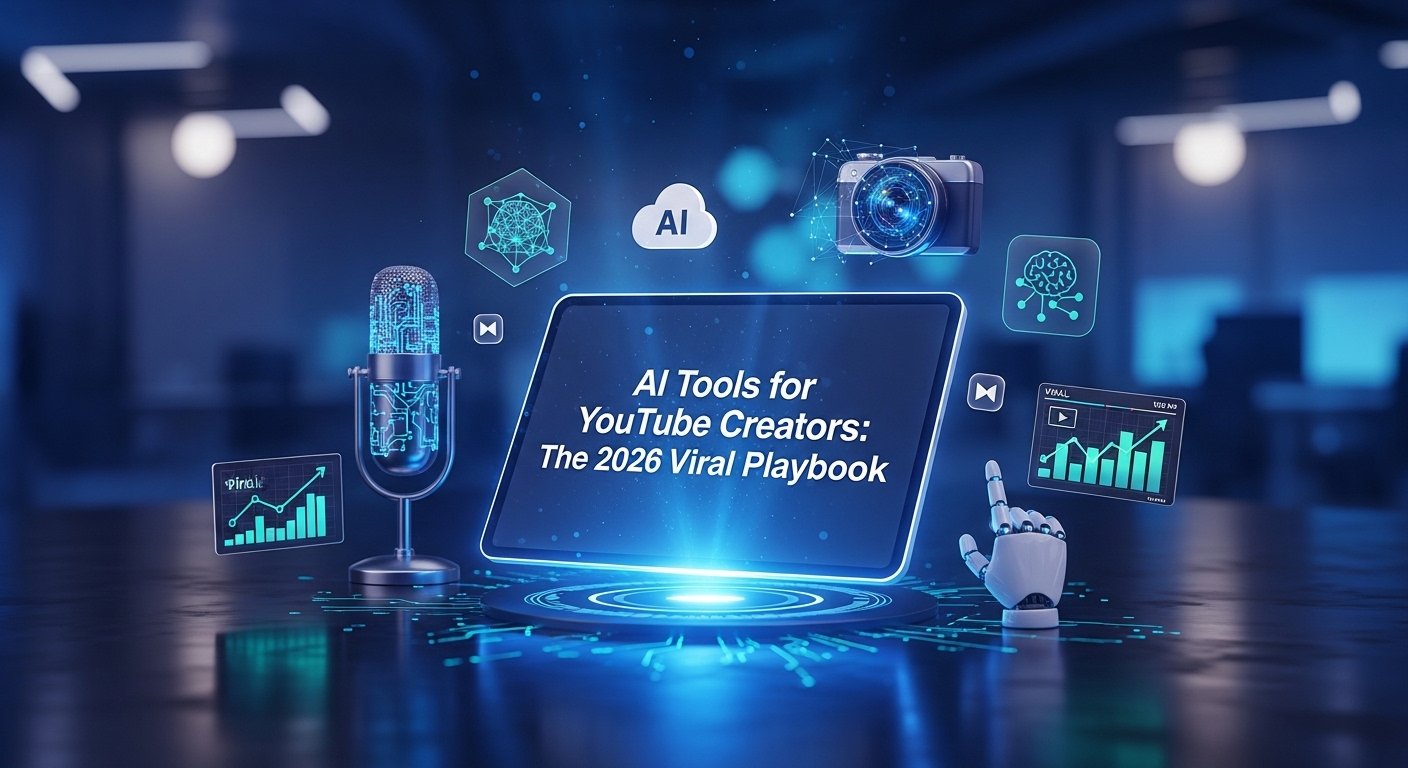
Ditch the expensive camera gear and the 40-hour editing weeks; in 2026, the most successful YouTubers are using AI “Creative Duos” to script, voice, edit, and translate their content for a global audience in just a few hours.
1. The State of YouTube in 2026
In 2026, YouTube has officially transitioned from a “Video Platform” to a “personalized experience engine.” The competition for attention has never been more intense. Every minute, 500 hours of video are uploaded, and much of it is incredibly high quality. If you are still doing everything manually—from researching thumbnails with your eyes to editing out every “um” and “ah” by hand—you’re not just working hard; you’re working ourselves out of a career. The “Handcrafted” era of YouTube is being replaced by the “Augmented” era. AI is no longer a luxury for the top 0.1% of creators; it is the entry-level requirement for anyone who wants to be discovered by the algorithm.
But here is the good news: AI has also democratized production. Five years ago, if you wanted to make a professional-looking documentary or a high-energy “MrBeast-style” video, you needed a team of five editors and a $10,000 workstation. Today, a teenager with a basic smartphone and three AI subscriptions can produce a video that looks like it came out of a Hollywood studio. AI is the great equalizer, allowing the quality of your ideas to shine through without being limited by the size of your team. This guide is about how to build that “one-person media empire” using the tools available right now in 2026.
The YouTube algorithm in 2026 is also smarter. It doesn’t just look at “keywords” anymore; it looks at “Audience Satisfaction.” It measures the micro-emotions of viewers through advanced engagement signals. AI tools help you optimize for this by analyzing which parts of your video cause people to click away and suggesting “Retention Hooks” to keep them watching. The goal is no longer just to get a click; it’s to keep them on the platform. By leveraging AI to understand these deep patterns, you can create content that the algorithm is “forced” to promote because it knows it will keep people happy and engaged.
Furthermore, the barrier between international markets has completely dissolved. In 2026, a creator in Mumbai can reach an audience in New York just as easily as a local creator, thanks to AI-powered dubbing and translation. This has created a “Global Attention Market” where the best content wins regardless of geography or language. This guide will dive deep into how you can use this to your advantage, turning your local channel into a global brand that reaches millions of people in dozens of different languages, all with the help of artificial intelligence.
2. AI Scripting: Writing for Retention
The script is the foundation of every successful video. If the script is boring, no amount of fancy editing can save it. In 2026, creators use ChatGPT-4o or Claude 3.5 Sonnet to act as “Lead Writers.” But they don’t just ask for a script. They use “Retention-Focused Prompting.” This means telling the AI to include “Pattern Interrupts” every 60 seconds and to use the “Curiosity Gap” method for the intro. You want the viewer to feel like they are missing out on vital information if they click away before the 5-minute mark.
One of the most powerful scripting tools in 2026 is Vidiq’s AI Coach. It has been trained on millions of successful YouTube videos and knows exactly what works for your specific niche. If you are a gaming creator, it will suggest a different script structure than if you are a financial educator. It helps you “reverse-engineer” the successes of your competitors. You can feed it a competitor’s URL and ask, “Why did this video go viral?”, and it will provide a breakdown of the hooks, the pacing, and the emotional payoff of the script.
Another technique is “Sentiment Analysis Mapping.” You can ask an AI to analyze your script and tell you which parts are the “low points” where a viewer might get bored. I always tell the AI: “Identify the three most technical or dry parts of this script and rewrite them to be more conversational and include a relatable analogy.” This ensures that the energy of the video stays high from the first second to the last. Remember, in 2026, the first 30 seconds of your video are 70% of the battle. If your script doesn’t grab them by the throat immediately, you’ve already lost.
Scripting for “B-Roll” is also streamlined. Modern AI scripts often include a separate column for “Visual Cues,” telling you exactly what should be on the screen while you are talking. This makes the transition to the editing phase much smoother. Instead of trying to find the perfect clip later, you’ve already mapped it out during the writing phase. This holistic approach to scripting ensures that your video is a cohesive experience where the words and visuals are in perfect harmony, a standard of quality that viewers in 2026 have come to expect.
3. The Rise of High-Fidelity AI Voices
For years, using a “robot voice” was the fastest way to kill a YouTube channel. But as we enter early 2026, that has changed. Tools like ElevenLabs have reached “The Singularity of Voice.” You can now create a voice that is indistinguishable from a human, complete with breathing, natural pauses, and emotional emphasis. For “Faceless Channels” or documentary-style content, this is a game-changer. It allows you to produce 10x more content without needing to book studio time or buy a $500 microphone.
Even creators who use their own voice are using AI for “Voice Cloning.” If you have a sore throat or you’re in a noisy environment, you can simply type your script, and the AI will generate the audio in your exact voice. This ensures perfect audio quality every single time. It also allows for “Infinite Retakes.” If you realize you made a mistake in the script after you’ve already “recorded” it, you don’t need to set up the mic again. You just change the text and hit “Generate.” This saves hours of frustration and ensures that your production value remains world-class regardless of your physical circumstances.
Moreover, AI voices allow for “Emotional Layering.” You can tell the AI to say one paragraph with “excitement” and another with “solemnity.” This level of control allows you to guide the viewer through an emotional journey, which is the key to creating viral content. In 2026, many of the world’s largest education and news channels are 100% powered by AI voices, and the audience doesn’t even know it. They are there for the information and the story, and as long as the voice is pleasant and natural, they will stay and watch.
Accessibility is another major benefit. AI-powered text-to-speech can provide high-quality audio descriptions for visually impaired viewers or translations for non-native speakers. By providing multiple audio tracks, you can make your content accessible to a much wider audience, which can significantly boost your channel’s reach and impact. In 2026, being an “Inclusive Creator” is not just a nice-to-have; it’s a key strategy for long-term growth and community building in the global digital landscape.
4. Editing Automation: Cutting Hours into Minutes
Editing used to be the “Bottle-neck” of YouTube growth. It’s a tedious process of cutting out silences, finding B-roll, and adding subtitles. In 2026, tools like Descript and Gling.ai have turned editing into a text-editing experience. You can see a transcript of your video, and when you delete a word in the text, it deletes that part of the video. It automatically identifies silences, filler words like “um,” and even provides “AI Green Screen” to remove any background without a physical green screen.
For B-roll, Runway Gen-3 and Pika Labs have changed the game. If you need a clip of a “futuristic city in 2050” to illustrate a point, you no longer have to pay $100 for a stock video that everyone else has used. You can generate a unique, cinematic 10-second clip from a single text prompt. This makes your videos look incredibly expensive and unique. This level of “Custom Visuals” is what keeps a viewer’s eyes glued to the screen in an age of constant distraction. You are no longer just an editor; you are a digital cinematographer.
Furthermore, AI-powered Auto-Reframe tools like those in Premiere Pro and CapCut can take your long-form horizontal video and automatically turn it into 10 high-impact vertical “Shorts” or “Reels.” The AI identifies the most interesting part of the frame and makes sure the speaker is always centered. This allows a creator to “Dominate every platform” with a single piece of content. In 2026, you can’t just be on YouTube; you need to be everywhere. AI makes that possible without needing to hire a separate social media manager.
Audio post-production is also getting an AI makeover. Tools like Adobe Podcast Enhance can take a recording made on a basic smartphone and make it sound like it was recorded in a professional sound booth. It removes background noise, echo, and optimizes the vocal frequencies for maximum clarity. This means you can record your content anywhere—in a park, a car, or a busy coffee shop—and still provide your audience with an elite listening experience. This level of flexibility is what allows modern creators to be more prolific and spontaneous with their content.
5. Thumbnails and Title Engineering
You can make the best video in history, but if the thumbnail is bad, zero people will watch it. In 2026, we don’t guess what makes a good thumbnail. We use **AI Eye-Tracking** software like Neurons or Attention Insight. You can upload three different designs, and the AI will give you a “Heatmap” of where a viewer’s eyes will go. If they aren’t looking at your face or the main object, your thumbnail will fail. This data-driven approach removes the “Luck” factor from YouTube growth.
For Title creation, Claude 3.5 is the king of “SEO-Psychology.” I feed it 10 successful titles from my niche and ask it to “Extract the psychological triggers (e.g., scarcity, curiosity, fear of missing out) and generate 20 new titles for a video about [X].” I then A/B test these titles using TubeBuddy’s AI A/B testing tool. The difference between a 3% click-through rate (CTR) and an 8% CTR is the difference between a video getting 10,000 views and 1,000,000 views. In 2026, you are not just a creator; you are an “Attention Engineer.”
The “Perfect Thumbnail” AI Prompt: “Review the current YouTube trending page for the [NICHE] category. Identify the 3 most common color schemes and font styles. Now, design a thumbnail concept for a video titled ‘[YOUR TITLE]’ that explicitly breaks those trends to create a ‘Pattern Interrupt’. The goal is to make my thumbnail the only one that stands out in a sea of red and yellow.”
Image generation for thumbnails is also becoming more sophisticated. Tools like Midjourney v7 allow for incredibly detailed control over lighting, character expression, and composition. You can create a thumbnail image that looks like a high-budget movie poster, adding a level of “Professional Polish” that was once impossible for solo creators. This aesthetic excellence signals to the viewer and the algorithm that your content is “Premium,” which can lead to higher CPMs and better sponsorship opportunities in the long run.
6. Global Scaling: AI Translation and Dubbing
The most underestimated opportunity on YouTube in 2026 is **Global Channels**. Only 15% of the world speaks English as a first language. By only uploading in English, you are ignoring 85% of your potential audience. In the past, dubbing a channel into Spanish or Hindi required hiring expensive voice actors and translators. Today, HeyGen’s Video Translator can take your English video and translate it into dozens of languages, while keeping your original voice and even **altering your lip movements** to match the new language perfectly.
This is the “Secret Sauce” of 2026 growth. You can take one successful video and turn it into 10 viral videos in 10 different countries. Each channel builds its own audience and earns its own AdSense revenue. This effectively multiplies your income by 5x or 10x without you ever having to step in front of a camera twice. The “Global Creator” is the finally evolution of the YouTuber, turning a hobby into a multi-national media corporation that communicates with the entire planet simultaneously.
Localizing your metadata is just as important as dubbing the audio. AI can help you translate your titles, descriptions, and tags while ensuring they remain SEO-optimized for the local language and culture. It’s not just about direct translation; it’s about cultural adaptation. An AI that understands the slang and cultural references of a specific region can help your content feel “local” rather than “imported,” which is the key to winning the trust and loyalty of international audiences. This level of refined localization is what separates truly global brands from simple exporters of content.
7. Staying Safe: AI Disclosure and Content ID
As AI becomes more prevalent, YouTube has implemented strict rules regarding “AI Disclosure.” In 2026, if you use AI to create a realistic person or event that didn’t happen, you MUST check the “Synthetic Content” box during upload. Failure to do so can lead to your channel being demonetized or even deleted. But don’t let this scare you. Disclosure actually builds trust with your audience. People appreciate transparency, and as long as the content is valuable, they don’t care if a tool helped you build it.
Finally, protect your work with AI Content ID safeguards. There are now AI-powered tools that scan the web to see if someone is “Cloning” your channel or using your AI voice without permission. This “Digital Rights Management” is essential for protecting your brand and your income. By staying informed about the legal and ethical landscape of AI, you can ensure that your channel stays healthy and profitable for the long term. AI is the engine, but you are still the driver. Use it responsibly and build something that lasts.
Copyright laws are also evolving around AI-generated content. In early 2026, many jurisdictions have established clearer guidelines on what can be copyrighted and who owns the rights to AI-assisted work. Staying abreast of these developments is crucial for protecting your intellectual property. By using ethical AI platforms that respect copyright and provide clear terms of service, you can build a library of content that is legally secure and valuable for years to come. The “Responsible Creator” is the one who will thrive in the complex legal environment of the AI age.
8. The Future: From Creator to Channel Director
In the end, the role of a YouTuber in 2026 is shifting from “Worker” to “Channel Director.” You are no longer the one pulling the literal levers; you are the one setting the vision, the tone, and the strategy. AI handles the technical execution—the editing, the voiceovers, the translations—allowing you to focus on the high-level decisions that actually matter. This shift is what will allow the next generation of creators to build massive, sustainable businesses without burning out. The future of YouTube is hybrid, and those who embrace it today will be the icons of tomorrow.
The “Channel Director” mindset is about resource allocation. Instead of asking “How can I edit this faster?”, you ask “What are the three core ideas that will define my brand this year, and which AI tools will bring them to life most effectively?” This strategic approach leads to a more cohesive and powerful brand presence. As AI continues to evolve, the value of human vision and creativity will only increase. By letting AI handle the routine, you free yourself to explore the truly groundbreaking and innovative aspects of content creation that machines can only dream of.