
Every billion-dollar company started with a person who decided to try something different. Every revolutionary product emerged from someone willing to question why things couldn’t be better. Every financial empire was once just an idea in someone’s head.
Entrepreneurship isn’t about becoming the next Elon Musk. It’s not about Silicon Valley or venture capital or garage startups. It’s about solving problems, creating value, and taking responsibility for your own economic destiny.
Maybe you’re tired of working for someone else’s vision. Maybe you see a problem that nobody is solving. Maybe you just want more control over your time, your income, and your future. Whatever brought you here, this guide will give you everything you need to understand entrepreneurship and take your first steps.
What You’re About to Learn: This guide covers the complete picture of entrepreneurship—from understanding what it truly means, to exploring different types of entrepreneurs, to developing the essential skills you need, to taking your first concrete steps. Whether you’re 18 or 58, whether you have $100 or $100,000, there’s a path for you.
What Is Entrepreneurship? (Beyond the Dictionary Definition)
Let’s get past the textbook definition. Yes, entrepreneurship is “the activity of setting up a business or businesses.” But that tells you nothing useful.
Entrepreneurship is really about three things:
1. Seeing What Others Don’t See
Every successful entrepreneur sees opportunities that others miss. They look at a broken system and see a solution. They look at a frustrated customer and see a product. They look at an industry’s inefficiencies and see profit.
This isn’t about being smarter—it’s about being curious. It’s about asking “why does this work this way?” when everyone else accepts that it does.
2. Acting on What Others Ignore
Seeing opportunities means nothing if you don’t act on them. Most people recognize problems every day—”this product is too expensive,” “this service is terrible,” “I wish someone offered this.” But they do nothing.
Entrepreneurs act. They test ideas. They fail forward. They learn by doing instead of waiting for perfect conditions.
3. Creating Value Others Will Pay For
An idea is worthless until someone pays for it. Entrepreneurship isn’t about building what you want—it’s about building what the market needs AND is willing to pay for.
This is the hard part. Many entrepreneurs start with “I want to build X” when they should start with “The market needs Y, and I can build it.”
The Simple Definition: Entrepreneurship is the practice of identifying problems, creating solutions, and getting paid to solve them—while taking on the risk of failure.
Why Entrepreneurship Matters (More Than You Think)
You might think entrepreneurship is just about making money. It’s not. It’s about creating change.
Economic Impact
- Job creation: Small businesses create 65% of new jobs globally
- Innovation: Startups produce 16x more patents per employee than large companies
- Economic resilience: Economies with more entrepreneurs recover faster from downturns
- Wealth generation: Entrepreneurs create 10x more wealth than employees over lifetime
Social Impact
- Problem solving: Entrepreneurs attack problems governments and corporations ignore
- Community building: Local businesses employ locals and keep money circulating
- Inspiration: Successful entrepreneurs inspire the next generation
- Autonomy: Entrepreneurship creates pathways to financial independence
Personal Impact
- Control: You decide when, where, and how you work
- Income ceiling: Employees hit salary caps; entrepreneurs don’t
- Purpose: Building something yours creates deeper meaning
- Legacy: Your work outlives you and can help others
The Myth of Selfishness: Critics call entrepreneurs selfish. But consider: every job you create helps a family. Every product you build solves someone’s problem. Every innovation you make available improves lives. Entrepreneurship is one of the most pro-social activities you can engage in.
Types of Entrepreneurs: Finding Your Category
Not all entrepreneurs are the same. Understanding different types helps you identify where you fit.
| Type | Description | Risk Level | Income Potential |
|---|---|---|---|
| Scalable Startup | Builds tech to reach millions | Very High | $0 – $1B+ |
| Small Business Owner | Local service or retail business | Medium | $30K – $500K |
| Social Entrepreneur | Mission-driven, often non-profit | Medium | Varies |
| Serial Entrepreneur | Starts multiple businesses | High | $100K – $10M+ |
| Lifestyle Entrepreneur | Business supports desired lifestyle | Low-Medium | $30K – $200K |
| Intrapreneur | Entrepreneur inside a company | Low | Salary + bonus |
| Homepreneur | Online/remote business from home | Low-Medium | $10K – $100K |
| Copreneur | Business partner who is spouse/partner | Medium | Varies |
Which Type Are You?
- Want to change the world with technology? Scalable Startup might be your path
- Want to serve your local community? Small business owner fits
- Mission-driven about social causes? Social entrepreneurship awaits
- Love starting but get bored maintaining? Be a serial entrepreneur
- Want freedom without extreme risk? Lifestyle business is ideal
- Have a job but want entrepreneurial freedom? Start intrapreneurial projects
There’s No “Best” Type: The “best” entrepreneur type is the one that matches YOUR goals, skills, and lifestyle preferences. A $50K/year lifestyle business you love beats a $500K/year business that destroys your happiness.
Essential Skills Every Entrepreneur Needs
Great entrepreneurs aren’t born with special powers. They develop skills over time. Here are the ones that matter most:
1. Problem-Solving
This is the most fundamental skill. Entrepreneurship is just organized problem-solving.
- Identify problems worth solving
- Break complex problems into smaller pieces
- Find creative solutions others haven’t tried
- Test solutions quickly and cheaply
- Iterate based on feedback
2. Sales and Marketing
You can have the best product in the world, but if nobody knows about it, you have nothing.
- Understand what customers really want
- Communicate your value clearly
- Build trust with potential customers
- Reach customers where they are
- Convert interest into paying clients
3. Financial Management
Most businesses don’t fail because of bad ideas—they fail because of cash flow problems.
- Understand revenue vs. profit
- Track where every dollar goes
- Price products/services profitably
- Manage cash flow carefully
- Know when to invest and when to cut costs
4. Time Management
As an entrepreneur, nobody manages your time but you. This skill compounds over everything else.
- Prioritize ruthlessly
- Focus on high-impact activities
- Delegate or eliminate low-value tasks
- Protect your most productive hours
- Batch similar tasks together
5. Communication
You’ll communicate with customers, employees, investors, vendors, and more. Clear communication prevents problems.
- Explain complex ideas simply
- Listen more than you talk
- Write clearly for emails and proposals
- Negotiate win-win outcomes
- Give and receive feedback gracefully
6. Resilience
Entrepreneurship is a roller coaster. You need to handle rejection, failure, and uncertainty.
- Bounce back from failures quickly
- Stay calm under pressure
- Maintain optimism without delusion
- Learn from mistakes instead of hiding from them
- Keep going when others say quit
Good News: None of these skills require formal education. You can learn all of them through books, courses, mentorship, and—most importantly—practice. Most entrepreneurs aren’t born with these skills; they develop them through experience.
Entrepreneurship Myths Debunked
Before you start, let’s clear up the misconceptions that stop people from pursuing entrepreneurship:
Myth #1: “I Need a lot of Money to Start”
REALITY: Some of the biggest companies started with almost nothing. You don’t need investors to start—you need customers. Many successful businesses began as service businesses (consulting, freelancing) that required zero capital beyond a laptop and internet connection.
Myth #2: “I Need a Unique Idea”
REALITY: There are no original ideas. Almost every successful business is “another X for Y.” The difference is execution, positioning, and customer service. Amazon was “another bookstore.” Facebook was “another social network.” Execution beats originality every time.
Myth #3: “I Need to Quit My Job First”
REALITY: Most successful entrepreneurs started while employed. Side businesses reduce risk, fund development, and provide mental security. Quit when your business can replace your salary—not before.
Myth #4: “Entrepreneurs Work Less”
REALITY: Entrepreneurs often work more, especially early on. The difference is you’re working on YOUR priorities instead of someone else’s. And you’re building an asset instead of building someone else’s dream.
Myth #5: “I Need Formal Business Education”
REALITY: Mark Zuckerberg, Bill Gates, and Richard Branson dropped out of college. Most knowledge you need is available online, in books, and through mentorship. Education helps, but it’s not required.
Myth #6: “Failure Means I’m Not Cut Out for This”
REALITY: Every successful entrepreneur has failed. Multiple times. Failure is tuition—it teaches you what works. The only real failure is not trying, or quitting after a setback.
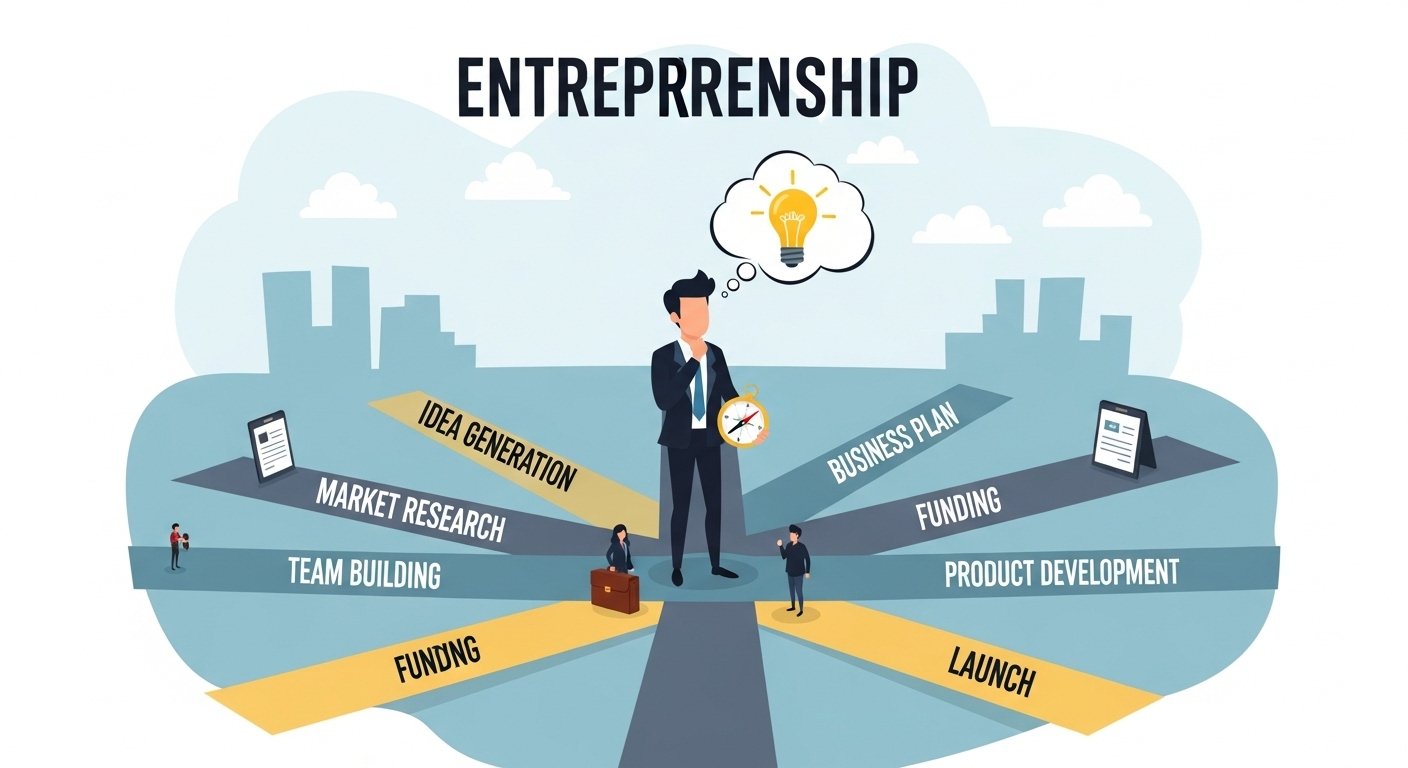
How to Start: Your Step-by-Step Roadmap
Enough theory. Here’s the practical path from idea to launch:
Step 1: Find Your Problem to Solve
Don’t start with “what business should I start?” Start with “what problems do I see that need solving?”
- Personal frustration: What products or services frustrate you?
- Industry knowledge: What do you know better than most people?
- Market gaps: What do competitors do poorly?
- Emerging trends: What are people starting to need?
- Your skills: What can you do better than others?
Exercise: Answer These Questions
1. What do I wish existed that doesn't?
2. What do I constantly complain about?
3. What would I use every day?
4. What problem would I pay to have solved?
5. Who has this problem besides me?
Step 2: Validate Your Idea (Before Building)
Before investing time and money, test if anyone will actually pay for your solution:
- Google your idea: Does it already exist? How are they doing?
- Find existing forums: Where do potential customers hang out online?
- Ask questions: What are their biggest frustrations?
- Create a landing page: Explain your solution, ask for emails
- Test demand: Offer pre-sales before building everything
Validation Before Building: Don’t spend 6 months building a product nobody wants. Spend 2 weeks talking to potential customers. Their feedback is worth more than any business plan.
Step 3: Choose Your Business Model
How will you make money? Common models:
- Product sales: Physical or digital products you create
- Service-based: Trading time for money (consulting, freelancing)
- Subscription: Recurring revenue from ongoing value
- Commission/affiliate: Taking a cut of other people’s sales
- Freemium: Free basic version, paid premium
- Marketplace: Connecting buyers and sellers
- Advertising: Getting paid to show ads to an audience
- Licensing: Others pay to use your intellectual property
Step 4: Start Before You’re Ready
Perfect is the enemy of profitable. Start before you feel ready:
- Register a domain: Secure your business name online
- Create a simple presence: Website, social media, or listing
- Announce to your network: Friends, family, social media
- Make your first sale: Even if it’s to yourself or a friend
- Get real feedback: Iterate based on actual market response
The Micro-Business Path: You can start selling today. Whatever you know, whatever you can do, someone will pay for it. Tutoring, writing, designing, coding, consulting, coaching, teaching—these all require zero capital beyond your existing skills.
Step 5: Build Systems (Before You Need Them)
As you start making sales, build systems so you can scale:
- Financial tracking: Separate business and personal accounts
- Customer management: Track who buys, what they need
- Communication: Professional email, quick response times
- Documentation: Write down your processes
- Backup systems: Protect your business data
Step 6: Grow Deliberately
Once you have paying customers, focus on growth:
- Understand metrics: Customer acquisition cost, lifetime value, churn
- Double down on what works: If one channel brings sales, invest there
- Reduce friction: Make buying as easy as possible
- Get referrals: Happy customers want to share
- Reinvest profits: Growth costs money
Common Entrepreneurship Mistakes to Avoid
Mistake #1: Building Before Validating
Most entrepreneurs fall in love with their idea and build it before checking if anyone wants it. Solution: Talk to 100 potential customers before writing a single line of code.
Mistake #2: Ignoring Cash Flow
Banks don’t care if you have great ideas—they care if you can pay your bills. Solution: Track cash religiously. Know your runway at all times.
Mistake #3: Wrong Pricing
Most new entrepreneurs price too low—either to compete or because they undervalue their work. Solution: Price based on value delivered, not time spent. Raise prices as you prove results.
Mistake #4: Trying to Do Everything
You can’t be the founder, marketer, accountant, and customer service rep. Solution: Identify your highest-value work and delegate or eliminate the rest.
Mistake #5: Copying Instead of Differentiating
If you’re doing exactly what competitors do, you’re competing on price alone. Solution: Find your unique angle, voice, and positioning. Be the only option for a specific type of customer.
Mistake #6: Ignoring Customers
Your assumptions about what customers want are probably wrong. Solution: Talk to customers weekly. Let their feedback drive your decisions.
The Number One Mistake: Not starting at all. Every day you wait is a day someone else is building the business that should be yours. Start before you’re ready. Start before you feel confident. Start before you have all the answers.
Resources to Accelerate Your Journey
Learning from others’ experience accelerates your path:
Books
- The Lean Startup: howtostartanentrepreneur.com/resources (scientific approach to building businesses)
- Zero to One: Peter Thiel on building companies that matter
- The $100 Startup: Chris Guillebeau on building businesses with minimal capital
- Atomic Habits: James Clear on building systems that compound
- Deep Work: Cal Newport on focused success in a distracted world
Online Learning
- Coursera: coursera.org (business and entrepreneurship courses)
- Udemy: udemy.com (practical skills for entrepreneurs)
- Skillshare: skillshare.com (creative and business topics)
- SCORE: score.org (free mentorship from retired executives)
- SCORE workshops: Live and recorded business training
Podcasts
- How I Built This: NPR interview show with founders
- The Tim Ferriss Show: Entrepreneurs deconstruct their strategies
- My First Million: Real business models deconstructed
- Gary Vaynerchuk Audio: Daily motivation and strategy
- The tropys: Business podcast on building sustainable companies
Free Tools to Start
- Canva: canva.com (design for non-designers)
- Shopify: shopify.com (e-commerce platform, free trial)
- Square: squareup.com (payments and point of sale)
- Mailchimp: mailchimp.com (email marketing, free tier)
- Wave: waveapp.com (free accounting software)
- Google Workspace: workspace.google.com (business email and tools)
Your 90-Day Entrepreneurship Roadmap
Here’s a practical timeline for the next three months:
| Week | Focus | Key Actions |
|---|---|---|
| 1-2 | Idea Discovery | List 20 problems you can solve. Talk to people with those problems. |
| 3-4 | Validation | Choose top idea. Survey 50 potential customers. |
| 5-6 | Simple Landing | Create basic website or social presence. Start collecting emails. |
| 7-8 | First Sale | Make your first dollar. Any sale validates demand. |
| 9-10 | Feedback Loop | Get 10 customers. Document what they love and hate. |
| 11-12 | Iterate and Plan | Improve based on feedback. Set next quarter goals. |
90 Days From Now: You could have a profitable side business generating your first $500-$5,000. That’s not hypothetical—that’s what happens when you follow these steps with consistency and focus.
Your Entrepreneurial Journey Starts Today
Entrepreneurship isn’t about becoming a millionaire (though you might). It’s about taking control of your economic destiny. It’s about solving problems that matter to you. It’s about building something that reflects your values, serves your customers, and creates the life you want.
The path isn’t easy. There will be setbacks, doubts, and moments when you question everything. But every successful entrepreneur has been exactly where you are now—uncertain, excited, and ready to begin.
Remember These Principles:
- Start before you’re ready: Perfection is impossible; progress is mandatory.
- Validate before building: Talk to customers before investing everything.
- Focus on value: Make money by solving problems, not chasing it.
- Embrace failure: Every setback is a lesson that brings you closer to success.
- Stay curious: The best entrepreneurs are always learning.
- Take action: A mediocre plan executed today beats a perfect plan executed never.
Your journey starts with a single decision: to try. Everything else—skills, knowledge, resources—can be acquired along the way. But you have to take that first step.
What’s stopping you from starting today?
Related Articles
- 5 Fresh Business Models Few People Know About
- How to Start Your Own Brand from China
- Lowest Cost Gadgets You Can Source from China