

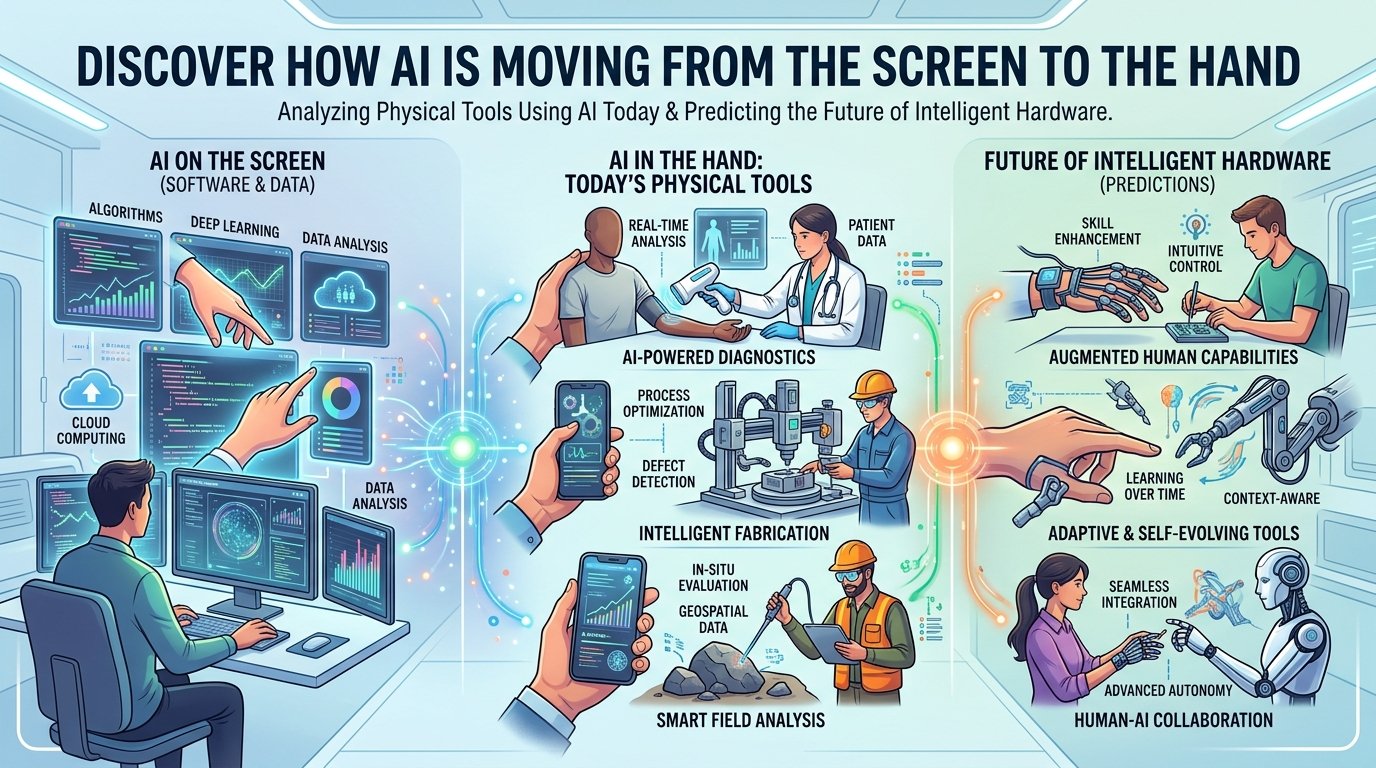
For the first decade of the “Artificial Intelligence Age,” we thought of AI as a ghost in the machine. It lived in our browsers, our smartphones, and our servers. It was something we *interacted* with through a screen. But as we move into the the second half of the 2020s, the ghost is finally becoming flesh. Intelligence is migrating into the very tools we hold in our hands.
This is the era of **Embodied Utility**. We are no longer just making “smart” devices; we are making “Informed Tools”—physical objects that possess their own situational awareness, predictive logic, and corrective capabilities. From the saws used by carpenters to the scalpels used by surgeons, the physical world is waking up.
In this 1500+ word exploration, we look at the physical tools that have already integrated AI and map out the near future where every object in your toolbox has a “Brain” of its own. We are moving from a world where we use tools to a world where tools **Collaborate** with us.
The Shift: From “Dumb” to “Reactive” to “Agentic”
Traditional tools (Dumb) follow the laws of physics. Current smart tools (Reactive) use sensors to stop if they hit a finger or get too hot. Future tools (Agentic) will use AI to predict your intent, correct your mistakes in real-time, and learn your specific style of working.
The Tools of Today — AI is Already Here
You might be surprised to find that your physical environment is already being orchestrated by “Edge AI” (AI that runs locally on small chips). Here are the sectors where physical tools have already crossed the threshold.
1. Precision Power Tools
Modern high-end miter saws and drills are no longer just motors and blades. Tools from brands like Bosch and Milwaukee now use “Predictive Torque Control.” AI algorithms analyze the resistance of the wood 1,000 times per second. If the tool detects a “Kickback” pattern (the signature of a blade catching), it stops before your arm can even move. This is AI as a physical reflex.
2. Intelligent Medical Diagnostics
Stethoscopes were once simple sound-amplifiers. Today, products like the **Eko Core** use AI to analyze heart sounds in real-time. The physical tool is now a diagnostic agent, flagging murmurs and arrhythmias that a human ear might miss, effectively turning every doctor into a specialist.
3. Autonomous Agricultural Tools
In the fields, tools like the **John Deere See & Spray** select individual weeds among millions of crops. Using a camera-based AI system on the sprayer arm, the tool makes a “Shoot/Don’t Shoot” decision in milliseconds. The tool has its own vision and its own intent.
The Near Future — 2027–2030
We are currently moving into the “Planning & Prototype” stage for tools that were previously thought impossible. Here is what is coming to your workshop, kitchen, and hospital in the next three years.
NEAR FUTUREThe “Ghost-Hand” Construction Tools
Imagine a handheld jigsaw that projects a glowing laser line onto the wood. If you veer off the line, the internal mechanics of the tool physically pivot the blade to stay on-track. The tool compensates for your unsteady hand. We will see “Skill-Leveling” tools that allow an amateur to perform master-level work.
NEAR FUTURECognitive Kitchenware
Knives and pans with built-in thermal and molecular sensors. A pan that “knows” exactly when the interior of a steak has reached 135 degrees and sends a signal to the stove (an AI agent) to simmer down. The pan becomes the chef’s assistant.
NEAR FUTUREBiometric Wearables (Labor Safety)
Exoskeletons and safety vests that use AI to monitor the worker’s fatigue levels. If the tool detects that the “Grip Strength” of a worker is failing or their posture is dangerous, it will physically lock the machinery or provide a resistive force to prevent an injury before it happens.
NEAR FUTURESelf-Correction Surgical Scalpels
Microsurgery tools that filter out the “Human Tremor.” Using high-speed AI tracking, the scalpel tip stays perfectly still even if the surgeon’s hand has a microscopic shake, allowing for eye and brain surgeries that were previously too risky.
The Architecture of Smart Hardware
How do these tools actually “Think”? They rely on three core technological shifts that are reaching maturity right now.
1. The Rise of “TinyML”
You don’t need a massive server to run a specific AI task. **Tiny Machine Learning (TinyML)** allows miniature chips (like the ESP32 or specialized ARM chips) to run neural networks with very low power. This allows a hammer or a wrench to have “Brains” without needing a massive battery.
2. Multi-Modal Sensors
Tools are getting “Senses.” We are seeing the integration of **LiDAR** (light-based distance), **Ultrasonic** sensors, and **IMUs** (Accelerometers). When an AI can see the 3D space around the tool, it knows where it is in relation to the work-piece. A “Smart Drill” knows it’s about to hit a water pipe behind the drywall because it can “see” the density change.
3. The Haptic Feedback Loop
The tool doesn’t just display information on a screen; it talks to your hand. Using vibration patterns and resistance (Haptics), an AI tool can “Tell” you that you are pushing too hard or that the material is about to crack. The tool and the human become a single bio-mechanical loop.
The Impact — Why This Matters
The migration of AI into physical tools isn’t just a gimmick. It is a solution to the **Global Skills Gap**.
As the older generation of skilled tradesmen (masons, electricians, carpenters) retires, we are losing centuries of “Tacit Knowledge”—the kind of knowledge that lives in the muscles. By building that knowledge into the **Physical Tools**, we can transfer it to the next generation. An AI-powered welding mask that “Guides” the welder’s hand allows a student to learn in weeks what used to take years. We are “Uploading” human mastery into the hardware itself.
The Controversy — The End of Craftsmanship?
Of course, this raises a philosophical storm. If the tool is doing the “Mastery” for you, are you still a master? If an AI-corrected chisel makes a perfect joint, are you a carpenter or just a “Button-Pusher”?
The answer lies in the distinction between **Toil** and **Craft**. Toil is the repetitive, dangerous, and exhausting part of the work. Craft is the vision, the design, and the soul. By giving the “Toil” to the AI-infused tool, we free the human to focus on the “Craft.” The tool handles the precision so the human can handle the beauty.
The Future is in Your Hand
We are moving toward a world where the boundary between “User” and “Tool” is blurred. In 2026, we are laying the foundation for a world of “Ambient Intelligence,” where every object you pick up knows what its purpose is and how to help you achieve it.
The next time you walk into a hardware store, look closer at the tools on the rack. They aren’t just steel and plastic anymore. They are waiting to wake up. They are waiting to learn how you work. The future isn’t just in the cloud—it’s in your toolbox.