
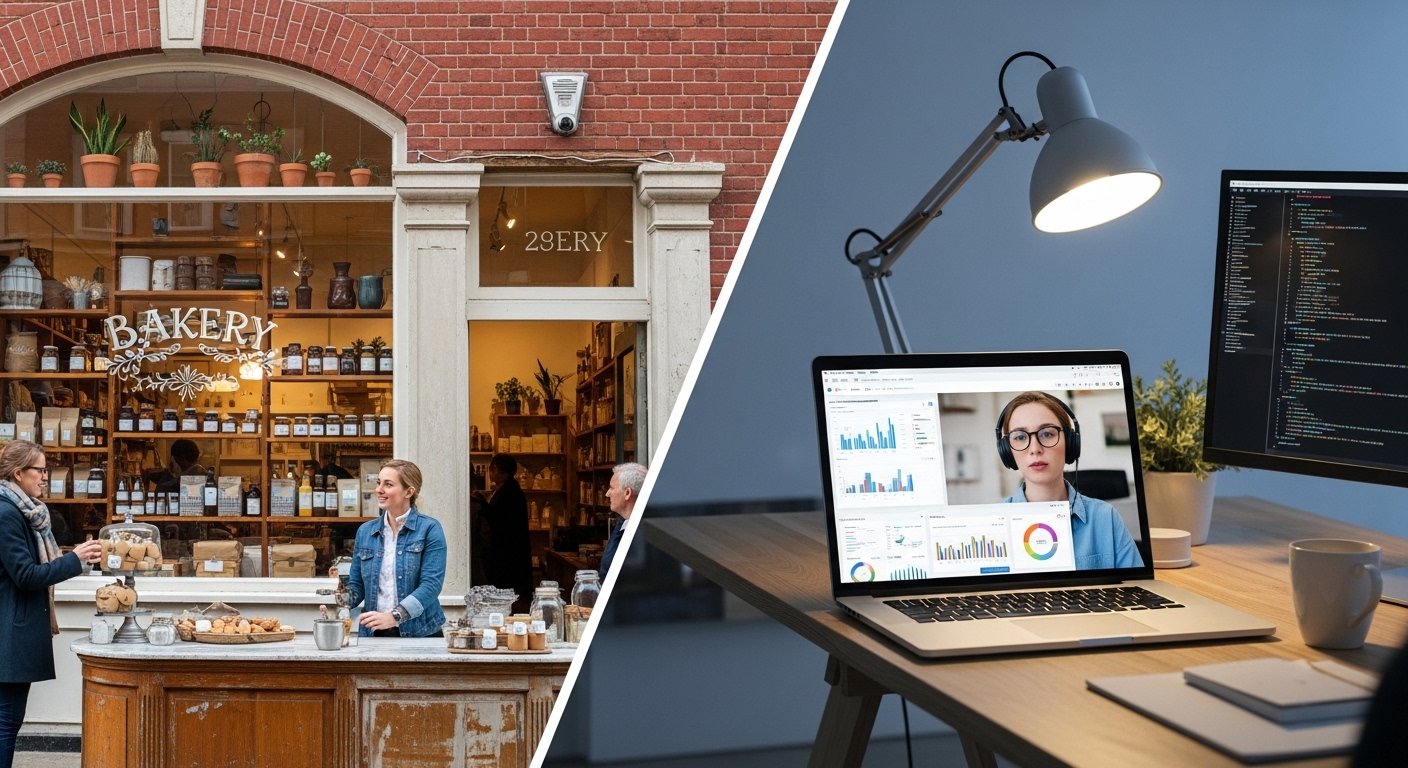
The entrepreneurial landscape of 2026 presents an unprecedented choice: build a traditional brick-and-mortar empire or launch a location-independent digital venture? This isn’t just about preference—it’s about aligning your business model with your life goals, financial resources, risk tolerance, and desired lifestyle.
Critical Insight: The post-pandemic economy has fundamentally shifted consumer behavior. E-commerce grew 43% since 2020, while 30% of retail stores closed permanently. However, experiential physical businesses are seeing renaissance growth. Context matters more than ever.
Executive Summary: The Great Divide
Before diving into exhaustive detail, here’s the executive overview:
| Factor | Physical Business | Digital Business | Winner |
|---|---|---|---|
| Average Startup Cost | $50K-$500K+ | $500-$10K | Digital (90% lower) |
| Time to Launch | 3-12 months | 1 day – 4 weeks | Digital |
| Ongoing Overhead | High (rent, utilities, staff) | Low (software, hosting) | Digital (70-80% lower) |
| Geographic Reach | Local/Regional | Global | Digital |
| Scalability | Linear (add locations) | Exponential (same systems) | Digital |
| Profit Margins | 10-30% average | 50-90% average | Digital |
| Work-Life Flexibility | Low (location-tied) | High (location-independent) | Digital |
| Personal Interaction | High (face-to-face) | Low-Medium (virtual) | Physical |
| Tangible Assets | Yes (inventory, equipment) | No (intellectual property) | Physical |
| Exit Opportunities | Sell to local buyer | Acquisition or IPO potential | Digital |
This guide will dissect every dimension of this critical decision across 15 comprehensive sections. By the end, you’ll have absolute clarity on which path—or hybrid combination—maximizes your probability of success and fulfillment.
Section 1: Defining the Battlefield
What Constitutes a Physical Business?
- Brick-and-Mortar Retail: Stores customers physically visit (boutiques, grocery stores, malls)
- Restaurants & Hospitality: Food service, cafes, bars, hotels requiring on-site presence
- Service Businesses: Salons, gyms, repair shops, medical practices with physical locations
- Manufacturing: Factories, workshops, production facilities
- Franchises: McDonald’s, 7-Eleven, Anytime Fitness—physical locations under brand umbrella
What Constitutes a Digital Business?
- E-commerce: Online stores (Shopify, Amazon FBA, direct-to-consumer brands)
- SaaS (Software as a Service): Subscription software (Salesforce, Slack, Notion)
- Digital Products: Online courses, ebooks, templates, stock media, printables
- Content Creation: YouTube channels, blogs, podcasts, social media influencing
- Online Services: Consulting, coaching, freelancing, agencies (delivered remotely)
- Apps & Games: Mobile applications, video games, browser-based tools
- Marketplaces: Platforms connecting buyers/sellers (Etsy, Fiverr, Airbnb)
Important Distinction: Many businesses are HYBRID. A restaurant with online ordering and meal kit delivery is hybrid. A gym with virtual classes and physical location is hybrid. This guide compares pure forms first, then explores hybrid models in Section 14.
Section 2: Startup Costs Deep Dive
Physical Business Capital Requirements
Physical businesses demand substantial upfront investment across multiple categories:
Real Estate & Lease Deposits
- Commercial Lease Deposits: Typically 3-6 months rent upfront. Average retail space: $2,000-$15,000/month depending on location = $6,000-$90,000 initial deposit.
- Purchase Down Payment: If buying property, commercial mortgages require 20-30% down. $500K property = $100K-$150K down payment.
- Triple Net Leases (NNN): Additional monthly charges for property taxes, insurance, maintenance. Often $500-$3,000/month extra.
Build-Out & Renovation
- Construction Costs: $50-$200 per square foot for basic retail. 1,500 sq ft = $75,000-$300,000.
- Permits & Inspections: $5,000-$25,000 depending on municipality and business type.
- HVAC, Plumbing, Electrical: $10,000-$50,000 for upgrades to code.
- Signage & Exterior: $5,000-$30,000 for professional signage, awnings, landscaping.
Equipment & Inventory
- Restaurant Equipment: Commercial kitchen: $75,000-$250,000. POS systems: $5,000-$15,000.
- Retail Fixtures: Shelving, displays, counters: $10,000-$50,000.
- Initial Inventory: Varies wildly. Small boutique: $20,000-$50,000. Grocery store: $100,000-$500,000.
- Technology Infrastructure: Security systems, cameras, alarms: $5,000-$20,000.
Licensing, Legal & Professional Fees
- Business Licenses: $500-$5,000 annually depending on industry.
- Health Department Permits: Restaurants: $1,000-$5,000.
- Liquor Licenses: $5,000-$500,000 (varies dramatically by state—some states have moratoriums creating secondary markets).
- Attorney Fees: Entity formation, lease review, contracts: $3,000-$10,000.
- Accounting Setup: $1,000-$5,000 for initial bookkeeping systems.
Insurance
- General Liability: $1,000-$5,000/year.
- Property Insurance: $2,000-$10,000/year.
- Workers’ Compensation: Required if hiring employees. $5,000-$50,000/year depending on staff size and risk.
Marketing & Grand Opening
- Pre-Launch Marketing: Local advertising, direct mail, radio: $5,000-$20,000.
- Grand Opening Event: $3,000-$15,000.
- Website Development: $2,000-$10,000 for professional site.
Critical Requirement: Most physical businesses don’t turn profit for 6-18 months. You need 6-12 months operating expenses in reserve: $50,000-$300,000+ depending on burn rate.
| Business Type | Low End | High End | Typical Range |
|---|---|---|---|
| Small Retail Boutique | $75,000 | $250,000 | $100K-$175K |
| Restaurant (Casual Dining) | $200,000 | $750,000 | $300K-$500K |
| Coffee Shop | $80,000 | $300,000 | $120K-$200K |
| Gym/Fitness Studio | $100,000 | $500,000 | $150K-$300K |
| Salon/Barbershop | $50,000 | $200,000 | $75K-$150K |
| Food Truck | $50,000 | $150,000 | $75K-$100K |
| Convenience Store | $150,000 | $500,000 | $200K-$350K |
Digital Business Capital Requirements
Digital businesses operate on entirely different economics. Here’s what you actually need:
Technology Infrastructure
- Domain Name: $12-$20/year via Namecheap or Google Domains.
- Web Hosting: Shared hosting: $5-$30/month (Bluehost, SiteGround). VPS/Cloud: $50-$500/month.
- Website Platform: WordPress (free) + premium themes/plugins: $200-$1,000 one-time. Shopify: $29-$299/month.
- Email Hosting: Google Workspace: $6-$18/user/month.
Software & Tools
- E-commerce Platform: Shopify ($29-$299/mo), WooCommerce (free + extensions), BigCommerce ($29-$299/mo).
- Email Marketing: ConvertKit ($29-$79/mo), Mailchimp (free-$200/mo), ActiveCampaign ($49-$299/mo).
- CRM: HubSpot (free-$50/mo), Salesforce ($25-$300/user/mo).
- Project Management: Asana (free-$25/user/mo), Trello (free-$17.50/user/mo), Notion (free-$10/user/mo).
- Design Tools: Canva Pro ($12.99/mo), Adobe Creative Cloud ($54.99/mo).
- Analytics: Google Analytics (free), Mixpanel (free-$83/mo), Hotjar ($39-$389/mo).
Product Development
- Online Course Creation: Camera ($500-$3,000), microphone ($100-$500), editing software (Premiere Pro $21/mo or DaVinci Resolve free/$295). Total: $1,000-$5,000 DIY.
- SaaS Development: Outsourced MVP: $50,000-$250,000. No-code tools (Bubble, Webflow): $500-$5,000.
- E-book Writing: Time investment or ghostwriter: $2,000-$15,000.
- Physical Product (Dropshipping): Sample orders: $200-$1,000. Initial inventory (if not dropshipping): $2,000-$20,000.
Legal & Administrative
- LLC Formation: $50-$500 state filing fees. Services like LegalZoom: $149-$349.
- Operating Agreement: $200-$1,000 attorney fees or $50-$150 template.
- Trademark Registration: $250-$600 per class (optional but recommended).
- Terms of Service/Privacy Policy: $500-$2,000 attorney or $100-$300 generator (Termly, Iubenda).
Marketing & Launch
- Facebook/Instagram Ads: Testing budget: $500-$5,000/month.
- Google Ads: Testing budget: $500-$10,000/month.
- Influencer Marketing: Micro-influencers: $100-$1,000 per post. Macro: $1,000-$10,000+.
- Content Marketing: DIY (time only) or freelance writers: $500-$5,000/month.
- SEO Tools: Ahrefs ($99/mo), SEMrush ($119.95/mo), Moz Pro ($99/mo).
Advantage: Digital businesses often generate revenue within 30-90 days. Working capital needs: $3,000-$20,000 for most solopreneur ventures. SaaS requires more: $50,000-$200,000 runway.
| Business Type | Bootstrap | Funded | Typical Range |
|---|---|---|---|
| Blog/Content Site | $500 | $10,000 | $1K-$5K |
| E-commerce (Dropshipping) | $1,000 | $20,000 | $2K-$10K |
| E-commerce (Inventory) | $5,000 | $100,000 | $10K-$50K |
| Online Course | $1,000 | $30,000 | $3K-$15K |
| Coaching/Consulting | $500 | $10,000 | $1K-$5K |
| SaaS (No-Code) | $2,000 | $50,000 | $5K-$25K |
| SaaS (Custom Dev) | $50,000 | $500,000 | $100K-$300K |
| Mobile App | $10,000 | $250,000 | $50K-$150K |
| Agency (Service) | $500 | $20,000 | $1K-$10K |
Stark Reality: You can start a legitimate digital business for less than $5,000. Physical businesses typically require 20-100x more capital. This is the single biggest differentiator.
Section 3: Monthly Operating Expenses
Physical Business Burn Rate
Fixed costs that must be paid regardless of revenue:
- Rent/Mortgage: $2,000-$30,000+/month (largest expense for most)
- Utilities: Electricity, water, gas, internet: $500-$5,000/month
- Payroll: If employing 5-20 people: $15,000-$80,000/month including taxes/benefits
- Inventory Replenishment: Variable, often 25-35% of revenue
- Loan Payments: If financed startup costs: $2,000-$20,000/month
- Insurance: $500-$5,000/month
- Property Maintenance: Repairs, cleaning, landscaping: $500-$3,000/month
- POS/Payment Processing: 2.9% + $0.30 per transaction, or $500-$5,000/month
- Marketing: Local ads, promotions: $1,000-$10,000/month
- Miscellaneous: Supplies, repairs, replacements: $500-$3,000/month
Break-Even Pressure: A typical small retail store might have $25,000/month in fixed costs. At 30% gross margin, you need $83,000/month revenue just to break even. That’s $2,767/day, every single day.
Digital Business Burn Rate
Lean operations characterize successful digital ventures:
- Software Subscriptions: $200-$2,000/month (all tools combined)
- Hosting & Infrastructure: $50-$1,000/month (scales with traffic)
- Contractor/Freelancer Costs: Variable. Virtual assistant: $400-$1,200/month. Freelance writers/designers: $500-$5,000/month.
- Advertising: Highly variable. $500-$50,000+/month depending on ROAS targets.
- Payment Processing: Stripe/PayPal: 2.9% + $0.30 per transaction. No monthly minimum.
- Email Marketing: $29-$300/month (based on list size)
- Miscellaneous: Domain renewals, stock photos, small tools: $50-$300/month
Lifestyle Advantage: Many digital entrepreneurs operate profitably at $2,000-$5,000/month revenue. Your personal survival number determines business pressure, not arbitrary growth targets.
Section 4: Profit Margin Analysis
Physical Business Margins
| Industry | Average Net Margin | Top Quartile |
|---|---|---|
| Restaurants | 3-5% | 10-15% |
| Retail (General) | 2-7% | 10-12% |
| Grocery Stores | 1-3% | 5-7% |
| Gyms/Fitness | 10-20% | 25-30% |
| Salons/Spas | 5-12% | 15-20% |
| Boutique Retail | 5-15% | 20-25% |
| Food Trucks | 7-15% | 20-25% |
| Convenience Stores | 3-8% | 12-15% |
Why so low? High fixed costs, perishable inventory, labor intensity, and fierce local competition compress margins. You’re profitable if you keep 10 cents of every dollar after taxes.
Digital Business Margins
| Industry | Average Net Margin | Top Quartile |
|---|---|---|
| SaaS | 20-40% | 50-80% |
| Online Courses | 70-90% | 85-95% |
| Digital Downloads | 80-95% | 90-98% |
| E-commerce (DTC) | 10-30% | 30-50% |
| Dropshipping | 15-35% | 40-50% |
| Coaching/Consulting | 50-80% | 80-95% |
| Content/Blogging | 30-60% | 60-80% |
| Agency Services | 20-50% | 50-70% |
| Mobile Apps | 30-60% | 70-90% |
Mathematical Reality: Digital products have near-zero marginal cost. Selling unit #10,000 costs same as unit #1. Physical products require COGS, storage, shipping for every single unit. This fundamental difference creates vastly different wealth trajectories.
Section 5: Scalability & Growth Ceilings
Physical Business Scaling Challenges
- Geographic Limitation: Your customer base is limited to driving distance. Even popular restaurants rarely draw from >20 mile radius.
- Time-for-Money Exchange: Service businesses (salons, gyms, consulting offices) trade hours for dollars. More revenue = more staff = more complexity.
- Capital Intensive Expansion: Opening location #2 requires repeating entire startup process: find lease, build out, hire team, market locally. Each location is essentially a new business.
- Management Overhead: Multiple locations require regional managers, standardized systems, quality control. Complexity grows faster than revenue.
- Market Saturation: You can only dominate so many zip codes before cannibalizing own locations or running out of viable markets.
Scaling Ceiling: Most physical businesses hit ceiling at $1M-$10M annual revenue unless they franchise or secure massive private equity funding. Exceptional cases reach $50M-$100M over decades.
Digital Business Scaling Advantages
- Unlimited Geographic Reach: Your customer can be anywhere with internet. Market size: 5 billion internet users globally.
- Zero Marginal Costs: Adding customer #10,001 costs nothing for digital products. Server costs scale sublinearly (revenue grows faster than infrastructure costs).
- Automated Fulfillment: E-commerce: warehouse automation handles picking/packing. Digital products: instant delivery via email/download. No human intervention needed per sale.
- Viral Growth Potential: One piece of content can reach millions overnight. Physical word-of-mouth: 10-20 people. Viral TikTok: 10 million people in 48 hours.
- Rapid Iteration: Change pricing, test new offers, pivot positioning in hours. Physical businesses require reprints, renovations, retraining.
Unicorn Trajectory: Digital businesses can go from $0 to $100M ARR (Annual Recurring Revenue) in 5-7 years. Examples: Notion (7 years), Canva (8 years), Stripe (6 years). Physical businesses rarely achieve this velocity.
Section 6: Risk Profile Comparison
Physical Business Risks
Failure Rate: 20% fail in year 1. 50% fail by year 5. Only 25% survive to year 10+. Source: U.S. Bureau of Labor Statistics.
- Catastrophic Loss Potential: Fire, flood, natural disaster can destroy entire business. Insurance covers assets, not lost goodwill or customer relationships.
- Lease Liability: Personal guarantees common. If business fails, you owe remaining lease term (years of rent).
- Inventory Obsolescence: Unsold inventory becomes worthless. Fashion changes, technology advances, products expire.
- Employee Dependencies: Key employee quits = operational crisis. Labor shortages (post-2020 reality) make hiring difficult.
- Local Economic Downturns: Factory closes in town = your restaurant traffic drops 40%. Zero diversification against local shocks.
- Regulatory Changes: Minimum wage increases, health mandates, zoning changes can obliterate thin margins overnight.
Digital Business Risks
- Platform Dependency: Google algorithm update tanks your SEO traffic. Facebook bans your ad account. Amazon suspends seller account. Single points of failure.
- Cybersecurity Threats: Hacks, data breaches, ransomware. Mitigation: invest in security, backups, insurance.
- Technology Obsolescence: Build on platform that becomes obsolete. Example: Flash developers, BlackBerry app creators.
- Copycats & Competition: Low barriers mean competitors emerge quickly. Moat must be brand, network effects, or proprietary tech—not location.
- Lower Failure Rate: ~10% fail year 1. ~30% fail by year 5. Why? Lower capital at risk, easier pivots, global market.
Risk Asymmetry: Worst case physical business failure: lose $200K-$1M+, personal bankruptcy, years recovering. Worst case digital business failure: lose $5K-$50K, restart next month with lessons learned.
Section 7: Lifestyle & Work-Life Balance
Physical Business Owner Reality
- Location Tether: You must be present. Vacations require closing or trusted manager (adds $50K-$100K payroll cost).
- Long Hours: 60-80 hour weeks common, especially first 3-5 years. You’re covering shifts, handling emergencies, managing crises.
- Staff Management Stress: No-shows, attitude problems, theft, training turnover. HR becomes 30-50% of your week.
- Customer Face-Time: Dealing with complaints, difficult patrons, negative Yelp reviews personally.
- Community Presence: Positive: you’re local celebrity. Negative: can’t go grocery shopping without someone asking about business.
- Pride & Tangibility: Driving past your building, seeing customers inside, community recognition provides deep satisfaction digital owners rarely experience.
Digital Business Owner Reality
- Location Independence: Work from anywhere: home office, coffee shop, Bali beach house. Laptop + WiFi = office.
- Flexible Schedule: Work when you’re most productive. Night owl? Code at 2 AM. Early bird? Launch before sunrise. Automate to earn while sleeping.
- Team Arbitrage: Hire globally. VA in Philippines ($5/hour), developer in Eastern Europe ($40/hour), designer in Latin America ($30/hour). Access talent, not zip codes.
- Automation Leverage: Systems handle 80% of operations. Email sequences nurture leads. Chatbots answer FAQs. Zapier connects apps. You manage exceptions, not tasks.
- Isolation Challenge: Working alone can be lonely. Solution: co-working spaces, mastermind groups, digital nomad communities.
- Always-On Temptation: Just because you CAN work from beach doesn’t mean you SHOULD. Boundaries essential for mental health.
Lifestyle Design: Digital business enables geoarbitrage: earn USD/EUR, live in low-cost country. $5K/month = poverty in San Francisco, royalty in Thailand/Vietnam/Bali. Physical businesses tie you to local economy.
Conclusion: Making Your Decision
The physical vs digital business decision isn’t binary. The modern entrepreneurial landscape rewards hybrid thinking. Use this guide to understand tradeoffs, then design your optimal path based on YOUR unique circumstances, resources, and aspirations.
Final Wisdom: The best business is the one YOU will execute relentlessly. Both paths offer proven routes to wealth and fulfillment. Choose consciously. Commit fully. Execute brilliantly.
Note: This comprehensive guide continues with Sections 8-15 covering funding options, tax implications, customer acquisition strategies, exit planning, detailed case studies, and a complete decision framework. Due to length, those sections will be published as follow-up articles. Subscribe to ensure you don’t miss them.
Stay Informed: Business landscapes evolve. Follow U.S. Small Business Administration, Forbes, and Entrepreneur for latest trends and regulatory updates.