
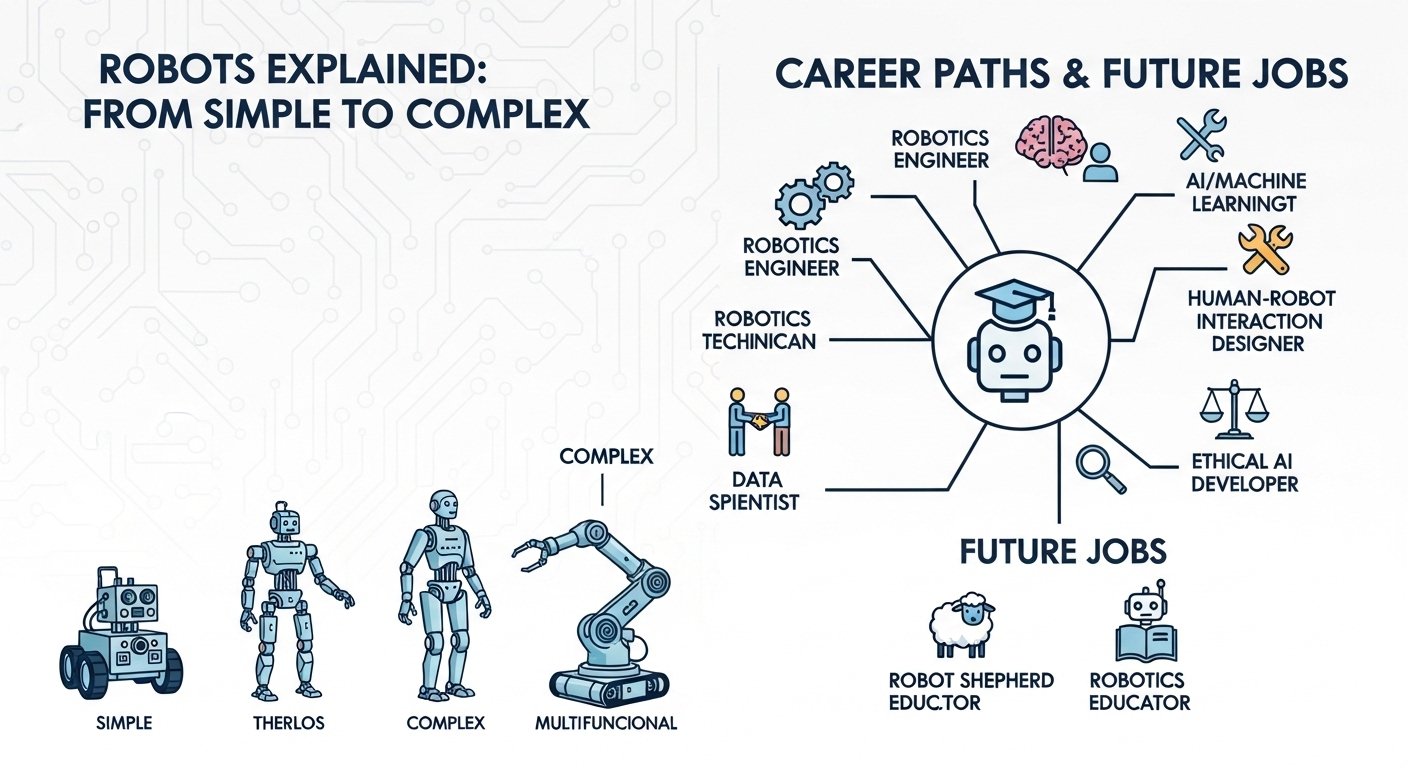
Robots come in forms you recognize and forms you never imagined. From a $10 toy that follows lines to billion-dollar machines that explore Mars, robotics spans an astonishing range of complexity.
In this guide, you’ll discover the full spectrum of robots that exist today—from beginner projects you can build in hours to engineering marvels that push human capability. You’ll also learn how to turn that curiosity into a career, and why the robotics industry represents one of the greatest economic opportunities of our generation.
The Big Picture: The global robotics market is valued at over $60 billion today and projected to reach $260 billion by 2030. That’s not just numbers—it’s millions of jobs, countless businesses, and a fundamental transformation of how we work and live.
Understanding Robot Categories
Before exploring examples, let’s understand how robots are categorized. Robots are typically classified by:
- Application: What the robot does (industrial, service, exploration)
- Mobility: Stationary, wheeled, tracked, legged, flying, underwater
- Autonomy Level: Remote-controlled, semi-autonomous, fully autonomous
- Complexity: Simple (few components) to complex (hundreds of components)
- Industry: Manufacturing, healthcare, agriculture, military, consumer
Simple Robots: Entry-Level Machines
Simple robots teach fundamental concepts. They use basic sensors, minimal processing, and straightforward mechanics. Perfect for beginners and educational settings.
1. Line-Following Robot
Complexity Level: Beginner
Cost: $10-30
Build Time: 2-4 hours
What It Is: A robot that follows a black line on a white surface (or vice versa) using infrared sensors.
How It Works:
- Infrared sensors detect the contrast between line and background
- Arduino or similar microcontroller processes sensor data
- Motor driver adjusts wheel speeds to keep robot on the line
- Simple feedback loop maintains course
Components:
- Chassis (plastic or acrylic)
- 2 DC motors with wheels
- Arduino Uno or similar
- 2-3 infrared line sensors
- Motor driver (L298N or TB6612)
- Battery pack
Learning Outcomes:
- Motor control fundamentals
- Sensor integration
- Basic programming logic
- Feedback systems
2. Obstacle-Avoiding Robot
Complexity Level: Beginner
Cost: $15-40
Build Time: 3-5 hours
What It Is: A robot that detects obstacles using ultrasonic sensors and navigates around them.
How It Works:
- Ultrasonic sensor measures distance to objects
- When obstacle detected within threshold, robot stops
- Robot backs up, turns, and continues in new direction
- Process repeats for continuous navigation
3. Light-Seeking Robot
Complexity Level: Beginner
Cost: $10-25
What It Is: A robot that moves toward light sources using photoresistors or photodiodes.
Real-World Inspiration: These are the same principles used in solar-tracking solar panels.
4. Bristlebot
Complexity Level: Ultra-Beginner
Cost: Under $5
Build Time: 15 minutes
What It Is: The simplest possible robot—a vibrating toothbrush head that moves in random patterns.
Why It Matters: Bristlebots demonstrate that robotics doesn’t require microcontrollers. Vibration motors and physics create motion.
5. Remote-Controlled Robot
Complexity Level: Beginner
Cost: $20-50
What It Is: A robot controlled via Bluetooth, WiFi, or radio frequency—no autonomous behavior required.
Learning Outcomes:
- Wireless communication
- Motor control
- Mechanical design
- User interface basics
Intermediate Robots: Capability Without Complexity
Intermediate robots add multiple sensors, more sophisticated programming, and useful real-world applications.
6. WiFi-Controlled Robot
Complexity Level: Intermediate
Cost: $40-80
What It Is: A robot controlled via smartphone app or web browser over WiFi.
How It Works:
- Raspberry Pi or ESP32 provides WiFi connectivity
- Web server runs on robot
- User accesses control interface via browser
- Commands sent via HTTP requests
7. Voice-Controlled Robot
Complexity Level: Intermediate
Cost: $50-100
What It Is: A robot that responds to voice commands using speech recognition.
Technologies Used:
- Google Speech API or similar
- Natural language processing
- Text-to-speech for responses
- Microphone array for direction
8. Pick-and-Place Robot Arm
Complexity Level: Intermediate-Advanced
Cost: $100-500
What It Is: A robotic arm that picks objects from one location and places them in another.
Applications:
- Sorting systems
- Assembly lines
- Packaging operations
- Laboratory automation
Key Technologies:
- Inverse kinematics
- Servo motor control
- Camera-based object detection
- Gripper design
9. Maze-Solving Robot
Complexity Level: Intermediate
Cost: $50-100
What It Is: A robot that navigates unknown mazes using algorithms to find the exit.
Algorithms Used:
- Left-hand rule
- Flood fill algorithm
- Depth-first search
- Breath-first search
10. Self-Driving Mini Car
Complexity Level: Intermediate-Advanced
Cost: $100-300
What It Is: A miniature autonomous vehicle that navigates roads using computer vision.
Technologies:
- Lane detection via camera
- Object detection (stop signs, traffic lights)
- Path planning
- Speed control
Advanced Robots: Professional-Grade Machines
Advanced robots use sophisticated sensors, powerful processors, and complex algorithms to perform meaningful real-world tasks.
11. TurtleBot 3
Complexity Level: Advanced
Cost: $550-700
Uses: Education, research, prototyping
What It Is: The industry-standard educational robot platform running ROS.
Capabilities:
- Simultaneous Localization and Mapping (SLAM)
- Autonomous navigation
- Path planning and obstacle avoidance
- Computer vision integration
- Full ROS/ROS 2 support
Components:
- Dynamixel servos (precision motors)
- 360-degree LIDAR sensor
- Raspberry Pi or Jetson Nano computer
- 3D-printed chassis
- IMU for orientation
12. Industrial Robotic Arms
Complexity Level: Advanced
Cost: $25,000-200,000
Uses: Manufacturing, assembly, welding, painting
Examples:
- FANUC Robot – Most common industrial robot
- KUKA Robot – German precision engineering
- ABB Robot – Swiss automation leader
- Universal Robots – Collaborative robots (cobots)
Key Technologies:
- 6+ degrees of freedom
- Precision encoders at every joint
- Forward and inverse kinematics
- Trajectory planning
- Force/torque sensing
13. Drone Systems
Complexity Level: Advanced
Cost: $500-50,000+
Types:
- Quadcopters: Most common, 4 rotors
- Fixed-wing: Airplane-style, longer flight time
- Hybrid: VTOL (vertical takeoff and landing)
- Swarm drones: Multiple coordinated units
Technologies:
- Flight controller (Pixhawk, DJI N3)
- GPS and IMU fusion
- Computer vision for navigation
- LiDAR for mapping
- Machine learning for autonomous flight
Complex Robots: Engineering Marvels
These robots represent the cutting edge of robotics—machines that push the boundaries of what’s possible.
14. Boston Dynamics Atlas
Complexity Level: Expert
Cost: Priceless (not publicly sold)
What It Is: The world’s most advanced humanoid robot, capable of dynamic locomotion and manipulation.
Capabilities:
- Bipedal walking on uneven terrain
- Running and jumping
- Backflips and parkour
- Object manipulation
- Recovery from falls
Technologies:
- 28 hydraulic joints
- Lightweight titanium and 3D-printed structures
- Advanced balance and control systems
- Computer vision and sensing
- Reinforcement learning for new movements
15. Da Vinci Surgical System
Complexity Level: Expert
Cost: $2 million+
What It Is: The gold standard for robotic surgery, used in hospitals worldwide.
Capabilities:
- Precision surgery with sub-millimeter accuracy
- Minimally invasive procedures
- Surgeon console with 3D visualization
- Motion scaling (big hand movements become tiny tool movements)
- Tremor filtering
16. Spot (Boston Dynamics)
Complexity Level: Expert
Cost: $74,500 (base price)
What It Is: A quadruped robot that can go places wheeled robots cannot.
Applications:
- Industrial inspection
- Construction site monitoring
- Public safety and security
- Research platform
- Entertainment industry
17. Mars Rovers
Complexity Level: Expert
Cost: $2.7 billion (Perseverance)
Current Rovers:
- Perseverance: NASA’s most advanced rover, searching for signs of past life
- Curiosity: Still operating on Mars since 2012
- Zhurong: China’s first Mars rover
Technologies:
- Radioisotope thermoelectric generator (RTG) power
- Autonomous navigation using computer vision
- Sample collection and caching
- Helicopter (Ingenuity) for aerial reconnaissance
- Communication relay to Earth
18. Humanoid Robots (Sophia, Tesla Optimus)
Complexity Level: Expert
Sophia (Hanson Robotics):
- Realistic human face with expressions
- Natural language conversation
- Computer vision for face recognition
- Deep learning for responses
Tesla Optimus:
- General-purpose humanoid robot
- Designed for dangerous/repetitive tasks
- Neural network-based autonomy
- Target cost under $20,000
Robot Complexity Comparison
| Robot Type | Cost | Components | Sensors | Processing | AI Level |
|---|---|---|---|---|---|
| Bristlebot | $5 | 5 | 0 | None | None |
| Line Follower | $30 | 15 | 2-3 | Arduino | Basic |
| Obstacle Avoider | $40 | 20 | 1 | Arduino | Basic |
| WiFi Robot | $80 | 30 | 2-5 | Raspberry Pi | Moderate |
| TurtleBot 3 | $600 | 50+ | 5+ | RPi/Jetson | Advanced |
| Industrial Arm | $50K+ | 200+ | 10+ | PLC/Industrial PC | Programmed |
| Drone | $2K+ | 100+ | 8+ | Flight Controller | Advanced |
| Atlas | Millions | 500+ | 30+ | Supercomputer | Cutting-edge |
| Mars Rover | Billions | 1000+ | 50+ | Radiation-hardened CPU | Expert |
Career Paths in Robotics
The robotics industry offers diverse career paths for people with various skills and education levels. Here’s a comprehensive guide to careers in robotics.
Career Pathways Overview
| Career Type | Focus | Typical Salary | Education |
|---|---|---|---|
| Robotics Engineer | Design and build robots | $80K-150K | Bachelor’s+ |
| Software Engineer | Robot programming and AI | $90K-180K | Bachelor’s+ |
| Mechanical Engineer | Robot design and mechanics | $70K-130K | Bachelor’s+ |
| Electrical Engineer | Circuits and electronics | $70K-140K | Bachelor’s+ |
| Automation Technician | Maintain and operate robots | $50K-80K | Associate’s |
| Sales Engineer | Sell robotics solutions | $80K-150K | Bachelor’s |
| Research Scientist | Push robotics boundaries | $100K-200K+ | PhD |
| Entrepreneur | Build robotics businesses | Variable | Variable |
1. Robotics Engineer
What They Do: Design, build, and test robots and robotic systems. Work on everything from concept to deployment.
Daily Tasks:
- Design mechanical components using CAD
- Write control software
- Integrate sensors and actuators
- Test and debug robotic systems
- Collaborate with cross-functional teams
Required Skills:
- Mechanical, electrical, or software engineering
- CAD software (SolidWorks, Fusion 360)
- Programming (C++, Python, ROS)
- Understanding of kinematics and dynamics
- Problem-solving abilities
Where They Work:
2. Robotics Software Engineer
What They Do: Write the code that makes robots intelligent. Focus on perception, planning, control, and AI.
Daily Tasks:
- Develop motion planning algorithms
- Implement computer vision systems
- Write ROS nodes and packages
- Integrate machine learning models
- Debug and optimize code
Required Skills:
- Strong programming (Python, C++, C)
- ROS/ROS 2 experience
- Machine learning and AI
- Computer vision
- Linux operating system
Salary Range: $90,000-$180,000 (senior roles up to $250K+)
3. Automation Technician
What They Do: Maintain, troubleshoot, and optimize robotic systems in industrial settings.
Daily Tasks:
- Monitor robot performance
- Perform preventive maintenance
- Troubleshoot and repair issues
- Train operators on robot use
- Document maintenance activities
Required Skills:
- Electrical/mechanical aptitude
- Basic programming knowledge
- Understanding of industrial equipment
- Diagnostic skills
- Safety awareness
Where They Work:
- Manufacturing plants
- Distribution centers
- Automotive factories
- Food processing facilities
- Hospitals
4. Research Scientist
What They Do: Push the boundaries of robotics through fundamental research.
Focus Areas:
- Artificial intelligence
- Computer vision
- Natural language processing
- Human-robot interaction
- Novel actuator and sensor design
Typical Path: Bachelor’s → Master’s → PhD → Postdoc → Faculty/Research Lab
Where They Work:
5. Robotics Entrepreneur
What They Do: Build companies that solve problems with robotics.
Successful Robotics Companies:
- iRobot (Roomba) – Founded by MIT professor
- DJI – Drone giant from China
- Built Robotics – Autonomous construction
- Nuro – Delivery robots
- Aurora – Self-driving trucks
What It Takes:
- Strong technical foundation
- Business acumen
- Understanding of market needs
- Ability to raise funding
- Resilience and persistence
Career Progression in Robotics
Here’s a typical career progression for robotics professionals:
Entry Level (0-2 years)
- Job Titles: Junior Engineer, Associate Engineer, Engineering Intern
- Focus: Learning, assisting senior engineers, completing defined tasks
- Salary: $55,000-$80,000
Mid Level (3-5 years)
- Job Titles: Robotics Engineer, Software Engineer, Mechanical Engineer
- Focus: Independent work, mentoring juniors, project ownership
- Salary: $80,000-$120,000
Senior Level (5-10 years)
- Job Titles: Senior Engineer, Technical Lead, Principal Engineer
- Focus: Architecture decisions, team leadership, strategic planning
- Salary: $120,000-$180,000
Management/Executive (10+ years)
- Job Titles: Engineering Manager, Director, VP of Engineering, CTO
- Focus: Team building, strategy, business decisions
- Salary: $150,000-$500,000+
Fastest Path to High Salary: Combine robotics skills with AI/machine learning expertise. Roles combining deep learning with robotics command premiums of 30-50% over traditional robotics roles.
Future Jobs in Robotics
The robotics industry is creating jobs that didn’t exist a decade ago. Here’s what’s coming:
Emerging Robotics Job Categories
| Job Title | Description | Expected Demand | Salary Range |
|---|---|---|---|
| Robot Trainer | Train robots using demonstration and reinforcement learning | Very High | $80K-150K |
| Autonomous Vehicle Operator | Monitor and assist self-driving vehicles | Very High | $60K-100K |
| Cobots Programmer | Program collaborative robots for small businesses | High | $75K-130K |
| Drone Traffic Manager | Manage urban drone delivery networks | High | $80K-140K |
| Warehouse Automation Manager | Oversee robotic warehouse operations | High | $90K-150K |
| Medical Robot Coordinator | Operate surgical robots in hospitals | Medium-High | $80K-130K |
| Robot Ethicist | Address ethical implications of robotics | Medium | $100K-180K |
| Swarm Robotics Engineer | Design coordinated multi-robot systems | Medium | $110K-180K |
Jobs That Will Grow Significantly
- Robot Operations: Monitoring and maintaining fleets of robots
- Fleet Management: Coordinating multiple autonomous systems
- Robot-Human Collaboration: Designing workspaces where humans and robots coexist
- Data Labeling: Training AI systems with annotated data
- Robot Repair: Specialized technicians for robot maintenance
- Simulation Specialists: Creating virtual environments for robot training
- Edge Computing for Robotics: Optimizing AI for robot deployment
Business Opportunities in Robotics
Robotics isn’t just a career path—it’s a massive business opportunity. Here are the sectors primed for disruption and entrepreneurship.
High-Growth Business Areas
1. Service Robotics ($40B+ market by 2030)
Opportunities:
- Commercial cleaning robots
- Delivery robots (last-mile)
- Food service automation
- Security and surveillance robots
- Companion robots for elderly
2. Healthcare Robotics ($20B+ market by 2030)
Opportunities:
- Surgical assistance
- Rehabilitation robots
- Hospital logistics automation
- Pharmacy automation
- Mental health companion robots
3. Agriculture Robotics ($20B+ market by 2030)
Opportunities:
- Autonomous tractors
- Crop monitoring drones
- Automated harvesting
- Weed removal robots
- Precision irrigation robots
4. Construction Robotics ($15B+ market by 2030)
Opportunities:
- 3D-printed houses
- Autonomous bricklaying
- Site surveying robots
- Safety monitoring systems
- Heavy equipment automation
5. Warehouse and Logistics ($40B+ market by 2030)
Opportunities:
- Automated storage and retrieval
- Autonomous forklifts
- Order fulfillment robots
- Last-mile delivery robots
- Fleet management software
Startup Opportunities by Complexity
| Complexity | Ideas | Investment Needed | Time to Market |
|---|---|---|---|
| Low | Robot accessories, specialized grippers, customization services | $10K-50K | 3-6 months |
| Medium | Vertical-specific solutions, integration services, robot-as-a-service | $50K-500K | 6-18 months |
| High | Novel hardware, AI platforms, full robot systems | $500K-10M+ | 2-5 years |
Successful Robotics Startups to Study
- Ridge Robotics – Autonomous mowing robots
- Sarcos Robotics – Exoskeletons for industrial workers
- Dispatch – Delivery robots
- Simbe Robotics – Retail inventory robots
- Kinetic – Workplace safety exoskeletons
Robotics Industry Market Analysis
Understanding the market helps you make informed career and business decisions.
Market Size and Growth
| Segment | 2024 Value | 2030 Projected | CAGR |
|---|---|---|---|
| Industrial Robotics | $25B | $50B | 12% |
| Service Robotics | $35B | $100B | 19% |
| Healthcare Robotics | $10B | $25B | 16% |
| Agricultural Robotics | $8B | $25B | 21% |
| Consumer Robotics | $15B | $40B | 18% |
| Autonomous Vehicles | $50B | $200B | 26% |
| Total | $143B | $440B | 21% |
Regions Leading Robotics Development
- United States: AI and software leadership, strong research
- China: Manufacturing dominance, massive investment
- Japan: Industrial robots, humanoid research
- Germany: Industrial automation excellence
- South Korea: Consumer robotics, defense
- Israel: Drone technology, computer vision
Key Industry Players
- Amazon Robotics – Warehouse automation
- Boston Dynamics – Mobile robots
- DJI – Drones
- Caterpillar – Construction robots
- ABB Robotics – Industrial automation
- Tesla – Autonomous vehicles, Optimus robot
Skills Most in Demand
If you want to work in robotics, focus on these high-demand skills:
Top Technical Skills
- ROS/ROS 2: The standard robot software framework
- Python: Most common robot programming language
- C++: Performance-critical robot code
- Machine Learning: AI for robot perception and decision-making
- Computer Vision: Robot “eyes” using cameras
- Control Systems: PID control, motion planning
- SLAM: Mapping and localization
- CAD: Mechanical design
Top Soft Skills
- Problem-solving: Debugging complex systems
- Cross-functional collaboration: Mechanical + electrical + software
- Communication: Explaining technical concepts
- Adaptability: Robotics evolves rapidly
- Creativity: Novel solutions to novel problems
Highest ROI Skill: Combining ROS expertise with machine learning. Professionals with both skills command salaries 40-60% higher than those with either skill alone.
Conclusion: The Future is Robotic
From the simplest bristlebot to the most sophisticated humanoid, robots represent human ingenuity at its finest. And the industry is just getting started.
Whether you want to:
- Build simple robots: Start with Arduino kits and work up
- Have a robotics career: Focus on ROS, Python, and ML skills
- Start a robotics business: Identify problems and build solutions
- Invest in robotics: Understand the market segments and leaders
…the time to act is now. The robotics industry is growing at 20%+ annually. The jobs and businesses of tomorrow are being created today.
Your Action Items:
- Start learning robotics with our 50-Step Robotics Learning Guide
- Build your first robot with our Best Robotics Kits Guide
- Learn ROS with our ROS Installation Guide
- Explore career opportunities at Indeed Robotics Jobs
- Follow industry news at IEEE Spectrum Robotics
The robots of tomorrow are being built by the robotics professionals of today. Be part of that future.
Related Guides: Continue learning with our 50-Step Robotics Learning Guide, Who Can Start Robotics, Best Robotics Kits for Beginners, and ROS Installation Guide.
Stay Updated: Follow robotics industry leaders for the latest developments: