

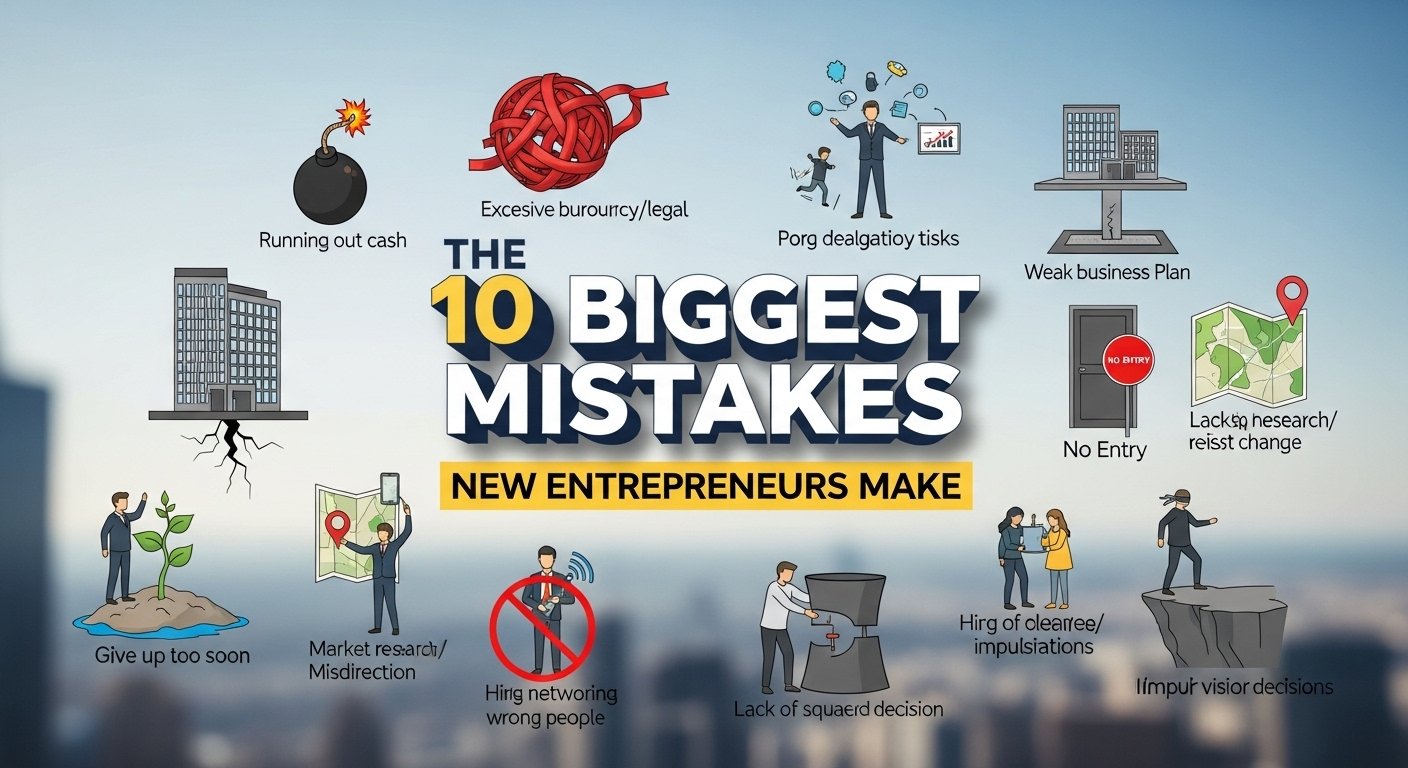
SHORT DESCRIPTION: The most costly mistakes new entrepreneurs make and proven strategies to avoid them. From skipping validation to hiring too fast, learn from the failures that have ended countless startups.
Starting a business is exciting. The passion, the possibility, the dream of building something meaningful. But between the idea and the success story lies a minefield of preventable mistakes that have ended countless ventures before they had a chance to flourish.
CB Insights’ research reveals that approximately 20% of startups fail within their first year, and nearly 50% don’t survive past year five. While failure is sometimes unavoidable, most of these collapses stem from predictable, avoidable errors.
This guide examines the 10 most devastating mistakes new entrepreneurs make—and more importantly, how you can dodge them entirely.
Mistake #1: Skipping Market Validation
The seductive trap: You have a brilliant idea. You’re convinced it will change the world. So you build it. You build it beautifully. And then… nothing. No customers. No interest. No revenue.
Failory reports that “no market need” is the #1 reason startups fail, cited by 42% of failed companies. Founders fall in love with their solution instead of the problem.
What This Looks Like in Practice
- Building a product before talking to potential customers
- Assuming you know what customers want without research
- Ignoring or dismissing early signs of disinterest
- Spending months in “stealth mode” perfecting a product nobody asked for
How to Avoid This Mistake
- Talk to customers first: Conduct at least 15-25 customer interviews before building anything
- Test demand cheaply: Create a landing page and see if people sign up
- Pre-sell: Ask people to pay before you build. If they won’t prepay, they won’t pay later
- Watch for workarounds: People using manual solutions or competing products reveal validated demand
Steve Blank’s customer development methodology revolutionized startup success rates by proving that structured customer learning beats intuition every time.
Mistake #2: Running Out of Cash
Cash flow is the heartbeat of business. No cash, no business—regardless of how brilliant your product is or how passionate your customers are.
Cash flow problems account for the second-largest cause of startup failure. Many founders underestimate how long it takes to become cash-flow positive and overestimate how quickly revenue will arrive.
What This Looks Like in Practice
- Spending lavishly on office space, equipment, or hiring before revenue justifies it
- Ignoring accounts receivable—letting invoices go uncollected
- Assuming next month’s sales will “save” this month’s bills
- Underpricing to win business that actually loses money on each transaction
How to Avoid This Mistake
- Build a 12-month cash flow projection: LivePlan or even a simple spreadsheet can help
- Track burn rate religiously: Know exactly how long you can survive without revenue
- Maintain 6-12 months of runway: Bank this before you need it
- Invoice immediately and follow up: Use Wave or FreshBooks to stay on top of receivables
- Price for profitability: Race-to-the-bottom pricing kills businesses
Nolo’s cash flow guide offers practical strategies for managing working capital in the critical early months.
Mistake #3: Hiring Too Fast or Too Slow
Hiring is both the most powerful growth lever and the fastest way to destroy culture, burn cash, and complicate decision-making. New entrepreneurs either hire frantically at the first sign of stress or avoid hiring until they’re drowning.
Research by Gartner shows that bad hires cost companies up to 40% of their annual salary in lost productivity, rehiring expenses, and cultural damage.
What This Looks Like in Practice
- Hiring too fast: Making desperate hires because you’re overwhelmed, hiring friends who aren’t qualified, or bringing on people before you can afford them
- Hiring too slow: Trying to do everything yourself until you’re burned out, losing opportunities because you can’t execute, or delaying critical roles until it’s almost too late
How to Avoid This Mistake
- Hire for core weakness: Identify the exact skill gaps holding you back
- Start with contractors: Use Upwork or Fiverr before committing to employees
- Create a hiring scorecard: Define exactly what success looks like before you interview
- Hire slowly, fire quickly: Extend the hiring process but terminate underperformers immediately
- Avoid hiring friends: Unless they’re genuinely the best candidate, business and friendship rarely mix well
Mistake #4: Ignoring Competition
New entrepreneurs often view competition as something to ignore or dismiss. “We’re different,” they say. “They don’t do it like us.” But competition validates markets—and understanding competitors reveals opportunities.
CB Insights’ analysis shows that “got outcompeted” is cited by only 9% of failures—but “no competitive differentiation” underlies many other failure reasons.
What This Looks Like in Practice
- Refusing to research competitors because you’re “different”
- Being unaware of direct and indirect competitors
- Copying competitor features without understanding why they work
- Underpricing to compete instead of differentiating on value
How to Avoid This Mistake
- Audit competitors monthly: Use SimilarWeb to analyze their traffic and engagement
- Sign up for their products: Experience their customer journey firsthand
- Read their reviews: Both positive and negative reveal what customers value
- Identify white space: What are competitors not serving? What do customers complain about?
- Position deliberately: HubSpot’s competitive analysis frameworks help you find your differentiated position
Mistake #5: Poor Financial Management
Many entrepreneurs are brilliant at their craft but financially illiterate when it comes to running a business. They conflate revenue with profit, ignore tax obligations, and mix personal and business finances.
SCORE reports that financial management issues are a top reason small businesses fail—yet it’s one of the most learnable skills.
What This Looks Like in Practice
- Mixing personal and business bank accounts
- Not tracking expenses or revenues systematically
- Ignoring tax obligations until penalties accumulate
- Not knowing your gross margin, burn rate, or break-even point
- Taking salary before covering business obligations
How to Avoid This Mistake
- Open separate business accounts immediately: Wave offers free business banking
- Track every transaction: Use QuickBooks Self-Employed or Xero
- Know your numbers: Monthly recurring revenue, gross margin, customer acquisition cost, lifetime value
- Plan for taxes: Set aside 25-30% of revenue for quarterly estimated taxes
- Hire a CPA: A good accountant pays for itself many times over
Mistake #6: Scaling Before Ready
Early success creates dangerous confidence. “If we’re growing at 20% monthly with this small team,” founders think, “imagine if we had 10x the resources!” So they raise money, hire aggressively, and expand recklessly—then discover their systems, processes, and market can’t support the growth.
Forbes reports that premature scaling is responsible for 74% of high-growth startup failures.
What This Looks Like in Practice
- Hiring aggressively before proving repeatable sales processes
- Expanding to new markets before dominating current ones
- Building infrastructure for 10x load before reaching 2x
- Adding features rapidly without product-market fit
How to Avoid This Mistake
- Prove before you scale: Can you acquire customers faster by working harder, or have you hit a ceiling?
- Systematize before hiring: Document processes so new hires can replicate your success
- Scale channels, not just spending: Validate marketing channels before multiplying spend
- Track efficiency metrics: LTV:CAC ratio, payback period, and net revenue retention
Mistake #7: Neglecting Marketing Until It’s Too Late
The “build it and they will come” myth kills more startups than almost any other. Even the best products fail without effective customer acquisition.
HubSpot’s marketing statistics show that 61% of small businesses say generating traffic and leads is their biggest marketing challenge.
What This Looks Like in Practice
- Focusing 100% on product and 0% on marketing
- Assuming marketing can wait until the product is “perfect”
- Not allocating budget for customer acquisition
- Ignoring SEO, content marketing, and organic channels that take time to build
How to Avoid This Mistake
- Start marketing day one: Even pre-launch, build an audience
- Choose 1-2 channels: Master content marketing or paid ads before diversifying
- Track CAC religiously: Know what each customer costs to acquire
- Build in public: Indie Hackers shows how transparency builds audiences
- Invest in retention: A retained customer is cheaper to serve than a new one
Mistake #8: Not Understanding Your Customer
Products are built for “users” and “customers”—abstract, averaged, mythical beings who don’t actually exist. The real customer is specific, with specific problems, in a specific context, with specific ways of making decisions.
Strategyzer’s Value Proposition Canvas research shows that alignment between product and actual customer jobs-to-be-done dramatically improves success rates.
What This Looks Like in Practice
- Designing products for demographics instead of behaviors
- Assuming you are your customer
- Building features that solve problems customers don’t have
- Not knowing where customers discover, evaluate, and purchase
How to Avoid This Mistake
- Create buyer personas: Not demographic fiction, but behavioral profiles of real people
- Map the customer journey: From problem awareness to purchase to retention
- Interview regularly: Nielsen Norman Group’s interviewing guide helps you extract actionable insights
- Watch customers use your product: Hotjar recordings reveal friction points
Mistake #9: Founder Burnout and Neglecting Health
Entrepreneurship is a marathon, not a sprint. But the intensity of building something from nothing leads many founders to work unsustainable hours, neglect their health, and burn out before their business has a chance to succeed.
Psychology Today reports that entrepreneurs are twice as likely to experience depression and three times as likely to develop substance abuse issues compared to the general population.
What This Looks Like in Practice
- Working 80+ hour weeks as a badge of honor
- Neglecting exercise, sleep, and healthy eating
- Ignoring strained personal relationships
- Running on stress and caffeine until collapse
How to Avoid This Mistake
- Set boundaries: Working more hours doesn’t mean working better
- Exercise daily: Even 20 minutes improves cognitive function
- Protect relationships: James Clear’s commitment strategies help balance ambition with presence
- Find a support system: SCORE mentors or entrepreneur groups provide community
- Consider a coach: A fresh perspective prevents costly tunnel vision
Mistake #10: Giving Up Too Soon (or Persisting Too Long)
The hardest balance in entrepreneurship: knowing when to pivot and when to persist. Many entrepreneurs quit at the first sign of difficulty. Others persist past the point of reason, throwing good money after bad.
Confirmation bias makes founders seek evidence that supports their original idea while ignoring signs it won’t work.
What This Looks Like in Practice
- Quitting too early: Abandoning a viable idea after weeks without traction
- Persisting too long: Spending years on a fundamentally flawed concept
- Raising money to delay failure instead of validating assumptions
- Defining “pivot” as failure instead of course correction
How to Avoid This Mistake
- Set milestones: Define specific, measurable goals before you start
- Distinguish failing from learning: Eric Ries’ Lean Startup reframes failure as data
- Pivot with purpose: A pivot isn’t admitting defeat—it’s adapting to reality
- Create accountability: Share progress with mentors or peer groups
- Know your “enough” number: Define in advance how much time and money you’re willing to invest
Frequently Asked Questions
What is the #1 reason startups fail?
CB Insights’ research shows “no market need” is the #1 reason, cited by 42% of failed startups. This is followed by running out of cash (29%) and having the wrong team (23%). The good news? All top failure reasons are preventable with proper planning and validation.
How long should I validate my business idea before building?
Most experts recommend 3-6 months of validation before significant development. This should include 15-25 customer interviews, at least one paid pre-sale, and market size research. The faster you get to real customer feedback, the faster you learn whether your idea has legs.
How much money should I have saved before starting a business?
Financial planners recommend 6-12 months of personal expenses saved for entrepreneurial transitions. This runway lets you focus on building rather than panic-selling or making desperate decisions.
When should I hire my first employee?
Hire when you’re turning away work due to lack of time, not when you’re overwhelmed by existing work. The first hire should cover your weakest area—a contractor can test the need before you commit to a full-time salary.
How do I know if I should pivot or persist?
Steve Blank’s framework suggests pivoting when: you can’t achieve product-market fit after multiple iterations, the market size is too small, or your core assumption has been invalidated. Persist when: you’re seeing gradual improvement, customers are engaging even if not buying, and your core thesis remains valid.
What percentage of startups actually succeed?
Approximately 20% of startups fail within the first year, and 90% never reach $1 million in revenue. However, among bootstrapped companies (no VC funding), 73% are still operating after 10 years—suggesting that slower, more sustainable growth leads to higher survival rates.
How can I avoid founder burnout?
Self-awareness and boundaries are essential. Set clear working hours, exercise daily (even 20 minutes), maintain relationships outside work, and consider hiring a business coach or finding a peer support group. Your health isn’t separate from your business—it’s the foundation of it.
Should I raise money or bootstrap?
It depends on your business model and goals. Bootstrapping preserves ownership and forces profitability, while VC funding enables faster growth in capital-intensive businesses. If you can bootstrap, you retain more control. If you need capital to capture a time-sensitive opportunity, fundraising may be appropriate.
Conclusion
The path to entrepreneurial success isn’t about avoiding all mistakes—it’s about making different mistakes. The entrepreneurs who succeed aren’t smarter or luckier; they’ve learned to fail fast, iterate quickly, and avoid the catastrophic errors that end ventures early.
Review this list regularly. Before major decisions, ask yourself: “Which mistake am I at risk of making?” Often, the warning signs appear long before the failure.
The 10 mistakes covered here aren’t original insights. They’re patterns—documented by researchers, experienced by veterans, and preventable with awareness and discipline.
Your Action Step: Choose ONE mistake from this list that resonates with your current situation. Write down specific actions you’ll take this week to address that vulnerability. Small course corrections early prevent dramatic pivots later.
For more insights on building a successful business, explore our guides on business validation, side hustle vs full-time business, and bootstrapping without VC funding.
Related Articles
- How to Validate Your Business Idea Before Building Anything
- Side Hustle vs Full-Time Business: Which Is Right For You?
- How to Build a Million-Dollar Business Without VC Funding
- Startup Funding: 15 Methods Explained