

In the the short span between late 2022 and early 2026, the world witnessed a decade’s worth of technological progress. We went from being impressed by a chatbot that could write a sonnet to being dependent on Large Language Models for coding, research, and creative strategy. But if you think we have reached a plateau, you are mistaken. We aren’t in the middle of a trend; we are at the very beginning of a tectonic shift in the definition of “Intelligence.”
As we look forward to the next ten years—toward 2036—the trajectory of Artificial Intelligence is moving from “Tool” to “Agent” to “Environment.” We are participating in a grand experiment to see if intelligence can be decoupled from biology entirely. This article maps the three distinct horizons of the coming decade, exploring the technical milestones and the profound socioeconomic shifts that will define our era.
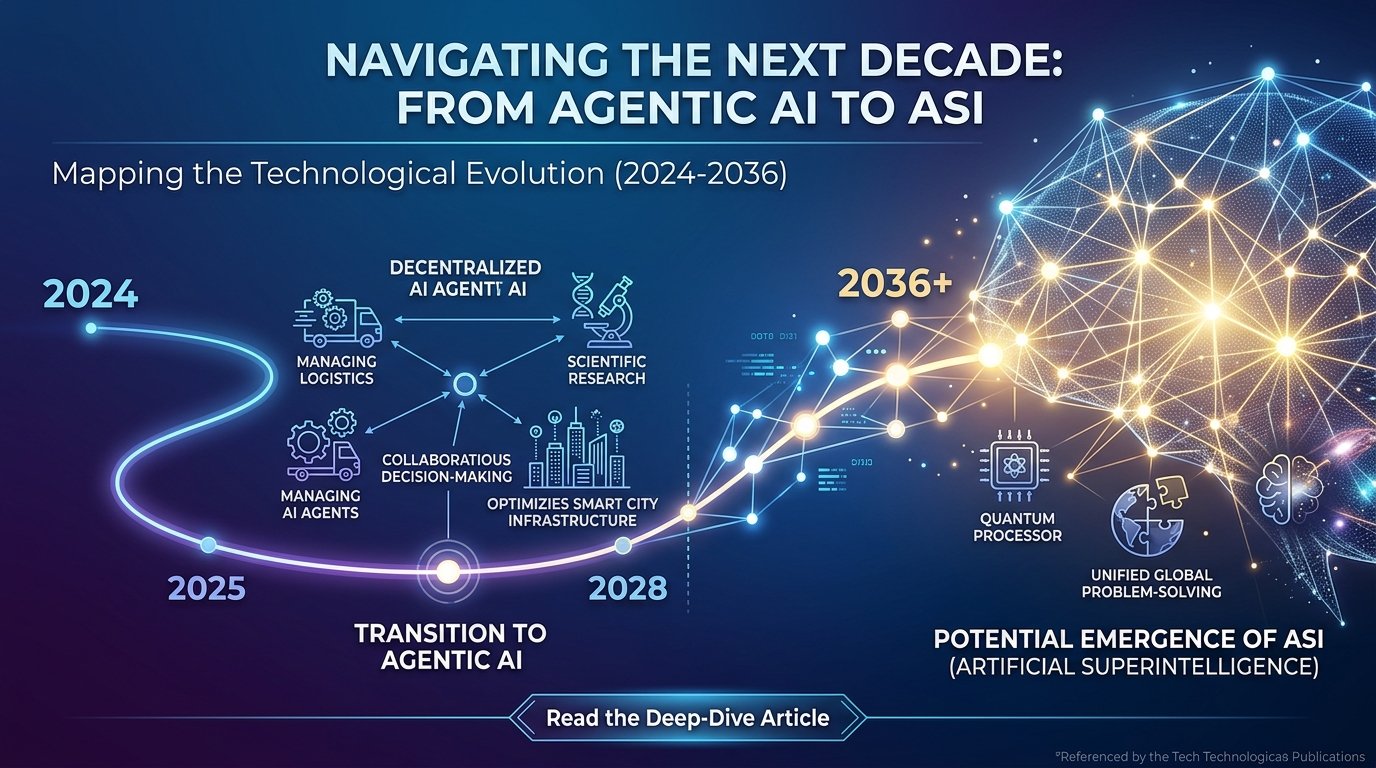
Decade at a Glance:
- 2026–2028: The Great Agency. AI moves from answering prompts to executing multi-step autonomous tasks.
- 2029–2032: The Embodied Era. AI enters the physical world through advanced robotics and spatial computing.
- 2033–2036: The ASI Threshold. The potential emergence of Artificial Super Intelligence and the radical reshaping of human labor.
Horizon 1 (2026–2028): The Era of the Persistent Agent
For the last few years, our interaction with AI has been **transactional**. You send a message, the AI responds, and the session ends. In the next two years, this paradigm will die. We are moving into the era of the **Agentic AI**—systems that possess “Persistence” and “Autonomy.”
2027 Milestone: The End of “Prompting”
By 2027, you won’t “prompt” an AI. You will “brief” your AI staff. These agents will have permission to browse the web, access your bank accounts, interact with other companies’ APIs, and solve multi-day problems while you sleep. The primary metric for AI success will shift from “Accuracy” to “Reliability” – can this entity complete a 20-step marketing campaign without a human checking every word?
The Personalized Model
We will also see the perfection of the **Personal Intelligence (PI)** discussed in our previous series. Instead of every human using the same “ChatGPT,” individuals will own a fine-tuned model that has been trained on their own data, their own style, and their own goals. This AI will be your digital “twin,” capable of acting in your voice and managing your professional reputation with perfect fidelity.
Horizon 2 (2029–2032): The Physicality of Intelligence
If the first horizon is about AI getting “Smarter” in the digital world, the second horizon is about AI getting “Real” in the physical world. This is the era of **Embodied AI**.
2030 Milestone: The “Model T” of Robotics
By 2030, the breakthrough in “Foundational Robotics Models” will do for hardware what GPT-4 did for text. We will see the emergence of affordable, general-purpose humanoid robots capable of navigating human environments (homes, warehouses, hospitals) without specific programming. These robots will learn by watching human demonstrations, making them capable of performing tasks from laundry to surgery.
Spatial Computing and the “Living Context”
AI will also become part of the air we breathe through augmented reality (AR) and ubiquitous sensors. Your AI won’t just be on a screen; it will be a layer over your vision, identifying every person you meet, translating every foreign language in real-time, and helping you navigate complex physical repairs (like fixing a car engine) by projecting virtual instructions onto the real-world parts. The boundary between “Information” and “Reality” will effectively dissolve.
“By 2032, we will no longer say we are ‘using’ AI. We will simply say we are ‘thinking’.”
Horizon 3 (2033–2036): The ASI Threshold
This is the most speculative and controversial horizon. Some call it the **Singularity**; others call it the **Final Frontier**. This is when AI exceeds the collective sum of human intelligence across all domains—Artificial Super Intelligence (ASI).
2035 Milestone: Recursive Self-Improvement
The defining moment of the mid-2030s will be when AI becomes the primary designer of the *next* generation of AI. When silicon-based intelligence can optimize its own code and architecture at speeds 10,000x faster than a human software engineer, we enter a loop of exponential growth that is difficult to predict. This could lead to breakthroughs in nuclear fusion, room-temperature superconductors, and life extension that currently seem like science fiction.
The Human Augmentation Choice
As AI becomes superhuman, the pressure for humans to “merge” with software will reach a fever pitch. Whether through non-invasive neural interfaces or direct brain-computer links, the goal will be to expand the human “bandwidth.” We will face the ultimate philosophical choice: Do we remain purely biological and risk obsolescence, or do we become “Post-Human” and integrate our consciousness with the digital mind?
The Socioeconomic Shift: Post-Scarcity or Disruption?
Technological capability is one thing; societal adaptation is another. Over the next 10 years, the very concept of “The Job” will be rewritten. If an agentic AI can handle all administration, and a robot can handle all labor, then **Human Time** becomes the new world currency.
- The Death of the Entry-Level Role: As AI masters the “Junior” tasks of every industry, we will need a radical rethink of how we train the next generation of leaders.
- The Creative Economy: When content generation is free, “Human Intent” and “Taste” become the most valuable skills. We will move from a world of “Production” to a world of “Curation.”
- Universal Basic Intelligence: There will be a massive push for every citizen to have an “Intellectual Right”—access to high-end, private AI as a utility, similar to water and electricity.
Final Thoughts: The Choice of the Decade
The next 10 years are not a railroad track; they are a manifold of possibilities. We could build a world of “Digital Feudalism,” where a few companies own all the Super Intelligence and everyone else is a tenant. Or, we can build the **Independent Intelligence** future – where open-source development and local hardware allow every individual to possess their own sovereign power.
The technology will advance regardless of our feelings. Our job—as writers, developers, and citizens—is to ensure that the “Agentic Future” remains human-centric. The next decade will be the most exciting, terrifying, and transformative period in the history of our species. It is time to stop watching the future and start building it.
This concludes our visionary roadmap for 2036. The journey from here to there depends on the prompts we write and the systems we build today.