

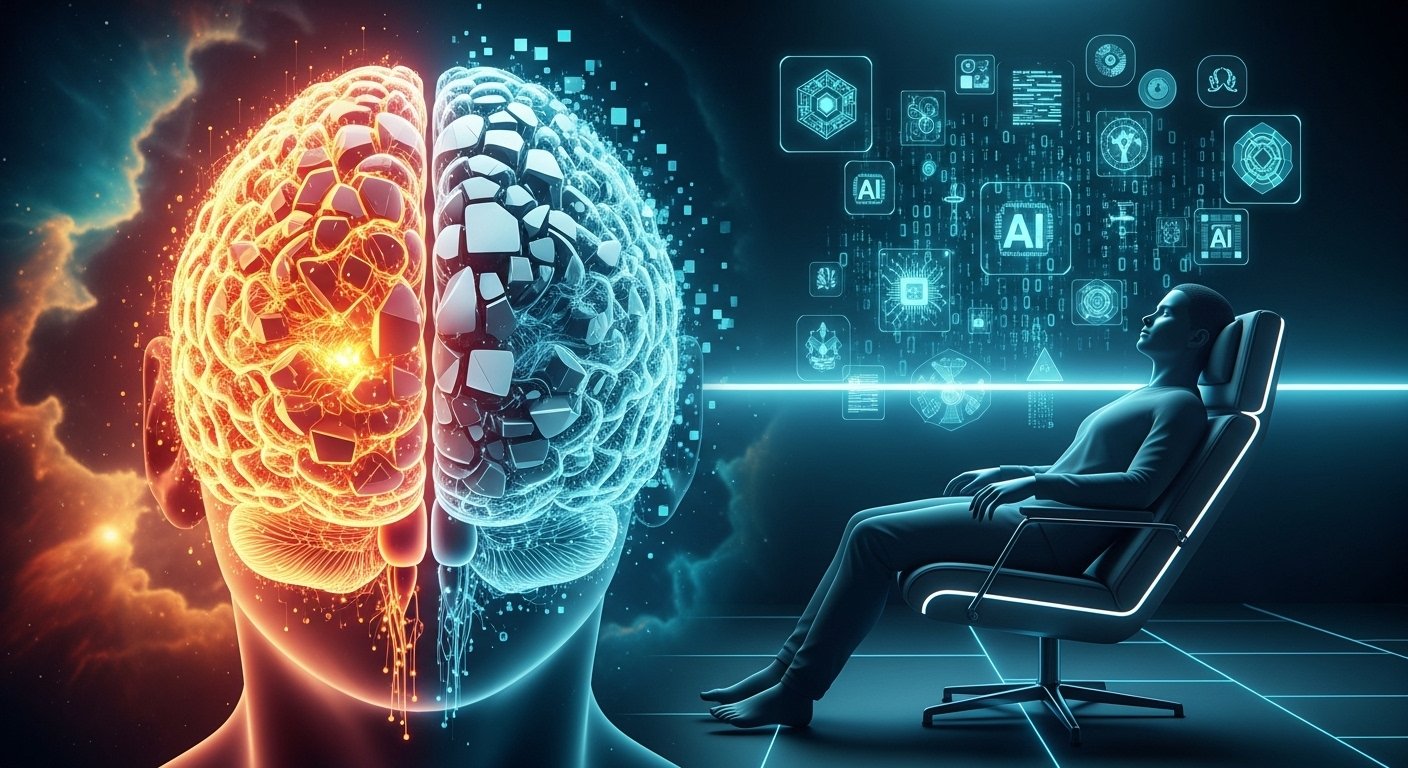
Throughout the entirety of human history, **Effort** has been the primary architect of our anatomy and our intellect. Our ancestors survived because they could physically outrun predators and mentally out-think the seasons. The human body is a machine designed for struggle; our muscles grow when resisted, and our brains sharpen when challenged. We are, quite literally, “built for work.”
But as we move deeper into the 2026–2030 era, we are approaching a world of **Zero Friction**. With the rise of the Agentic AI (as discussed in our previous articles), the need for human effort is being systematically dismantled. AI agents will handle our administration, our research, our logistics, and even our creative output. Humanoid robots will soon handle our laundry, our groceries, and our domestic maintenance.
While this sounds like a paradise of convenience, it poses a terrifying question: **What happens to a biological machine built for struggle when there is nothing left to struggle against?** As AI takes over the “maximum tasks,” we face a crisis of obsolescence—not just in the job market, but in our own cells. This long-form exploration looks at the physical and mental health impacts of an effort-free world and outlines the survival strategy for the next generation of humans.
In this biological and psychological forecast, we will answer:
- The “Comfort Crisis”: Why total efficiency leads to biological decay.
- Cognitive Atrophy: What happens when we stop using our brains for logic?
- The Sedentary Trap: The physical cost of a world run by robots.
- Social Isolation in the Age of Agents: The end of community-driven effort.
- The Human Survival Guide: How to maintain health in a world that requires zero effort.
Section 1: The Bio-Mechanical Decay — Physical Impact
The human body operates on a “Use It or Lose It” principle. This is known as **Biological Economy**. If you don’t use your muscles, your body stops spending energy to maintain them. In a world where AI-driven robots perform all physical tasks—carrying bags, cleaning floors, even driving cars—the average human will have virtually zero daily caloric expenditure related to survival.
1. The Sarcopenia of Convenience
Sarcopenia (muscle wasting) is usually an old-age condition. In the 2030s, we may see it in twenty-year-olds. Without the “micro-efforts” of daily life (walking to a store, lifting a box, reaching for a shelf), human bone density and muscle mass will plummet. We face a future where the human body becomes brittle and weak, reliant on exoskeleton assistance for basic movement.
2. The Metabolic Collapse
Human metabolism is designed for intermittent exertion and recovery. A world of total sedentary comfort disrupts our insulin sensitivity and hormonal balance. When AI-controlled bots bring us everything we need at the touch of a button, we aren’t just getting lazy; we are systemically breaking the chemical pathways that keep us alive.
Section 2: The Cognitive Hollow — Mental Impact
The impact on the mind is even more insidious. Intelligence is like a muscle; it requires **Resistance** to grow. For centuries, humans had to perform complex mental tasks: memorizing routes, calculating budgets, synthesizing information, and navigating social nuances.
WARNING: The “Google Maps” Effect on the Brain
Studies have already shown that when people use GPS for navigation, the “Hippocampus” (the part of the brain responsible for spatial memory) begins to shrink. Now, apply this to everything. If an AI writes your emails, summarizes your books, and makes your decisions, your **Executive Function** will begin to atrophy. We risk a future of “Cognitive Fragility,” where humans are incapable of holding complex thoughts or solving problems without a digital crutch.
The Loss of Critical Thinking
When an AI agent “does the work,” the human only sees the “Result.” We lose the “Middle Path”—the part of the work where we make mistakes, hit walls, and find breakthroughs. It is in that struggle that learning happens. A world without mental effort is a world without learning. We might become the smartest-looking species in history while being, individually, the least intelligent.
Section 3: The Social & Emotional Void
Effort is often communal. We work *with* others to build something. We share the struggle of a project, a household, or a community. When AI agents handle 100% of these tasks, the “Shared Struggle” disappears.
Psychologically, humans find meaning through **Agency**—the feeling that our actions have an impact on the world. If every task is handled by a bot, we lose our sense of impact. This “Crisis of Meaning” is the greatest threat to human mental health in the next decade. It leads to profound depression, anxiety, and a sense of “Ghostly Existence” where we are merely observers of a world being run for us, but not *by* us.
Section 4: The Survival Guide — How to Stay Human
As we realize that AI is taking over the tasks, we must make a conscious, almost “Aggressive” effort to stay biological and sharp. To survive the era of agents, we need to introduce **Intentional Friction**.
1. The “Analog Hour” Requirement
To keep the brain sharp, humans must spend time every day performing a skill that has zero AI assistance. This could be learning a musical instrument, solving complex math on paper, or writing long-form by hand. We must protect the “Neural Pathways of Effort.”
2. Physicality as a Civil Right
Exercise must move from a “luxury” to a survival necessity. In a world of robots, we must treat our bodies like high-performance vintage machines that need to be “Driven” to stay functional. Resistance training and high-intensity movement are the only way to counteract the “Automation Decay.”
3. Mental “Sparring” with AI
Don’t just use AI to get an answer. Use it to **Debate**. Challenge the AI’s logic. Ask it to find flaws in your thinking and find flaws in its. Use the AI as a “weight” to train your logic, not a “fork” to feed you pre-masticated information.
Section 5: Toward a New Philosophy of Work
We are entering the “Post-Toil” era. This is a blessing, but only if we fill the vacuum with **Purpose**. If we use our free time to merely consume digital entertainment, we will decay. If we use our free time to pursue “Higher Effort”—art, philosophy, physical mastery, and human connection—we might become the most evolved version of ourselves.
The choice of the next decade is simple: Do we become “Hollow Humans” served by digital gods, or do we become “Augmented Masters” who use AI to handle the mundane so we can reach the sublime? Survival in the age of AI isn’t about knowing how to code; it’s about knowing how to **Strive** when you don’t have to.
Conclusion: The Soul of Effort
AI can simulate our language, calculate our data, and move our boxes. But AI cannot “Experience the Struggle” for us. The sweat of a hard workout, the headache of a difficult problem, and the satisfaction of a manual craft are the uniquely human experiences that keep our bodies and minds alive.
As the agents take over, the most “Advanced” thing you can do is to remain a “Primal” human. Carry your own bags. Write your own letters. Do your own thinking. In a world of perfect efficiency, **Inefficiency is where the soul lives.**
Protect your agency. Protect your health. Explore our next guide on maintaining mental focus in the age of digital distractions.