
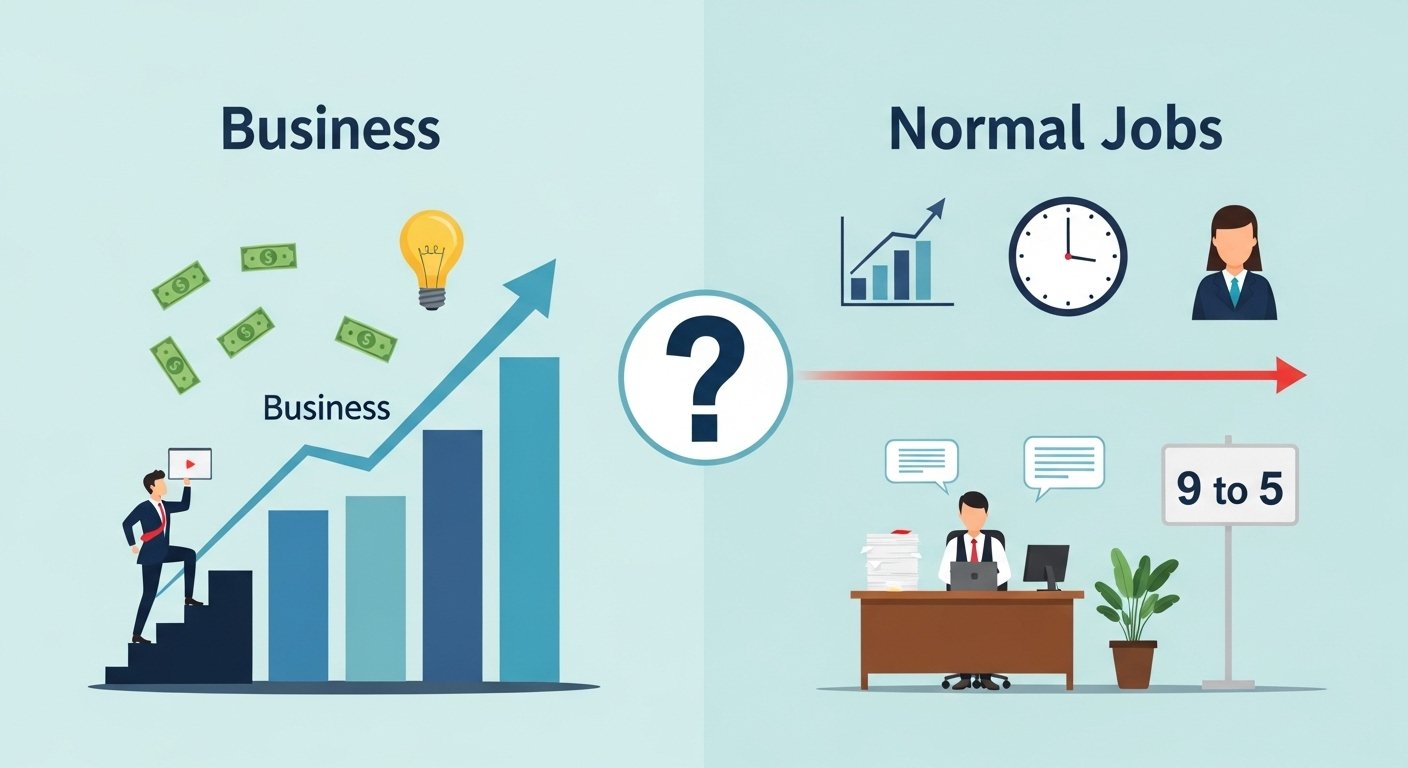
The question echoes through millions of minds every Monday morning: “Should I keep working for someone else, or should I build something of my own?”
Our parents told us to get a good job. Work hard, climb the ladder, retire with a pension. That world no longer exists. Today, we’re witnessing the largest wealth transfer in history—from employees to entrepreneurs.
But here’s the uncomfortable truth: starting a business is risky. Very risky. Most fail. And even successful entrepreneurs often took years before seeing real income. So the question isn’t simply “business vs job.” It’s about timing, preparation, risk tolerance, and honest self-assessment.
In this guide, we’ll explore why entrepreneurship often wins, when it makes sense to quit your job, and how to minimize the risks of the leap.
The Honest Truth: Business doesn’t always win. Many people are happier, wealthier, and more fulfilled staying in well-paying jobs. This guide helps you make an informed decision based on your unique circumstances—not ideology or survivorship bias.
Why Business Often Wins Over Traditional Employment
Let’s start with why entrepreneurship frequently creates more wealth, freedom, and fulfillment than traditional employment.
1. Unlimited Earning Potential
With a job, your income is capped. You can only work so many hours, and your employer decides what those hours are worth. With a business, your earning potential is theoretically unlimited.
| Factor | Traditional Job | Business |
|---|---|---|
| Income cap | Salary + bonus (often $100K-$500K for most) | Unlimited |
| Hourly value | Fixed by employer | You determine your worth |
| Growth ceiling | Promotions, 3-5% raises | 10x, 100x growth possible |
| Passive income | None | Systems generate money while you sleep |
Consider this: The average CEO of a Fortune 500 company earned 351 times more than their median employee in 2024. Even at a small business level, the owner typically earns significantly more than employees doing similar work.
But it’s not just about CEOs. Freelancers, consultants, agency owners, and e-commerce entrepreneurs regularly outearn their corporate counterparts—not because they work more hours, but because they own the upside.
2. Time Freedom and Control
A job trades your time for money—but you only get paid when you’re working. Take a vacation? No pay. Sick day? No pay. Want to attend your child’s school play? Hope your boss is understanding.
Business owners have more flexibility in theory. When you build systems that work without you, you gain freedom. A profitable business can generate income while you’re at the beach, sleeping, or pursuing hobbies.
Real freedom means having options. The business owner can choose to work 80 hours this week or 20. The employee typically cannot.
3. Asset Building and Wealth Creation
When you work a job, you’re building someone else’s asset. The company you work for gets more valuable, its owners get wealthier, and you get a paycheck.
When you build a business, you’re building YOUR asset. A business can:
- Be sold for multiples of annual profit (2x-10x or more)
- Generate passive income indefinitely
- Be passed to your children
- Provide tax advantages unavailable to employees
- Appreciate over time with proper management
The median net worth of a business owner is dramatically higher than that of an employee. Not because owners work harder—but because they own something that generates value.
4. Tax Advantages
Employees pay taxes on their income. Business owners can often legally reduce their tax burden through:
- Business expenses: Write off equipment, travel, meals, and even home office
- Retirement contributions: Much higher limits than traditional employees
- Profit reinvestment: Grow the business pre-tax
- Business structure: LLC, S-Corp, and other structures offer tax benefits
- Depreciation: Write off equipment over time
It’s not about cheating the system—it’s about using the tax code as written. Business owners legally pay less in taxes than employees earning the same amount.
5. Personal Growth and Fulfillment
For many entrepreneurs, the money is secondary. Building something meaningful—solving problems, creating jobs, bringing ideas to life—provides fulfillment that a paycheck cannot.
When you work for yourself, every problem is your responsibility, but every solution is also your victory. That ownership drives growth in ways traditional employment rarely matches.
Why Traditional Jobs Still Have Advantages
Before we romanticize entrepreneurship, let’s be honest: jobs aren’t inherently bad. For many people, they remain the better choice.
1. Guaranteed Income and Stability
No matter what happens to the economy, your industry, or your customers, you receive a paycheck. This stability is valuable—perhaps invaluable if you have dependents, debt, or health concerns.
Business owners face feast or famine. Some months bring windfalls; others bring near-zero income. If that unpredictability causes stress, a stable job may be the healthier choice.
2. Benefits and Perks
Health insurance alone can cost $10,000-$30,000 annually for a family in the US. Add in retirement matching, paid time off, parental leave, and other benefits, and the “total compensation” of a good job far exceeds the visible salary.
- Health insurance: Often 80-100% paid by employer
- Retirement matching: Free money (3-6% of salary)
- Paid vacation: 2-4+ weeks annually
- Job security: Cannot be fired instantly (typically)
3. Lower Stress and Mental Load
Entrepreneurs carry the weight of everything. When a business fails, it’s not just financial—it’s personal. The stress of payroll, customer problems, and market uncertainty is real.
Many entrepreneurs report that their stress levels actually decreased after leaving corporate jobs—not increased. But that’s not universal. Know your stress tolerance honestly.
4. Clear Boundaries
Employees typically work defined hours. When you leave the office, you’re off duty. Entrepreneurs often find work creeping into evenings, weekends, and vacations—especially early on.
Until your business runs without you, you’re always somewhat “on.” That mental load accumulates.
5. No Capital Required
Starting a business costs money—sometimes a lot. Employees don’t need capital. They simply show up and work.
If you don’t have savings, insurance, or a financial cushion, starting a business becomes exponentially riskier. The job provides the foundation to eventually build safely.
Critical Point: For many people—perhaps most people—a good job is genuinely the better choice. It depends entirely on your individual circumstances, goals, risk tolerance, and responsibilities. There’s no shame in choosing employment.
Should You Quit Your Job to Start a Business?
Now for the real question. Here’s a practical framework for making the decision.
The Statistics You Must Know
Let’s start with uncomfortable data:
| Timeframe | Business Survival Rate |
|---|---|
| Year 1 | ~80% survive |
| Year 3 | ~50% survive |
| Year 5 | ~35% survive |
| Year 10 | ~20% survive |
But these statistics are misleading:
- They include all businesses: From a person selling crafts on Etsy to a tech startup
- Survival isn’t success: Many “surviving” businesses barely pay their owners minimum wage
- Selection bias: People who prepare properly have much higher success rates
- Different industries: Service businesses have much higher survival than retail or restaurants
The honest truth: Most businesses fail. But most businesses also fail because their owners weren’t prepared, didn’t validate ideas, or gave up too early. Proper preparation dramatically improves odds.
When Quitting Makes Sense
- You have 12+ months of expenses saved: Not 3 months. Twelve. Business revenue takes time.
- You’ve validated your business idea: You have paying customers or strong evidence of demand
- You have a support system: Family support, professional network, or both
- Your job is draining you: Not just “I don’t like Mondays”—actual harm to your mental or physical health
- You have a specific plan: Not “I’ll figure it out”—a real strategy with milestones
- You’re prepared for the worst: Can you survive on unemployment? Moving back home? Taking a lower-paying job?
When Staying Makes More Sense
- You have no savings: Build a runway first
- You have high fixed expenses: Mortgage, children, medical costs
- You haven’t validated your idea: Keep your job while testing
- You’re in a high-paying field: Tech, finance, or medical careers often outearn entrepreneurship
- You have financial dependents: Children, aging parents, spouse without income
- You haven’t developed business skills: Marketing, sales, finance, operations
How to Minimize the Risk of Starting a Business
You don’t have to quit your job to start a business. In fact, you probably shouldn’t—until you’ve reduced the risk significantly.
Strategy 1: The Side Business First
The safest approach: Build your business while employed until it generates enough income to replace your salary.
- Start evenings and weekends: Dedicate 10-20 hours weekly to your business
- Set income milestones: Replace 25%, then 50%, then 100% of income before quitting
- Live on less: Reduce expenses to make the transition easier
- Validate before scaling: Prove the business works before going full-time
Strategy 2: The Career Capital Approach
Use your job to build skills, network, and capital for eventual entrepreneurship.
- Develop expertise: Become the best in your field
- Build network: Connect with potential customers, partners, and employees
- Save aggressively: Maximize your runway
- Learn business skills: Take courses in marketing, sales, finance
- Start small projects: Side clients to validate demand
Strategy 3: The Parallel Path
Build assets that generate income alongside your job—making the eventual transition seamless.
- Index funds: Dividends provide passive income
- Rental property: Real estate generates monthly cash flow
- Digital products: Books, courses, templates create royalties
- Affiliate income: Automated commissions from content
By the time you quit, you might have multiple income streams that supplement your transition.
Strategy 4: The Controlled Leap
If you must quit before full validation, minimize damage with:
- Negotiate a leave of absence: Some employers allow this
- Keep health insurance: COBRA or spouse’s plan
- Set a deadline: “If not profitable by X date, I return to job market”
- Have a backup plan: Know what you’ll do if it doesn’t work
Business vs Job: Detailed Analysis
Financial Comparison
| Factor | Job ($100K salary) | Successful Business |
|---|---|---|
| Gross income over 10 years | $1,000,000 | $500K-$5,000,000+ |
| Job security | Moderate | Low initially, high eventually |
| Benefits value | $20,000-$40,000/year | Self-funded required |
| Tax efficiency | Standard | Potentially much higher |
| Asset building | 401K, small | Business equity, large |
| Upfront investment | None | $0-$100,000+ |
| Risk | Low-Medium | High initially |
Lifestyle Comparison
| Aspect | Job | Business |
|---|---|---|
| Hours | Fixed (usually 40-50) | Variable (often more early on) |
| Vacation | Paid (2-4+ weeks) | Unpaid, requires planning |
| Location | Often office | Often flexible |
| Stress type | Bureaucracy, politics | Responsibility, uncertainty |
| Growth | Limited by organization | Unlimited (but self-driven) |
| Autonomy | Limited | Complete |
Who Thrives in Business?
- Comfortable with uncertainty: Not needing immediate feedback or validation
- Self-motivated: No boss means you must drive yourself
- Comfortable selling: Every business requires marketing and sales
- Resilient: Failure is common; bouncing back is essential
- Systems thinker: Building processes and delegating
- Tolerant of risk: Financial and psychological
Who Thrives in Employment?
- Values stability: Predictable income and schedule
- Specialists prefer: Deep expertise in one area vs. generalist
- Risk-averse: Discomfort with financial uncertainty
- Prefers team environment: Collaboration over solo work
- Values benefits: Health insurance, retirement, PTO matter significantly
- Wants clear expectations: Prefers defined role and responsibilities
Real Stories: The Spectrum of Outcomes
Let’s be honest about the range of outcomes:
Success Story: The Gradual Builder
Sarah worked as a software engineer earning $150K/year. For two years, she built her SaaS product on evenings and weekends. When it hit $8K/month MRR, she quit. Her business now generates $120K/year, and she works 30 hours weekly.
Key factors: Stable income funded development, she validated before quitting, lived below her means during growth.
Success Story: The Leap Taker
Marcus was miserable in his marketing job. He had $30K saved and no dependents. He quit, launched a consulting business, and within 18 months was earning more than his old salary. Three years later, he employs four people.
Key factors: Low expenses, high risk tolerance, strong network, quick adaptation.
Cautionary Tale: The Premature Leap
Jennifer quit her job with $10K savings and a “great idea.” Eighteen months later, she was broke, had burned through savings, and had to take a lower-paying job than before. The idea was sound, but she ran out of money before finding product-market fit.
Key factors: Insufficient runway, no validation, high fixed expenses.
Cautionary Tale: The Misery Story
David hated his corporate job but didn’t actually want to run a business—he wanted to be an employee at a company he enjoyed. He quit, started a business, and realized he didn’t enjoy entrepreneurship either. He returned to employment, still unfulfilled.
Key factors: Misdiagnosed the problem. Entrepreneurship wasn’t the answer.
Your Decision Framework
Here’s a practical test to help you decide:
The Readiness Quiz
- Financial readiness (critical): Do you have 12+ months of living expenses saved?
- Yes → Continue to question 2
- No → Stay employed, build savings first
- Idea validation (critical): Do you have paying customers or strong proof of demand?
- Yes → Continue to question 3
- No → Keep your job, validate first
- Skill readiness (important): Do you have the skills to market, sell, and deliver your product/service?
- Yes → Continue to question 4
- No → Stay employed, develop skills
- Support system (important): Does your family support this? Do you have professional backup?
- Yes → Continue to question 5
- No → Build support first
- Risk tolerance (important): Can you honestly handle potential failure, financial loss, and uncertainty?
- Yes → You may be ready
- No → Consider side business approach
The Math Test
Calculate your “Go Number”—how much your business needs to earn monthly to replace your job:
Monthly Job Income: $X
Plus Benefits Value: $Y (insurance, retirement match, etc.)
Total Monthly Need: $Z

Business revenue needed: $Z per month
At 50% profit margin: $Z x 2 = Your break-even target
If selling services at $100/hr: $Z x 2 / 100 = Hours needed weekly
If your business can realistically reach this target within your runway, the math supports the leap.
The Regret Test
Ask yourself:
- If I stay at my job and never try entrepreneurship, will I regret it?
- If I quit and fail, will I regret it?
- Which regret is heavier?
Most people who’ve tried entrepreneurship—even failed entrepreneurs—don’t regret the attempt. They regret NOT trying more than they regret the failure itself.
The Hybrid Approach: Best of Both Worlds
Here’s what most successful entrepreneurs actually did:
The “Millionaire Employee” Path
Many millionaires didn’t start businesses—they built careers that provided high income, equity, and stability.
- Tech employees: FAANG engineers earning $300K-$1M+ annually
- Sales professionals: Commission-based roles with uncapped earnings
- Executives: C-suite positions with equity compensation
- Specialists: Doctors, lawyers, consultants with premium rates
If your job can make you wealthy, it’s often smarter than entrepreneurship.
The “Entrepreneur Plus” Path
Start a business alongside employment, then choose:
- If the business succeeds beyond the job: Quit
- If the job pays more: Keep the business as a hobby/income supplement
- If the job provides needed benefits: Keep both until transition
The “Bridge Business” Path
Build a business that bridges you from employment to full-time entrepreneurship:
- Phase 1: Build side business to replace 50% of income
- Phase 2: Negotiate reduced hours or remote work at your job
- Phase 3: Business grows, job reduces
- Phase 4: Full-time entrepreneurship when business fully replaces income
The Best Path: For most people, the optimal path is: Keep your job, build a business on the side, validate it, then quit when the business proves itself. This isn’t cowardly—it’s smart risk management.
Your Action Steps
If You Decide to Stay Employed
- Maximize your income: Negotiate raises, switch jobs for higher pay
- Reduce expenses: Live below your means to build savings
- Develop skills: Marketing, sales, finance, operations
- Start a side project: Validate ideas without quitting
- Build assets: Invest in index funds, real estate
If You Decide to Build a Side Business
- Pick one idea: Don’t try multiple; focus
- Validate quickly: Talk to potential customers before building
- Set a schedule: 10-20 hours weekly, consistent
- Track progress: Monthly revenue goals
- Celebrate milestones: First customer, first $1K, first $10K
If You Decide to Quit
- Build runway: 12+ months expenses minimum
- Negotiate exit: Leave on good terms, protect reputation
- Set a deadline: If not profitable by X, what then?
- Have a backup plan: Know your options if it doesn’t work
- Go all in: Half-measures rarely work
Common Mistakes to Avoid
- Quitting before validation: Never assume customers will come
- Underestimating expenses: Business costs more than expected
- Ignoring benefits: Health insurance alone is expensive
- Burning bridges: Leave jobs professionally
- Perfectionism: Launch before you’re “ready”
- Giving up too early: Most businesses take 2-3 years to become profitable
- Misdiagnosing motivation: Is this freedom-seeking or escapism?
- No runway: Running out of money is the #1 reason businesses fail
The #1 Mistake: Quitting your job because you hate it, rather than quitting to pursue something you’re passionate about. If your only reason for leaving is escape from misery, you’ll likely bring that misery into entrepreneurship.
The Decision Is Yours
Business doesn’t always win over jobs. Jobs don’t always win over business. The right choice depends on your circumstances, goals, risk tolerance, and responsibilities.
What we can say with confidence:
- Entrepreneurship creates more wealth potential—but requires more risk and effort
- Employment provides more stability—but caps your upside
- The safest path is usually gradual—build while employed, transition when ready
- Your job can fund your business—use it as a tool, not an obstacle
Neither path is inherently superior. The best path is the one that aligns with your goals, circumstances, and risk tolerance—then executing that path with full commitment.
Your Challenge: Don’t make this decision based on someone else’s story. Don’t let social media highlight reels influence you. Don’t run from something—run toward something. Make the decision that serves your unique life, then commit fully to making it work.
The choice between business and employment isn’t binary forever. Many entrepreneurs start businesses after successful careers. Many employees start side businesses that become their primary income. Your path will be unique.
Whatever you decide: decide thoughtfully, commit fully, and build the life you actually want—not the one someone else told you to want.
Related Guides: Continue your journey with our Zero Investment Business Ideas, Auto Money Generator Business Models, Side Hustles Guide, and Digital Skills for Entrepreneurs.
Additional Resources:
- McKinsey & Company – Business research and reports
- Gartner – Industry analysis
- Small Business Administration – US government small business resources
- SCORE – Mentorship for small businesses