
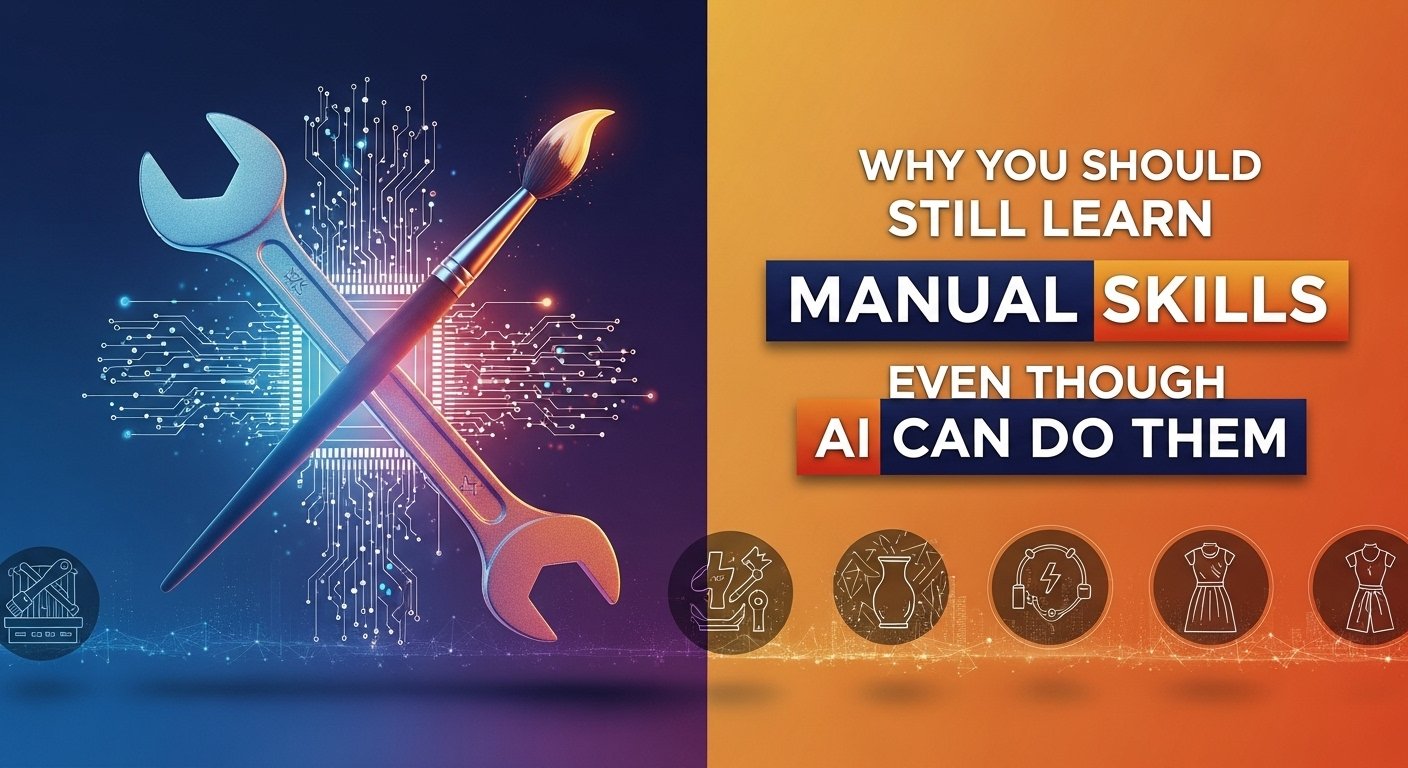
AI can now write code, compose music, generate art, and diagnose diseases. Robots can assemble cars, deliver packages, and even pour coffee. So why on earth should you spend your weekends learning to weld, cook a proper meal from scratch, or fix a leaky faucet?
The answer might surprise you: because these skills make you more human, not less.
The Paradox: As AI takes over more cognitive tasks, the skills that remain uniquely human—physical craft, tactile intuition, problem-solving with your hands—become more valuable, not less. Here’s why learning manual skills is one of the smartest investments you can make in 2026 and beyond.
1. The Cognitive Benefits Are Extraordinary
Your brain is not designed to stare at screens all day. It’s designed to interact with the physical world—to feel the grain of wood, sense the resistance of dough, hear when an engine is running right. When you work with your hands, you engage neural pathways that screens simply cannot activate.
How Manual Work Changes Your Brain
- Activates the cerebellum: The “little brain” that coordinates movement and learning gets engaged in ways that seated learning cannot match.
- Builds myelin: Repetitive physical practice creates myelin sheaths around nerve fibers, literally making your brain faster and more efficient.
- Reduces cortisol: Studies consistently show that craftspeople and makers report lower stress levels than knowledge workers.
- Improves focus: The immediate feedback loop of physical work—heat the iron too much and it spoils—teaches a kind of present-moment awareness that meditation apps charge $60/year to teach.
Research Insight: A 2023 study from the University of Oxford found that people who regularly engage in manual crafts show 23% better problem-solving skills in unrelated cognitive tasks. The brain doesn’t compartmentalize—it gets generally sharper from focused physical work.
The Tactile Feedback Loop
When you learn to cook, you develop an intuition that no recipe can teach. You learn to feel when dough is properly kneaded, when a steak is perfectly seared, when sauce has reached the right consistency. This tactile intelligence—what chefs call ” Mise en place” of the senses—is something AI cannot replicate because it exists in the space between objective measurement and subjective experience.
Similarly, a skilled woodworker can look at a piece of timber and know, without measuring, whether it’s too wet to work, whether the grain will hold a screw, whether it’s worth saving or should become firewood. This knowledge comes from thousands of hours of interaction with materials. It’s embodied, not uploaded.
2. Practical Independence: Save Thousands Yearly
Let’s talk about money. Not passion, not fulfillment—cold, hard cash.
The average American spends $1,500-$3,000 per year on services they could do themselves with basic skills. A plumber charges $75-$150 per hour. An electrician, $50-$125. A mechanic, $60-$120. A tailor, $15-$50 per item. These costs add up fast.
| Skill | Average Service Cost | What You Could Save Yearly |
|---|---|---|
| Basic Plumbing Repairs | $150-$500 per call | $500-$2,000 |
| Electrical Basics (outlets, switches) | $100-$300 per job | $300-$1,200 |
| Oil Changes & Basic Auto | $30-$100 per service | $200-$600 |
| Home Painting | $2,000-$5,000 per room | $1,500-$4,000 |
| Cooking From Scratch | $15-$25 per meal (vs eating out) | $3,000-$6,000 |
| Basic Sewing/Alterations | $20-$100 per item | $200-$500 |
| Gardening/Landscaping | $50-$150 per visit | $500-$2,000 |
Total Potential Annual Savings: $6,000-$16,000
And that’s assuming you only handle basic tasks. Intermediate skills—like tiling a bathroom, rebuilding an engine, or refinishing furniture—can save tens of thousands when you consider home improvement projects.
The $150,000 Secret: If you save just $500/month by doing things yourself instead of hiring help, that’s $6,000/year. Invested modestly (8% annual return), that becomes over $150,000 in 15 years. Learning to change your own oil isn’t just about the $50 you save today—it’s about the $150,000 you’re building for tomorrow.
3. Career Advantages in Unexpected Ways
Here’s what most career advisors miss: employers increasingly value candidates who have tangible skills outside their job description.
The Maker Advantage
When two candidates have similar technical credentials, the one who can say “I built my own computer, I restored a classic motorcycle, I make furniture in my garage” stands out. Why?
- Problem-solving credibility: You have tangible proof you can complete difficult projects from start to finish.
- Resourcefulness: Makers figure things out. They don’t give up when the manual doesn’t apply.
- Attention to detail: A perfectly sanded edge or a properly soldered joint shows you care about quality.
- Self-reliance: Companies love employees who don’t need hand-holding for every minor issue.
Entrepreneurial Opportunities
AI can write code, but it can’t install your gutters. AI can design logos, but it can’t rebuild your transmission. In an AI-saturated market, the skills that differentiate you are often physical, local, and irreplaceable.
| Traditional Career Track | Skills-Based Alternative | Income Potential |
|---|---|---|
| Marketing Manager | Custom Sign Making | $50K-$150K+ (solo) |
| Software Developer | Custom Electronics/IoT | $60K-$200K+ |
| Graphic Designer | Custom Printing/T-shirt Biz | $40K-$120K+ |
| Accountant | Tax Prep + Bookkeeping | $45K-$100K+ |
| Teacher | Trade Skills Instructor | $50K-$90K+ |
| Corporate Trainer | Culinary Instructor | $40K-$80K+ |
The gig economy and platforms like Thumbtack, TaskRabbit, and even Facebook Marketplace have created unprecedented demand for skilled local service providers. A good handyman in a major city can earn $80K-$150K annually. A skilled welder, $60K-$120K. A culinary entrepreneur, $50K-$200K.
The Hybrid Professional: The most valuable workers in 2026 are often hybrid professionals—someone who can use AI tools AND build with their hands. A web developer who can also do basic electrical work. A marketing professional who makes their own promotional materials. An engineer who welds their own prototypes. These combinations command premium rates.
4. Mental Health and Meaning in an AI World
Here’s the uncomfortable truth about AI: it can generate endless content, but it cannot generate meaning. Meaning comes from struggle, from effort, from creating something that you made with your own hands and your own sweat.
The Satisfaction Gap
Have you ever noticed that you feel better after cleaning your garage than after binge-watching a Netflix series? Even though the series might have been entertaining, the physical accomplishment of organizing, lifting, and disposing creates a different kind of satisfaction—one that sticks with you.
Psychologists call this “eudaimonic well-being” versus “hedonic pleasure.” AI-generated content provides the latter. Building something with your hands provides the former. And research consistently shows that eudaimonic well-being is what predicts life satisfaction, not hedonic pleasure.
The Flow State: Manual work consistently induces flow—the state of complete absorption in an activity where time disappears and you’re performing at your peak. Mihaly Csikszentmihalyi, who spent decades studying flow, noted that people most commonly experience it during crafts, music, sports, and other hands-on activities. Not during scrolling. Not during content consumption.
Against the Abstraction Trap
We live in an increasingly abstract world. Work happens in spreadsheets. Communication happens in text. Even relationships happen through screens. This abstraction is linked to rising rates of depression, anxiety, and loneliness.
Manual skills anchor you to the physical world. They remind you that you’re a body, not just a mind. They create tangible outputs you can point to and say “I made that.” They connect you to centuries of human tradition—from your grandfather’s carpentry to ancient pottery techniques.
- Grounding effect: Working with physical materials grounds you in the present moment.
- Identity anchor: “I’m a woodworker” is a more stable identity than “I’m a content creator.”
- Social connection: Trades communities are often tighter than office cultures.
- Legacy creation: Physical objects outlast digital content. Your great-grandchildren might treasure a table you built.
5. AI and Manual Skills: Collaboration, Not Competition
Here’s a reframing that changes everything: AI doesn’t make manual skills obsolete. AI makes manual skills more powerful.
The Augmentation Model
Consider how AI tools are transforming skilled trades:
- CNC machines + craftspeople: CNC handles repetitive cutting; craftspeople handle design, finishing, and quality control.
- 3D printing + engineers: Rapid prototyping with 3D printers; engineers provide the design expertise and material knowledge.
- Recipe apps + cooks: Apps suggest combinations; cooks provide technique, palate, and presentation.
- Diagnostic tools + mechanics: OBD scanners identify problems; mechanics provide the skill to fix them.
- Design software + builders: CAD software designs; skilled tradespeople build to spec.
In every case, AI handles the routine or computational aspects while humans provide the judgment, creativity, and dexterity that machines cannot match.
The Master Craftsperson of 2026: Tomorrow’s master craftsperson isn’t fighting AI—they’re collaborating with it. They use AI for design iteration, material sourcing, cost estimation, and client communication. But they still feel whether the wood is right, see when the joint needs another pass, and know when the finish is perfect. AI amplifies their skill; it doesn’t replace it.
Skills AI Cannot Replace
| Skill Category | Why AI Struggles | Examples |
|---|---|---|
| Fine Motor Dexterity | Robots still lag behind human hands for delicate work | Watchmaking, surgery, string instrument playing |
| Physical Intuition | Can’t feel tension, balance, or material state | Blacksmithing, ceramics, culinary arts |
| Adaptive Problem-Solving | Struggles when the situation doesn’t match training data | Home repairs, custom fabrication, improvisation |
| Client/Social Interaction | Services require human presence and trust | HVAC technician, barber, personal trainer |
| Safety-Critical Work | Liability and real-time judgment requirements | Electrical work, structural engineering, driving |
6. Getting Started: Which Skills Should You Learn?
Not all skills are equal for all people. Here’s a framework for deciding where to invest your learning energy:
The Practicality Matrix
| Factor | High Value | Lower Value |
|---|---|---|
| Frequency of need | Daily/weekly tasks | Once-in-a-lifetime projects |
| Cost of hiring | $100+/hour professionals | $20-30/hour tasks |
| Safety margin | Low-risk applications | High-risk (structural, electrical) |
| Learning curve | Masterable in 20-100 hours | Requires years of apprenticeship |
| Tool investment | $100-$1,000 starter kits | $10,000+ professional setup |
Recommended Starting Skills (By Category)
High-ROI Skills to Learn in 2026:
Home Maintenance (Start Here):
- Basic plumbing (fixing leaks, replacing fixtures)
- Electrical basics (outlets, switches, lighting)
- Painting and drywall repair
- Appliance troubleshooting and repair
Food & Cooking:
- knife skills and food preparation
- Cooking fundamentals (stocks, sauces, proteins)
- Baking basics (bread, pastries)
- Food preservation (canning, fermenting)
Crafts & Making:
- Basic woodworking (shelving, simple furniture)
- Sewing and alterations
- Leather working
- 3D printing and modeling
Transportation:
- Basic auto maintenance (oil, brakes, tires)
- Bicycle repair
- Small engine repair
Learning Resources by Budget
| Budget | Resources | Skills to Start |
|---|---|---|
| Free ($0) | YouTube, library books, community workshops | Cooking, basic repairs, gardening |
| Low ($50-$200) | Online courses (Skillshare, Udemy), tool starter kits | Woodworking, sewing, electronics |
| Medium ($200-$500) | In-person classes (community college, maker spaces) | Welding, automotive, plumbing basics |
| High ($500+) | Professional certifications, trade school courses | HVAC, electrical, specialized trades |
7. Addressing the Counterarguments
You’ve probably heard these objections. Let’s address them directly:
“AI will replace plumbers and electricians too”
Perhaps eventually. But consider: we were told robots would replace factory workers decades ago. Today, skilled tradespeople are in historic shortage, commanding premium wages. Physical work in variable environments (homes, construction sites) is incredibly difficult to automate. The Boston Dynamics videos look impressive; they don’t show a robot diagnosing why your water heater is making that strange noise.
“I don’t have time to learn skills”
You have 2-3 hours of daily screen time you could reallocate. You have weekends. You have lunch breaks. Learning a skill doesn’t require quitting your job—it requires 2-4 hours per week of focused practice. In one year, that’s 100-200 hours. Enough to become competent at most practical skills.
“I’m not mechanically inclined”
Nobody is born mechanically inclined. It’s a learned skillset. The “I’m just not good with my hands” mentality is a self-fulfilling prophecy. Motor skills develop with practice. Start with simple tasks, build confidence, progress to complex ones. Everyone who is now skilled started as a beginner.
“Hiring professionals supports the economy”
True! And you should hire professionals for complex, dangerous, or specialized work. But there’s a difference between hiring an expert for a major project and calling a plumber because your kid dropped a toy in the toilet. Basic competence doesn’t eliminate professional services—it reduces unnecessary calls and helps you better communicate with the professionals you do hire.
The Safety Caveat: Know your limits. Electrical work beyond changing outlets, structural modifications, and complex plumbing should be left to licensed professionals. The goal is competence in routine maintenance and basic repairs, not dangerous DIY that creates bigger problems.
8. The Practice Framework: Building Real Competence
Learning manual skills requires a different approach than learning software or theory:
The Deliberate Practice Model
- Start with safety: Understand the risks before you touch anything. Watch multiple videos on safety procedures. Buy proper protective equipment.
- Learn the fundamentals: Don’t jump to impressive projects. Master the basics—how to hold a tool, how to make a straight cut, how to measure accurately. The basics are 80% of quality.
- Copy before you create: Follow existing plans exactly before improvising. A recipe exactly as written. A project plan exactly as designed. Deviation comes after you understand why the plan works.
- Embrace failure: Your first projects will be ugly. Your first welds will be garbage. Your first meals will be mediocre. This is not failure—it’s tuition. Each mistake teaches you something no video can.
- Seek feedback: Show your work to people with more experience. Take a class. Join a community. External feedback accelerates learning faster than solo practice.
- Build incrementally: Each project should stretch you slightly beyond your current capability. Not so much that you fail completely, but enough that you have to figure something new out.
Skill Tracking: The Competence Ladder
| Level | Hours Invested | What You Can Do |
|---|---|---|
| Novice | 0-20 hours | Simple tasks with supervision, following tutorials |
| Beginner | 20-50 hours | Basic projects independently, recognize common problems |
| Competent | 50-150 hours | Handle most routine tasks, troubleshoot independently |
| Skilled | 150-500 hours | Complex projects, mentor others, professional-quality work |
| Expert | 500+ hours | Master-level work, innovation, teaching, business capability |
Conclusion: The Human Edge
AI is remarkable. It can do things that would have seemed like magic a decade ago. But here’s what it cannot do:
- It cannot feel the satisfaction of building something with your own hands.
- It cannot save you $500 when your sink starts leaking at 10 PM.
- It cannot look you in the eye and say “I made this.”
- It cannot connect you to centuries of human tradition and craft.
- It cannot give you the mental clarity that comes from focused physical work.
The Bottom Line: AI and manual skills are not competitors—they’re complements. The person who masters both is exponentially more capable than someone who only knows either. In a world where AI handles the routine, the human touch becomes the differentiator.
So yes, learn to code. Learn to use AI tools. But also learn to cook a proper meal, fix a leaky faucet, build a shelf, sew on a button, and change your own oil. These aren’t obsolete skills for a bygone era. They’re essential skills for becoming a complete, capable, and fulfilled human being.
The future belongs to the hybrid professional—someone who thinks with AI and acts with their hands. Be that person.
Related Articles
- The Complete Robotics Sensors Guide 2026
- Electronic Circuit Components: Complete Guide
- Best Robotics Kits for Beginners 2026
- Understanding Computer Hardware: ICs, Pins, and Registers