

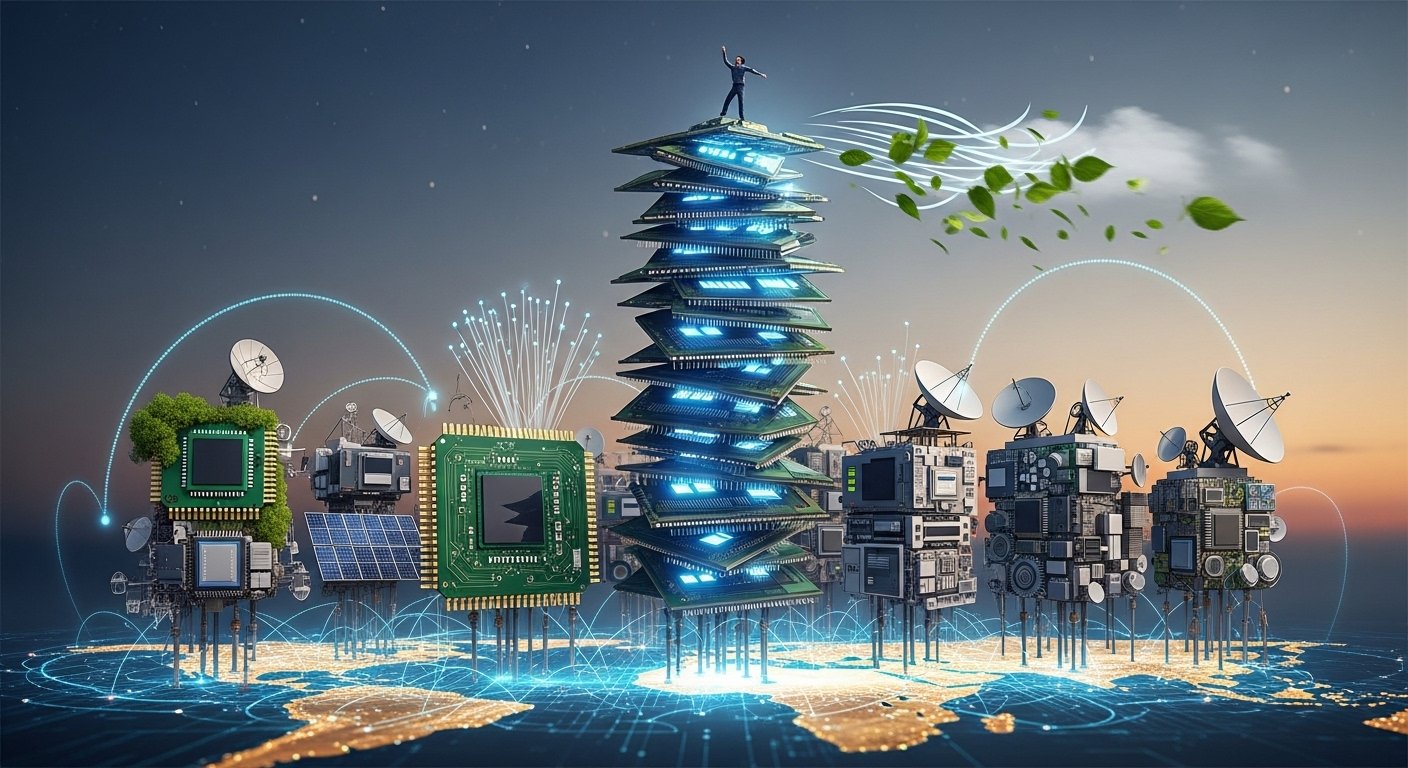
Imagine waking up tomorrow to discover that your country’s banks have stopped working. Not because of a technical glitch, but because a foreign power flipped a switch. Your savings exist only as numbers in a database you don’t control. Your supply chains freeze because the software that runs them has been remotely disabled. The supermarket shelves stay empty because the logistics network depends on infrastructure owned by your enemies.
This isn’t a dystopian fantasy. It’s a strategic vulnerability that nation-states are increasingly weaponizing. And most countries are dangerously unprepared.
The Central Thesis: When nations concentrate critical infrastructure, financial systems, and communication networks into a small number of technologies—or worse, depend on adversarial nations for these technologies—they create existential vulnerabilities. The 21st century’s most powerful weapons may not be missiles and tanks, but the kill switch to your digital economy.
1. The New Face of Warfare: Digital Strangulation
For millennia, wars were fought with soldiers, weapons, and territory. The goal was physical conquest. But the nature of warfare has fundamentally shifted. Today’s most devastating attacks can be launched from a keyboard, leave no casualties, and disable an entire economy without firing a single bullet.
The Shift from Kinetic to Digital
Modern warfare increasingly targets infrastructure rather than armies. The most vulnerable targets aren’t military installations—they’re the civilian systems that keep a nation functioning:
- Financial systems: Banks, stock exchanges, payment networks
- Energy infrastructure: Power grids, oil pipelines, nuclear facilities
- Communication networks: Internet backbone, cellular towers, satellites
- Supply chains: Ports, logistics software, inventory systems
- Government services: Databases, authentication systems, records
When a nation depends on foreign technology for any of these systems, it creates what military strategists call a “single point of failure”—one vulnerability that, if exploited, collapses the entire system.
Real-World Precedent: When Russia invaded Ukraine in 2022, one of the first actions was targeting Ukrainian financial systems with the WhisperGate malware. While Ukraine’s rapid response minimized damage, the attack demonstrated that financial infrastructure is now a primary military target.
The Kill Switch Reality
Consider what a “kill switch” attack could accomplish:
| Technology Dependency | What Could Be Disabled | Time to Catastrophe | Recovery Difficulty |
|---|---|---|---|
| GPS Satellites (US-controlled) | All navigation, shipping, military targeting | Instant | Days to weeks |
| SWIFT Banking Network | International financial transactions | Instant | Days to months |
| Cloud Services (AWS, Azure, GCP) | Banks, hospitals, government services | Hours | Weeks to months |
| Semiconductor Supply Chains | All electronics, vehicles, defense systems | Months | Years |
| Undersea Internet Cables | All international communications | Hours | Weeks |
Each of these represents a dependency that a hostile nation could weaponize. And yet, most countries have only strengthened these dependencies over the past decade.
2. Digital Currency: The Ultimate Kill Switch
Few technological developments represent a greater strategic vulnerability than the move toward digital, centralized currencies—particularly Central Bank Digital Currencies (CBDCs) that exist entirely as entries in government-controlled databases.
The Allure and the Trap
Digital currencies promise efficiency. Transactions that take days can happen in seconds. Financial inclusion becomes easier. Monetary policy becomes more precise. Central banks see every transaction in real-time.
But from a strategic perspective, a fully digital currency controlled by a central authority is a vulnerability masquerading as a feature. Here’s why:
- Total visibility: Every transaction tracked, analyzed, controlled
- Programmable money: Governments can set expiration dates, restrict purchases, enforce social credit
- Remote disable: Individual accounts frozen instantly, without due process
- Single point of failure: One hack, one rogue administrator, one malicious command—and the entire economy stops
The Historical Lesson: In 2022, Canada froze bank accounts of protesting truckers within days of a government order. No court involvement. No appeal process. The bank accounts simply stopped working. This demonstrated—in democratic Canada—that digital currency is not neutral infrastructure. It’s a control mechanism that can be turned against citizens. Now imagine a foreign power with access to that same system.
CBDC Vulnerabilities Exposed
Central Bank Digital Currencies introduce unprecedented risks:
| Feature | Traditional Banking | CBDC | Strategic Risk |
|---|---|---|---|
| Account Control | Banks (private sector) | Central Bank (government) | Political weaponization |
| Offline Capability | Cash works without systems | Requires digital infrastructure | Infrastructure-dependent |
| Transaction Reversibility | Limited chargeback capability | Complete reversibility possible | Uncertainty in commerce |
| Systemic Risk | Distributed across banks | Single point of control | Target for attackers |
| Resilience | Multiple backup systems | Centralized database | Single failure = total failure |
When a country’s entire monetary system runs on a single digital platform, that platform becomes the most valuable military target in existence.
The Case for Currency Diversification
Strategic resilience requires maintaining multiple forms of value storage and exchange:
- Physical cash: Remains essential for resilience against digital disruption
- Distributed ledger technology: Cryptocurrencies that aren’t controlled by any single entity
- Multiple currency systems: Don’t depend entirely on CBDC infrastructure
- Commodity backing: Physical assets that can’t be remotely disabled
Alternative Models: Countries like Switzerland maintain strong physical cash systems. Some nations are exploring blockchain-based currencies with distributed control rather than central bank control. Others are investing in satellite-based communication systems that bypass terrestrial dependencies.
3. The Cloud Concentration Problem
The cloud computing revolution promised scalability and efficiency. What it also created is unprecedented concentration of critical infrastructure in the hands of a tiny number of companies, most of them American.
The Hyperscaler Duopoly
Three companies—Amazon (AWS), Microsoft (Azure), and Google (GCP)—control approximately 65% of the global cloud infrastructure market. Add China’s Alibaba Cloud and Tencent, and you have a handful of companies controlling the digital infrastructure of most of the world’s governments, banks, hospitals, and militaries.
| Provider | Market Share | Headquarters | Critical Services At Risk |
|---|---|---|---|
| AWS (Amazon) | 32% | United States | Government agencies, banks, intelligence |
| Microsoft Azure | 23% | United States | Pentagon, corporations, critical infrastructure |
| Google Cloud | 10% | United States | Media, communications, research |
| Alibaba Cloud | 4% | China | Chinese government, Belt and Road nations |
Real-World Concentration Risks
When AWS suffered a major outage in December 2021, effects rippled across the global economy:
- Amazon.com e-commerce operations halted
- Disney+ streaming disrupted
- Flight tracking systems affected
- Home delivery logistics paralyzed
- Millions of businesses unable to process transactions
This was an accident. Now imagine a deliberate attack—or a politically motivated decision by a cloud provider to cut off service to a client or nation.
The Legal Reality: Cloud providers operate under the laws of their home country. US cloud providers must comply with US government requests—including classified national security letters that prohibit disclosure. Foreign countries using US cloud infrastructure have no visibility into who might be accessing their data or what conditions might trigger service termination.
Building Distributed Cloud Resilience
Nations must pursue strategies to avoid cloud concentration:
- Sovereign cloud initiatives: France, Germany, and others are investing in state-controlled cloud infrastructure
- Multi-cloud strategies: Distributing workloads across providers to avoid single points of failure
- Edge computing: Processing data locally rather than in centralized data centers
- Open source infrastructure: Reducing dependency on proprietary systems controlled by foreign companies
- Backup systems: Maintaining offline capabilities that can function when cloud services fail
4. The Semiconductor Dependency Crisis
If cloud is the brain of the modern economy, semiconductors are the neurons. And the world has become dangerously dependent on a handful of facilities, controlled largely by a single nation.
The Chip Chokepoint
Taiwan produces approximately 60% of the world’s semiconductors and over 90% of the most advanced chips. TSMC (Taiwan Semiconductor Manufacturing Company) alone manufactures chips for Apple, NVIDIA, AMD, Qualcomm, and virtually every major technology company.
Meanwhile, the equipment to manufacture these chips comes almost entirely from two companies: ASML (Netherlands) and Applied Materials (USA). And the most advanced chips require technology that no company outside of a handful can produce.
EUV Lithography
| Chip Segment | Dominant Producer | Country | Vulnerability Level |
|---|---|---|---|
| Advanced Logic (5nm and below) | TSMC, Samsung | Taiwan, South Korea | Critical |
| Legacy Chips (28nm and above) | Multiple including China | Various | Moderate |
| Memory (DRAM, NAND) | Samsung, SK Hynix, Micron | South Korea, USA | High |
| ASML (exclusive) | Netherlands (US-allied) | Critical | |
| Semiconductor Materials | Shin-Etsu, Tokyo Ohka | Japan | High |
The Taiwan Flashpoint
If China were to invade Taiwan—or even blockade the island—the global semiconductor supply would collapse within months. Auto plants would stop within weeks. Consumer electronics would disappear from shelves. Smartphones, computers, medical devices, military systems—all would face production halts.
The US Response: The CHIPS Act committed $52 billion to rebuild American semiconductor manufacturing. Intel, TSMC, and Samsung are building new fabs in the United States. But these facilities won’t produce advanced chips for years—if ever. The vulnerability is immediate; the solutions are a decade away.
Strategic Responses to Chip Dependency
Countries are scrambling to reduce semiconductor vulnerabilities:
- CHIPS Act (USA): $52 billion for domestic semiconductor manufacturing
- European Chips Act: 43 billion euros to double EU chip production by 2030
- India Semiconductor Mission: $10 billion to build chip manufacturing ecosystem
- Japan Chip Investments: $6.8 billion to attract advanced manufacturing
- Strategic stockpiling: Some nations are building semiconductor reserves
But progress is slow. A semiconductor fab takes 3-5 years to build and decades to perfect. Meanwhile, geopolitical tensions are accelerating.
5. The Fragile Foundation of Global Internet
Most people assume the internet is distributed and resilient by design. They’re partially right. But the physical infrastructure that carries internet traffic is anything but distributed.
Undersea Cable Concentration
Over 95% of international internet traffic travels through undersea cables. These cables are surprisingly fragile—sharks bite them, anchors drag across them, and earthquakes disrupt them. But more concerning, they’re concentrated at a small number of landing stations.
- 400+ undersea cables carry global internet traffic
- 50 landing stations handle most traffic in and out of regions
- 3-4 companies (Subcom, NEC, Alcatel) manufacture most cables
- Several chokepoints (Strait of Malacca, Suez Canal) concentrate traffic
Military planners have identified these cables as critical targets. A nation-state adversary could significantly disrupt global communications by targeting a handful of landing stations.
The DNS Dependency
When you type a website address, your computer asks a DNS (Domain Name System) server to translate it into an IP address. This system is essential for the internet to function—and it’s surprisingly concentrated.
- 13 root DNS servers form the foundation of internet addressing
- Verisign controls two of these root servers
- Cloudflare, Google, Quad9 handle majority of DNS queries
- Most countries rely on foreign DNS infrastructure
The DNS Attack Surface: In 2021, a massive DDoS attack targeted the infrastructure behind major DNS providers. The attack exceeded 1 Tbps and disrupted major websites globally. This was a test, experts believe—one that demonstrated the fragility of centralized DNS infrastructure.
GPS: The Invisible Dependency
Few people realize how dependent modern civilization is on GPS (Global Positioning System). But the system that started as a military capability now underpins:
- Navigation: Every smartphone, car, ship, and aircraft
- Financial timestamping: Stock trades require precise timing
- Power grid synchronization: Utilities use GPS for grid timing
- Agriculture: GPS-guided tractors enable precision farming
- Communications: Cell towers synchronize using GPS
The United States controls GPS and can degrade or deny the signal at any time. Other nations have alternatives (Galileo for EU, GLONASS for Russia, BeiDou for China), but most countries depend entirely on American GPS.
6. Case Studies: When Dependencies Become Weapons
Russia’s Isolation: A Preview of Digital Warfare
When Western nations imposed sanctions on Russia after the 2022 Ukraine invasion, the economic warfare extended far beyond traditional financial measures:
- SWIFT exclusion: Russian banks cut off from international financial messaging system
- Technology export controls: Advanced semiconductors, equipment, and software banned
- Cloud service withdrawal: AWS, Microsoft, Oracle suspended operations
- Hardware abandonment: Cisco, Dell, HP pulled products and support
- Consulting firm withdrawals: McKinsey, PwC, EY terminated Russian operations
Russia was better prepared than most countries for this isolation—it had been building domestic alternatives for years. But even Russia experienced significant disruption. Other countries, with no domestic alternatives, would fare far worse.
The Lesson: Russia wasn’t invaded with soldiers. It was invaded with export controls, software termination, and financial exclusion. The 21st century weapon isn’t a missile—it’s a license key that stops working.
Venezuela: Economic Warfare Through Finance
Venezuela’s economic collapse wasn’t purely internal. US sanctions specifically targeted the Venezuelan financial system, oil industry, and government assets. The result was a nation that couldn’t access international banking, couldn’t sell its oil, and watched its currency collapse.
The Venezuelan experience demonstrates how financial technology dependencies can be weaponized against governments. When your economy depends on systems controlled by adversaries, those adversaries can strangle you without a single military action.
Iran: The Precursor Model
Iran has faced technology sanctions for decades, creating an isolated economy that struggles to maintain modern infrastructure. But Iran has also become skilled at developing domestic alternatives:
- National internet: Infrastructure to disconnect from global internet
- Domestic payment systems: Alternatives to SWIFT and Visa/Mastercard
- Local software: Iranian-developed alternatives to Western applications
- Smuggled technology: Networks to acquire restricted equipment
Whether you view Iran’s preparations as defensive resilience or authoritarian isolation depends on your perspective. But from a pure strategic standpoint, Iran has reduced its vulnerability to economic warfare.
7. Strategic Policy Recommendations
What should nations do to reduce technological dependencies and build resilience? Here’s a framework for digital sovereignty:
The Four Pillars of Digital Sovereignty
| Pillar | Focus Areas | Investment Priority |
|---|---|---|
| Financial Independence | CBDC alternatives, payment systems, gold reserves | High |
| Infrastructure Sovereignty | Cloud, data centers, internet backbone | Critical |
| Technology Development | Semiconductors, software, AI capabilities | High |
| Human Capital | Technical workforce, military cyber units | Medium |
Specific Actions by Category
Financial System Resilience:
- Maintain significant physical gold reserves as monetary hedge
- Develop domestic payment systems that can operate independently
- Ensure physical cash remains available for all essential transactions
- Build foreign currency reserves in multiple jurisdictions (not just USD)
- Establish bilateral currency swap agreements with trading partners
- Reduce reliance on SWIFT for critical bilateral trade
- Cloud and Data Sovereignty:
- Mandate that critical government data remain within national borders
- Invest in state-owned or sovereign cloud infrastructure
- Require multi-cloud deployments for critical systems
- Develop open-source alternatives to proprietary software
- Build redundant communication systems (satellite, terrestrial)
- Semiconductor Strategy:
- Invest in domestic chip manufacturing, even if less advanced
- Establish strategic chip stockpiles for critical applications
- Develop relationships with multiple chip suppliers across geopolitics
- Support research into alternative chip architectures
- Design systems that can function with less advanced chips
- Military Cyber Resilience:
- Develop offensive and defensive cyber capabilities
- Maintain analog backup systems for critical military functions
- Conduct regular exercises simulating technology disruptions
- Build redundant satellite communication systems
- Prepare military logistics for degraded digital environments
8. Corporate Responsibility in Technological Warfare
When Western companies withdrew from Russia, they demonstrated that corporations can be instruments of foreign policy. This raises uncomfortable questions about corporate responsibility in an era of technological warfare.
The Corporate Kill Switch
Consider what Western corporations withdrew from Russia in 2022:
- Apple: Disabled App Store, Apple Pay, and services
- Microsoft: Halted new sales and many services
- SAP: Exited cloud services
- Oracle: Ended cloud operations
- McDonald’s, Starbucks, Coca-Cola: Suspended operations (physical, but symbolically powerful)
These withdrawals weren’t just economic—they were military actions. When a nation’s banks can’t process transactions because their software vendor pulled out, that’s economic warfare.
The Implications for Tech Companies
Technology companies increasingly find themselves as actors in geopolitical conflicts:
- Neutrality is impossible: Every technology choice favors some interests and threatens others
- Legal exposure: Companies must comply with home-country laws, regardless of client contracts
- Reputational risk: Helping authoritarians earns international condemnation
- Security risk: Backdoors demanded by one government become vulnerabilities for all
The Dilemma: Tech companies serving foreign governments face an impossible choice. Comply with demands for backdoors or data access, and risk enabling oppression. Refuse, and face penalties—or exclusion from markets. There’s no clean answer, only strategic decisions about which risks to accept.
9. Personal Implications and Preparation
While this article focuses on national strategy, individuals should also consider their own vulnerabilities to technological disruption.
Personal Digital Resilience
- Physical savings: Maintain some liquid assets outside the banking system
- Diverse skills: Develop abilities that work without digital infrastructure
- Offline capabilities: Learn to function without internet-dependent tools
- Local community: Build relationships with neighbors who can help in disruptions
- Geographic diversification: Consider where you and your assets would be safest in various scenarios
Business Continuity: Companies should map their technology dependencies and develop contingency plans for when those dependencies are disrupted. Every business should ask: What happens if AWS goes down for a week? What if our payment processor stops working? What if our cloud provider is sanctioned?
The Imperative of Strategic Diversification
History teaches that empires fall when they become dependent on rivals for essential resources. The Roman Empire’s dependence on Germanic mercenaries. Europe’s dependence on Middle Eastern oil. The modern world’s dependence on semiconductors manufactured in geopolitically volatile regions.
Technology has transformed the nature of warfare, but not human nature. Nations still compete for advantage. Adversaries still seek vulnerabilities to exploit. The only difference is that the vulnerabilities have moved from physical resources to digital infrastructure.
The nations that will thrive in the coming decades aren’t those with the most advanced technology—they’re those with the most resilient technology ecosystems. Diversification over concentration. Redundancy over efficiency. Sovereignty over dependency.
The Path Forward: Every country must honestly assess its technological vulnerabilities. For each critical dependency, the question isn’t “how efficient is this system?” but “what happens when this system fails—or is made to fail?”
The 21st century’s most important infrastructure isn’t built with steel and concrete. It’s built with code, data centers, and protocols. And unlike physical infrastructure, it can be disabled with a command, a signal, or a decision by someone in a distant capital.
Strategic resilience requires treating digital infrastructure with the same seriousness we’ve historically applied to military defense. Because in the end, the kill switch is just another weapon—and nations that don’t control their own switches are nations that can be switched off.
Related Articles
- Why Learn Manual Skills in the AI Era
- The Complete Robotics Sensors Guide 2026
- Electronic Circuit Components: Complete Guide
- Understanding Computer Hardware: ICs, Pins, and Registers