
Consulting is one of the fastest paths to building a six-figure business with minimal overhead. You leverage what you already know—your expertise, experience, and skills—and sell it directly to clients who need it.
But here’s the problem most aspiring consultants face: they have expertise but no business. They don’t know how to package their knowledge, find clients, or price their services. They end up working for cheap or not at all.
This guide solves that. The Service-to-Authority Framework takes you from zero to a thriving consulting practice—step by step.
The Key Insight: You don’t need to be the world’s foremost expert to start consulting. You need to know more than your clients about a specific problem they face. The service-to-authority framework helps you package that knowledge into a profitable business that positions you as the undeniable expert.
Why Consulting? The Case for Selling Expertise
Before diving in, let’s establish why consulting is a compelling business model.
The Consulting Advantage
- Low startup costs: No product development, inventory, or manufacturing
- High margins: Your expertise has near-zero cost of delivery
- Flexible schedule: Control your time and client load
- Scalable income: Increase rates or reduce hours (or both)
- Authority building: Each client engagement establishes you as an expert
- Multiple revenue streams: Consulting + courses + speaking + products
Consulting vs. Other Business Models
| Model | Startup Cost | Time to Income | Scalability | Control |
|---|---|---|---|---|
| Consulting | $500-2,000 | 1-3 months | Limited by time | High |
| E-commerce | $5,000-50,000 | 3-6 months | High | Low |
| SaaS/Software | $20,000+ | 6-12 months | Very High | High |
| Info Products | $1,000-5,000 | 3-6 months | High | High |
| Franchise | $50,000+ | 1-3 months | High | Low |
The Consulting Truth: Consulting is the fastest way to monetize expertise. You don’t need to build an audience first, create products, or develop systems. You need one paying client. That’s it. Get one client, deliver results, get referrals. Start making money while building toward bigger things.
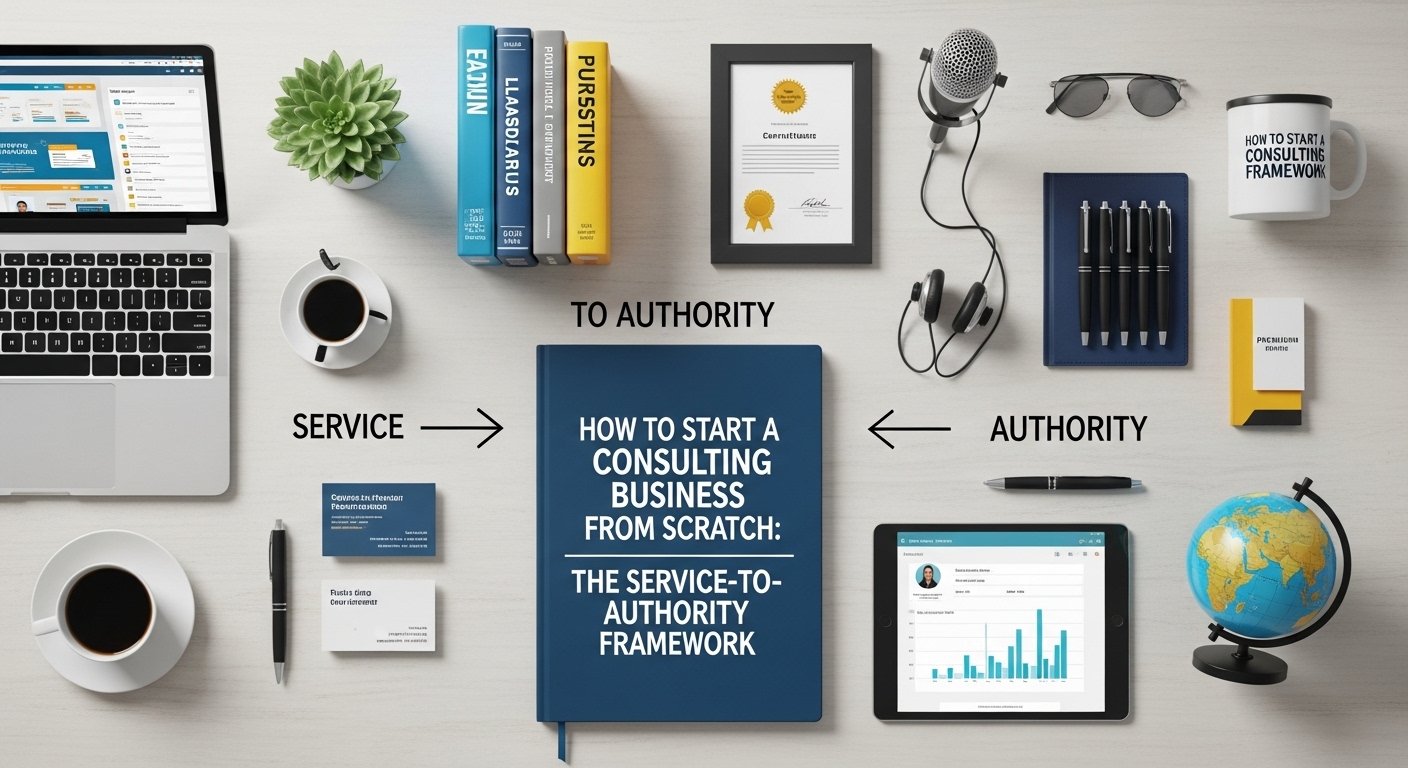
The Service-to-Authority Framework
This is the roadmap for building your consulting business. It has five phases.
The Framework Overview
PHASE 1: SERVICE
↓ Identify expertise and target market
PHASE 2: OFFER
↓ Package services into sellable offerings
PHASE 3: CLIENTS
↓ Find and close first paying clients
PHASE 4: PROOF
↓ Document results and build case studies
PHASE 5: AUTHORITY
↓ Leverage proof into premium positioning
↓
REPEAT CYCLE for exponential growth
Phase 1: Service (Identify Your Expertise)
The foundation of your consulting business is a clear, specific expertise you can sell.
The Expertise Identification Matrix
Answer these questions honestly:

1. What do people ask you for help with?
   (Your natural zone of competence)

2. What have you done professionally for 5+ years?
   (Experience-based expertise)

3. What problems do companies in your network face?
   (Market demand validation)

4. What would you teach for free?
   (Passion indicator)

5. What have you actually achieved results in?
   (Proven expertise)

The Intersection = Your Consulting Niche
Niche Selection Criteria
- Specificity: “Business consulting” is too broad. “SaaS customer retention consulting” is specific
- Paying clients exist: Companies actually spend money on this problem
- You have edge: Experience, background, or perspective competitors lack
- You enjoy it: You’ll do this for years—make it sustainable
Phase 2: Offer (Package Your Services)
Stop selling “consulting hours.” Package your expertise into irresistible offers.
The Offer Packaging Framework
IRRESISTIBLE OFFER = PROBLEM × SOLUTION × TRANSFORMATION

Components of a Great Offer:
1. Clear Problem Statement
   "You struggle with [specific problem]"

2. Solution Description
   "I help [ideal client] to [specific outcome]"

3. Transformation Proof
   "Through [method], you'll achieve [results]"

4. Delivery Mechanism
   "Via [format: coaching, audits, frameworks]"

5. Investment Level
   "[Price] with [payment options]"
Service Offer Tiers
| Tier | Format | Timeline | Price Range |
|---|---|---|---|
| Entry | Audit/Assessment | 1-2 weeks | $500-2,500 |
| Core | Strategy Package | 4-8 weeks | $2,500-10,000 |
| Premium | Implementation Partnership | 3-6 months | $10,000-50,000 |
| Elite | Fractional/Ongoing | Ongoing | $5,000-25,000/month |
Phase 3: Clients (Find and Close)
Get your first clients using this proven acquisition system.
The Client Acquisition Framework
- Warm network: Tell everyone you know about your services
- Content creation: Share expertise to attract inbound interest
- Cold outreach: Proactively reach decision-makers
- Partnerships: Align with complementary service providers
- Referrals: Create systems for client referrals
Where to Find Consulting Clients
- LinkedIn: B2B decision-makers, thought leadership
- Upwork: Freelance consulting opportunities
- Clarity.fm: Expert marketplace for consulting calls
- Guvence: Freelance consultant contracts
- Tezign: Creative and marketing consultants
- Market Tamer: Financial and business consultants
Phase 4: Proof (Document Your Results)
Results convert prospects. Document everything you do.
The Proof-Building System
For Every Engagement, Capture:
1. Before State
   - Client's starting metrics
   - Problems they faced
   - Goals they wanted to achieve

2. Process
   - What you did (methodology)
   - Challenges faced and overcome
   - Key decisions made

3. After State
   - Results achieved (quantified)
   - Lessons learned
   - Client testimonials

Use These for:
- Case studies (detailed)
- Testimonials (quotes)
- Social proof (metrics)
- Proposals (relevant examples)
Phase 5: Authority (Position for Premium)
Use your proof to command higher rates and better clients.
The Authority Elevation Ladder
LEVEL 1: Practitioner
- Working with individual clients
- Hourly/daily rates: $100-300
- Building initial results

LEVEL 2: Expert
- Established methodology
- Package pricing: $2,000-10,000
- Featured in industry media

LEVEL 3: Authority
- Recognized thought leader
- Premium pricing: $10,000-50,000+
- Keynotes, books, courses
- Sought out by clients
Niche Selection: Finding Your Profitable Sweet Spot
Your niche determines everything: your clients, your rates, and your competition.
The Niche Selection Framework
THE THREE DIMENSIONS OF NICHE:

1. INDUSTRY
   (Where does your expertise apply?)
   Examples: Healthcare, SaaS, E-commerce, Manufacturing

2. FUNCTION
   (What business area do you serve?)
   Examples: Marketing, Sales, Operations, Finance, HR

3. PROBLEM
   (What specific pain do you solve?)
   Examples: Low conversion, High churn, Poor cash flow

NICHE = Industry + Function + Problem

Example: "I help SaaS founders reduce customer churn"
         Industry: SaaS
         Function: Customer Success/Operations
         Problem: Churn reduction
Niche Quality Indicators
| Weak Niche | Strong Niche |
|---|---|
| “Business consulting” | “E-commerce brand positioning for DTC companies” |
| “Marketing help” | “Email marketing for course creators doing $500K+ annually” |
| “Sales improvement” | “Enterprise SaaS sales team hiring and onboarding” |
| “HR consulting” | “Remote team culture building for Series A startups” |
| “Financial planning” | “Tax optimization for real estate investors with 5-20 units” |
Finding Your Micro-Niche
Start Broad, Narrow Down:

Step 1: List your industries of experience
        → Manufacturing, Healthcare, Tech

Step 2: Identify functions you've worked in
        → Marketing, Sales, Operations

Step 3: Note specific problems you've solved
        → Lead generation, Customer acquisition, Scaling

Step 4: Find the intersection
        → Marketing + Lead Generation for Tech Companies

Step 5: Get hyper-specific
        → Marketing + Lead Generation for Series B SaaS companies

Result: A niche so specific you can own it
The Niche Warning: Many consultants resist narrowing their niche because it feels limiting. But specificity is your competitive advantage. A broad consultant competes with everyone. A niche consultant competes with no one because there is no one else with your exact combination of expertise, industry, and focus.
Pricing Your Consulting Services
Your pricing reflects your positioning. Get it right from the start.
The Pricing Mindset Shift
- From: “What are my competitors charging?”
- To: “What is the value of solving this problem worth?”
The Value-Based Pricing Framework
VALUE PRICING = CLIENT VALUE CREATED × YOUR SHARE

Example Calculation:
Client's problem costs them $100,000/year
You solve it, saving them $100,000
Your share (10-20%): $10,000-20,000
Your price: $10,000-20,000

This is BETTER than hourly pricing because:
- You're incentivized to solve the problem fast
- Client wants you to succeed
- Your income isn't capped by time
- You focus on outcomes, not hours
Pricing Models Compared
| Model | Pros | Cons | Best For |
|---|---|---|---|
| Hourly | Simple, low risk | Income capped, race to bottom | Early stage, hourly clients |
| Daily | Better margins | Still time-based | Project-based work |
| Project | Defined scope | Scope creep risk | Deliverables-based work |
| Retainer | Predictable income | Client may underuse | Ongoing relationships |
| Value-Based | Highest income potential | Harder to calculate | Clear ROI situations |
| Performance | Low risk for client | Income uncertainty | Results-driven engagements |
Rate-Setting Framework
FINDING YOUR INITIAL RATE:

Step 1: Calculate your target annual income
        $150,000 (desired) ÷ 1,000 billable hours
        = $150/hour floor

Step 2: Research market rates for your niche
        Check: Glassdoor, Payscale, industry surveys
        Note: Rates vary 3-10x based on expertise level

Step 3: Set rate based on experience
        New consultant: Market rate
        5+ years experience: 1.5x market
        Recognized expert: 2-3x market

Step 4: Adjust based on value delivered
        Can you prove ROI? Charge more.
        Are results uncertain? Price accordingly.

INITIAL RATE RECOMMENDATION:
Start at market rate or slightly below
(as low-risk way to build portfolio)
Raise 20-30% after 3 successful engagements
The Rate Negotiation Framework
WHEN CLIENT PUSHES BACK ON PRICE:

1. Don't apologize or explain
   Bad: "I understand, I can lower it to..."
   Good: "I appreciate your feedback. Let me explain what's included..."

2. Reframe to value
   "What would it be worth to solve [problem]?"

3. Offer alternatives
   "We could adjust scope to fit your budget..."
   "We could phase the engagement..."

4. Know your walk-away point
   Never go below your minimum rate
   Better to lose a client than undervalue yourself

5. Use social proof
   "Clients in similar situations have invested $X and achieved $Y"
Client Acquisition: Getting Your First Clients
Getting clients is the #1 challenge for new consultants. Here’s how to solve it.
The “First Client” Sprint
GETTING YOUR FIRST CLIENT IN 30 DAYS:

Week 1: Preparation
- Define your offer (1-2 packages)
- Set your rate
- Prepare pitch deck/proposal template
- List 50 potential clients

Week 2: Outreach
- Contact everyone in your network (50+ people)
- Send 10-20 cold emails
- Post on social media about your services
- Join 2-3 relevant communities

Week 3: Conversations
- Aim for 5 discovery calls
- Practice your pitch
- Refine based on feedback
- Follow up on all inquiries

Week 4: Close
- Send proposals to interested prospects
- Negotiate and close
- Deliver first engagement
- Ask for referral/testimonial
The Discovery Call Framework
DISCOVERY CALL STRUCTURE (30-45 minutes):

Opening (5 min):
- Thank them for their time
- Confirm the goal of the call
- "I'd like to understand your situation so I can share whether/how I can help"

Discovery Questions (20 min):
- "What's currently happening in [area]?"
- "What have you tried before?"
- "What would success look like?"
- "What's the cost of not solving this?"
- "Who else is involved in this decision?"

Your Pitch (10 min):
- "Based on what you've shared, I help [ideal client] to [outcome]"
- Share a relevant success story
- Present your offer or next steps

Close (5-10 min):
- "How are you feeling about this?"
- "Would you like to move forward?"
- Propose next steps
Cold Email Templates
TEMPLATE 1: DIRECT OUTREACH

Subject: Quick question about [Company Name]

Hi [Name],

I noticed [specific observation about their company/position].

[Company] appears to be dealing with [relevant challenge].
I've helped [similar companies] to [specific result achieved].

Would you be open to a 15-minute call to explore if this
could be valuable for [Company]?

[Your Name]

---

TEMPLATE 2: REFERRAL WARM

Subject: [Mutual Connection] suggested I reach out

Hi [Name],

[Mutual Connection] mentioned you're working on [topic].
I've been helping companies similar to yours with [expertise]
and thought there might be a fit.

Do you have 15 minutes this week to explore?

[Your Name]

---

TEMPLATE 3: VALUE-FIRST

Subject: [Useful resource] + quick question

Hi [Name],

I put together [useful resource] for [their industry].
[Description of what's inside].

I have a quick question for you: What's your biggest
challenge with [topic they're facing]?

[Your Name]
Where to Find Prospects
- LinkedIn Sales Navigator: Find decision-makers by industry/company size
- Hunter.io: Find company email addresses
- Apollo.io: Contact database with email finding
- Crunchbase: Find funded startups needing help
- Indie Hackers: Founders building profitable businesses
The Client Acquisition Truth: Most consultants fail not because they lack expertise, but because they’re afraid to sell. Get over the fear of “selling.” You’re not selling—you’re offering help to people who have problems you can solve. Every conversation is an opportunity to help someone. Approach with service mindset, and the selling becomes natural.
Real-World Consulting Success Stories
Scenario 1: The Corporate Escapee
THE START:
James spent 15 years in B2B sales at tech companies.
He knew sales processes inside and out.
At 42, he was burned out and wanted independence.

THE NICHE:
"I help Series B SaaS companies build enterprise sales teams"

THE LAUNCH:
Month 1: Told his network, got 1 warm referral
Month 2: Closed first client ($5,000 strategy engagement)
Month 3: Got testimonial, raised to $10,000 packages
Month 6: Three ongoing clients, $15K/month

THE GROWTH:
Year 1: $180,000 revenue
- 3 retainer clients ($8K/month combined)
- 2 project clients ($5K each)

Year 2: $350,000 revenue
- Raised rates to $15K/month retainers
- Started group coaching ($2,500/person)
- Landed first $50K engagement

Year 3: $600,000 revenue
- Built 2-person team (associate consultant + VA)
- Launched course for aspiring enterprise sellers
- Became recognized authority in the space

KEY INSIGHT:
James didn't need to be the world's best sales expert.
He just needed to know more than his clients about
solving their specific problem.
Scenario 2: The Industry Specialist
THE START:
Maria worked in healthcare administration for 20 years.
She knew HIPAA, medical billing, patient flow.
Retirement was boring—she wanted a new challenge.

THE NICHE:
"I help independent medical practices reduce claim denials
and improve billing efficiency"

THE CHALLENGE:
Healthcare is conservative. New vendors face skepticism.
Maria had no "business" experience.

THE APPROACH:
Month 1-3: Humble start
- Offered free initial audits to build trust
- Documented every result rigorously
- Collected testimonials

Month 4-6: First paying clients
- Converted free clients to paid ($2,500/month retainers)
- Partnered with medical billing software companies
- Got featured in medical industry Facebook groups

Year 1: $95,000 revenue
- 4 retainer clients ($2,500 each)
- 2 one-time projects ($5,000 each)

Year 2: $180,000 revenue
- 8 retainer clients
- Started speaking at medical conferences
- Created online course for practice managers

KEY INSIGHT:
Maria's industry experience was her moat.
She knew the problems, the language, the decision-makers.
Competitors without healthcare background couldn't compete.
Scenario 3: The Marketing Specialist
THE START:
Tyler was a freelance copywriter making $60K/year.
Good at what he did, but competing on price.
Clients haggled, deadlines were brutal, income capped.

THE TRANSFORMATION:
He shifted from "copywriter" to "conversion strategist"

THE NICHE:
"I help e-commerce brands under $1M increase revenue
through email marketing and copywriting"

THE POSITIONING:
- Stopped selling words
- Started selling revenue increases
- Created "Revenue Impact Guarantee"

THE PRICING SHIFT:
Before: $500-1,000 per email sequence
After: $3,000/month retainer (minimum 3-month commitment)

THE RESULTS:
Year 1: $140,000 revenue
- 4 retainer clients ($3,000-5,000/month)
- First $50K quarter

Year 2: $280,000 revenue
- 6 retainer clients
- Launched "E-commerce Email Masterclass" ($997)
- 200 students in first year

Year 3: $450,000 revenue
- 8 retainer clients ($5,000-10,000/month)
- Course + coaching revenue $100K
- Reduced consulting hours from 60/week to 25/week

KEY INSIGHT:
Tyler didn't write more emails. He reframed his offer.
By positioning as a strategist rather than a writer,
he tripled his rates and halved his workload.
Scenario 4: The Coach Who Turned Consultant
THE START:
Alicia was an executive coach making $80K/year.
She helped leaders with communication and productivity.
The problem: coaching felt intangible, hard to justify.

THE SHIFT:
She transformed from "coach" to "operational consultant"

THE NICHE:
"I help fast-growing startups design their leadership
infrastructure and communication systems"

THE DIFFERENCE:
Coaching: "Work through your issues over time"
Consulting: "Here's the exact system you need, implemented"

THE OFFER:
"Leadership Infrastructure Package" - $25,000
- Complete communication system design
- Implementation during 8-week engagement
- Documentation and training for the team
- 90-day follow-up support

THE LAUNCH:
Month 1: Reframed all existing coaching clients
- 2 converted to consulting ($25K each)
- Used case studies immediately

Month 3: First cold client
- Reached out via LinkedIn to Series A startups
- Closed $35K engagement

Year 1: $210,000 revenue
- 6 consulting engagements
- Average deal size: $35,000

Year 2: $380,000 revenue
- Added "Fractional Head of People" service
- $15K/month ongoing retainer model
- Built case study library

KEY INSIGHT:
Alicia didn't change her expertise. She changed her delivery.
By moving from "I'll help you figure it out" to
"Here's exactly what you need and I'll implement it,"
she tripled her value and her income.
Building Authority and Thought Leadership
Authority compounds. Every client engagement, every piece of content, every success story builds your reputation over time.
The Authority Building System
THE THREE PILLARS OF AUTHORITY:

1. RESULTS
   - Deliver exceptional client outcomes
   - Document everything
   - Create case studies
   - Collect testimonials

2. CONTENT
   - Share your expertise publicly
   - Write, speak, teach
   - Build an audience
   - Establish voice

3. CREDIBILITY
   - Get media mentions
   - Speak at events
   - Author content
   - Build professional network
Content Strategy for Consultants
- Medium: Long-form thought leadership articles
- LinkedIn: Professional content and networking
- Substack: Newsletter-based authority building
- YouTube: Video expertise demonstration
- Podcasts: Guest appearances and own show
The Speaking Strategy
SPEAKING LADDER:

Level 1: Free local events
- Chamber of commerce
- Meetup groups
- Local business events

Level 2: Industry conferences
- Apply to speak
- Host workshops
- Panel participation

Level 3: Paid speaking
- Workshop facilitator ($2,000-10,000)
- Keynote speaker ($5,000-50,000+)
- Conference headliner

Level 4: Own events
- Host webinars (live)
- Run workshops (paid)
- Organize conferences (premium)
Media and PR Strategy
- HARO (Help A Reporter Out): Connect with journalists seeking experts
- Qwoted: Source for journalist queries
- Response: Connect with media opportunities
- PR Newswire: Distribute press releases
- Business Wire: Announce milestones and content
Systems and Operations for Consultants
Run your consulting like a business, not a hobby. These systems make the difference.
Essential Business Systems
- QuickBooks: Invoicing, expense tracking, tax prep
- Wave: Free accounting for small consultants
- Calendly: Scheduling without back-and-forth
- DocuSign: Electronic contracts
- Loom: Async video communication
- Notion: Client notes and project management
The Client Onboarding System
ONBOARDING CHECKLIST:

Day 1: Welcome
- Send welcome email with contract and invoice
- Schedule kickoff call
- Add to client CRM
- Share communication preferences

Day 2-3: Discovery
- Conduct deep-dive kickoff call
- Document current state and goals
- Identify key stakeholders
- Establish success metrics

Day 4-7: Assessment
- Gather necessary access/documents
- Complete initial audit/assessment
- Identify quick wins
- Create project roadmap

Week 2: Kickoff
- Present findings and strategy
- Align on priorities
- Begin first deliverables
- Set weekly check-in schedule

Week 3-4: Execution
- Deliver against roadmap
- Weekly status updates
- Address blockers immediately
- Document all decisions

Week 8+: Close
- Present final deliverables
- Review success metrics
- Collect testimonials
- Discuss ongoing engagement/referrals
Client Relationship Management
CRM ESSENTIALS FOR CONSULTANTS:

What to Track:
- Contact information and preferences
- Project history and deliverables
- Communication log
- Invoice and payment history
- Next steps and follow-ups
- Referral sources

Tools to Use:
- HubSpot (free CRM)
- Pipedrive (sales-focused)
- Notion (customizable)
- Airtable (flexible database)

Minimum Requirement:
Spreadsheet with all client info
- Name, company, contact
- Services provided
- Revenue generated
- Last contact date
- Next action
Scaling Beyond One-to-One
The ceiling for one-to-one consulting is high but finite. Here’s how to break through.
The Consulting Scale Ladder
LEVEL 1: Solo Consultant
- One-to-one engagements only
- $100-300/hour ceiling
- Income = your hourly rate × hours

LEVEL 2: Premium Consultant
- High-ticket one-to-one
- $1,000-10,000+ projects
- Income = project value × clients

LEVEL 3: Group Consulting
- Cohort-based programs
- 10-30 clients simultaneously
- Income = per-person price × group size

LEVEL 4: Productized Service
- Self-service delivery
- Standardized packages
- Income = sales volume

LEVEL 5: Course/Content Company
- Knowledge products
- Scalable revenue
- Income = course sales + consulting

LEVEL 6: Agency
- Consultants delivering for you
- Systems and processes
- Income = margin on team output
Creating Information Products
- Teachable: Course hosting and delivery
- Thinkific: Course creation platform
- Gumroad: Digital product sales
- Kajabi: All-in-one knowledge business platform
- Podia: Simple course and community platform
The Scaling Insight: Every successful consultant eventually faces the same choice: make more money per hour, or leverage time through products and team. There’s no wrong answer—some consultants happily stay at $300K/year doing premium one-to-one work forever. Others build $1M+ businesses. Know what you want before building.
Consulting Mistakes to Avoid
The Top 10 Consulting Mistakes
| Mistake | Why It Fails | The Fix |
|---|---|---|
| Too broad a niche | Compete with everyone | Get hyper-specific |
| Underpricing | Attract budget shoppers | Charge for value, not time |
| No clear offer | Prospects confused | Package services clearly |
| Scope creep | Unlimited work for fixed pay | Define scope strictly |
| No contracts | Payment and scope disputes | Always use written agreements |
| No systems | Chaos and burnout | Build repeatable processes |
| Neglecting marketing | feast-or-famine pipeline | Market consistently |
| Client dependency | Business at risk | Diversify client base |
| No proof points | Hard to close deals | Document all results |
| Refusing to sell | No clients, no business | Embrace service mindset |
The Most Common Mistake: Consultants wait until they’re “ready” to start marketing. They want more experience, better testimonials, a perfect website. But you don’t need perfection to get clients. You need a clear offer, genuine expertise, and the willingness to reach out. Start before you’re ready. You’ll learn more from one client than from months of preparation.
Your Consulting Business Roadmap
Starting a consulting business is one of the most accessible paths to building a profitable business. Here’s how to begin.
The 30-60-90 Day Action Plan
30 DAYS: FOUNDATION
□ Define your niche (use the niche matrix)
□ Create 1-2 service packages
□ Set your pricing
□ Build simple website (or LinkedIn profile)
□ Tell everyone you know about your services
□ Start cold outreach (50+ prospects)
TARGET: First discovery call

60 DAYS: FIRST CLIENTS
□ Conduct 5-10 discovery calls
□ Send 3-5 proposals
□ Close first paying client
□ Deliver exceptional results
□ Document everything (testimonials, case studies)
TARGET: First paying client

90 DAYS: BUILD MOMENTUM
□ Have 2-3 active clients
□ Refine offer based on feedback
□ Raise rates (after 2+ successes)
□ Systemize operations
□ Build referral system
TARGET: $5,000-15,000 in revenue

CONTINUE:
□ Increase rates with each success
□ Build authority through content
□ Explore scaling options
□ Build toward $100K+ year
The Consulting Truth: You already have expertise. You already have experience. The only question is whether you’re willing to package it, communicate it, and sell it. The consultants who succeed aren’t the smartest or the most experienced—they’re the ones who took action. Your expertise has value. Stop keeping it to yourself and start sharing it—for profit.
The service-to-authority framework works because it’s built on reality. You help people, they pay you, you build proof, and you become more valuable. There’s no shortcuts, but there is a system. Use it.
Frequently Asked Questions
Do I need a degree or certification to be a consultant?
No. Consulting is based on demonstrated expertise, not formal credentials. Clients hire consultants to solve problems, not to see diplomas. What matters is: (1) proven experience in your area, (2) results you’ve achieved for others, (3) ability to communicate value. That said, some industries (legal, financial, medical) have regulatory requirements. Check your specific field. Certifications can help build credibility (like PMP for project management or Google Analytics certification) but aren’t required.
How do I get clients without any experience or testimonials?
Start by offering your services at a discount (or even free) to build your portfolio. But be strategic: choose clients who can provide good testimonials, have recognizable brands, or can refer you to others. Alternatively, use your past work experience as proof—you’ve helped employers for years, now help clients directly. Create hypothetical case studies based on your knowledge. And leverage content: write about your expertise to demonstrate capability before landing paid work. Tools like Clarity.fm let you start with smaller paid consultations to build track record.
Should I work with clients full-time or keep my day job while starting?
This depends on your financial situation and risk tolerance. The ideal path for most people: start consulting on the side while employed, build to 1-2 clients generating $5,000+/month, then transition to full-time. This gives you income stability, ability to raise prices from a position of confidence, and time to build systems properly. Don’t quit your job to “figure out” consulting—quit when you have proof it works.
How do I create a consultant contract?
Your contract should cover: scope of work, deliverables, timeline, payment terms, revision limits, confidentiality, intellectual property, termination clause, and liability limitations. Use templates from LawDepot or Docracy as starting points. For more complex engagements, consult a lawyer. Never start work without a signed contract—it’s protection for both you and your client.
What’s a reasonable rate for a new consultant?
Market rates for new consultants typically range from $75-150/hour depending on niche and market. B2B consultants generally command higher rates than B2C. After 3-5 successful engagements, raise rates 20-30%. By year 2, you should be at $150-300/hour. Top consultants in specialized niches charge $500-1,000+/hour. Remember: your rate should increase with experience, track record, and results. Use tools like Glassdoor and PayScale to research rates in your specific niche.
Related Articles
- Multiple Streams of Income: 20 Ways to Diversify
- Content Marketing That Actually Converts
- How to Get Your First 100 Customers
- How to Scale from $100K to $1M in Revenue