
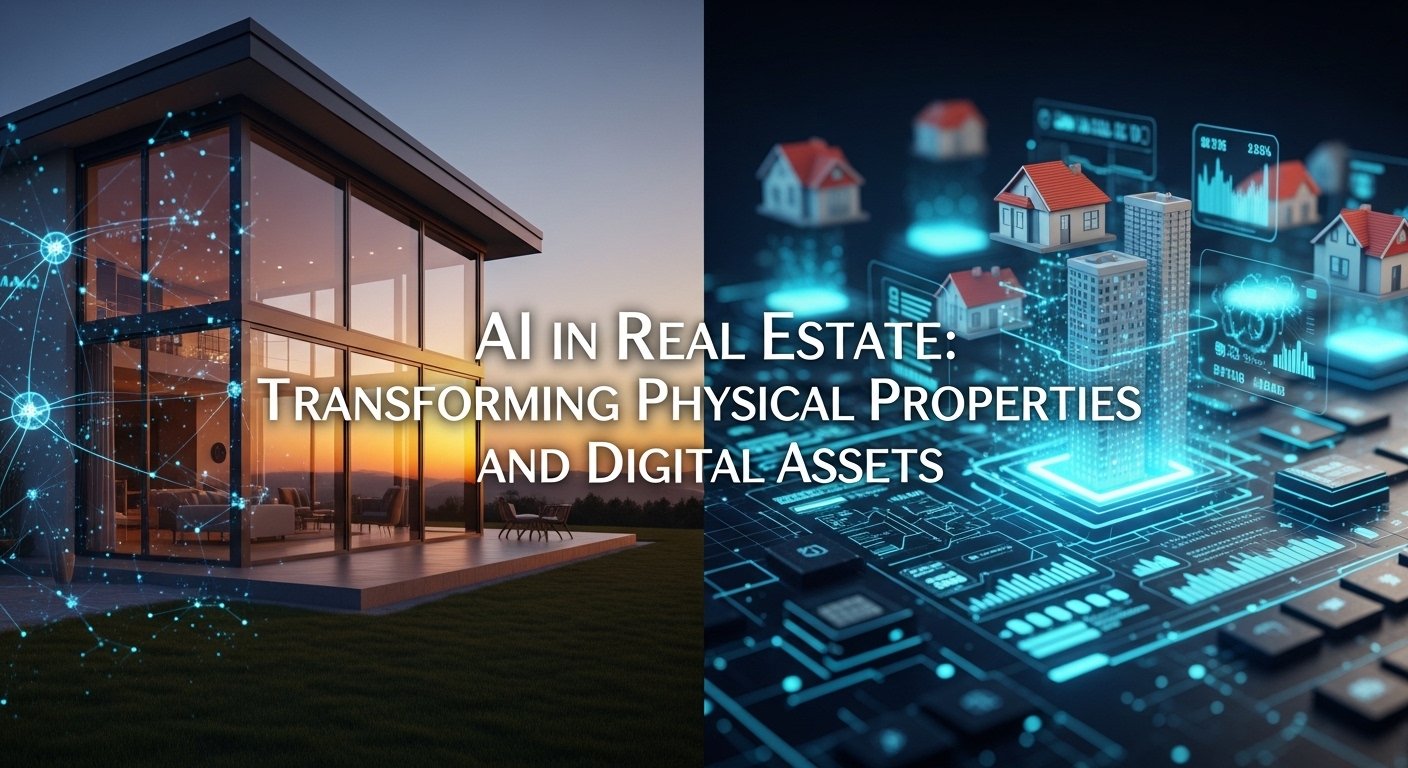
Real estate has always been one of the world’s most valuable asset classes. Now, artificial intelligence is reshaping how we buy, sell, manage, and invest in properties—both physical and digital. From smart homes that learn your preferences to virtual real estate in the metaverse, AI is opening doors that didn’t exist five years ago.
- How AI transforms traditional property valuation and research
- Virtual staging, 3D tours, and AI-powered property management
- The rise of digital real estate and AI’s role in metaverse investments
- Practical AI tools for real estate investors and agents
- Future trends shaping the industry
The Dual World of Real Estate Today
Modern real estate exists in two parallel universes:
Physical Real Estate
Houses, apartments, commercial buildings, land, and industrial properties. Tangible assets with physical addresses that you can visit, touch, and inhabit.
Digital Real Estate
Domain names, websites, virtual land in metaverses (Decentraland, The Sandbox), NFT properties, and digital advertising space. Intangible assets that exist in data centers and blockchain networks.
AI is revolutionizing both worlds, creating opportunities for investors, agents, and technology enthusiasts alike. Let’s explore how.
AI in Physical Real Estate
1. Property Valuation and Price Prediction
Traditional property valuation relied on comparable sales and appraiser expertise. AI has transformed this into a data-driven science.
Zillow Zestimate
Uses neural networks to analyze millions of data points, predicting home values with 80-90% accuracy in many markets.
Opendoor
AI-powered instant offers let sellers receive cash offers within 24 hours, using algorithmic pricing models.
Redfin Estimate
Machine learning models that factor in market trends, school districts, and neighborhood data.
HouseCanary
Predicts property values and rental yields 3+ years into the future using AI analysis of 50+ years of housing data.
2. Virtual Tours and 3D Property Visualization
According to NAR research, listings with virtual tours receive 87% more views than those without. AI is making these tours smarter and more immersive.
1. AI-Powered Scanning
Tools like Matterport use AI to automatically scan spaces with a smartphone, creating detailed 3D models without expensive equipment.
2. Virtual Staging
Matterport and Roolee use AI to furnish empty spaces digitally, showing buyers the potential of a property.
3. Measurement AI
Matterport automatically measures room dimensions, window heights, and ceiling clearances with 99% accuracy.
4. Defect Detection
AI can identify wall cracks, water damage, or structural issues from photos, helping inspectors focus on problem areas.
3. Smart Home and Building Management
Smart buildings are no longer science fiction. AI-powered systems are making properties more energy-efficient, secure, and comfortable.
Google Nest
Learns your temperature preferences and schedules, reducing energy bills by 10-15% on average.
Cove
AI-powered security system that learns normal household patterns and alerts only for unusual activity.
Enovation Controls
Commercial building AI that optimizes HVAC, lighting, and elevators based on occupancy patterns.
Appfolio
AI-powered property management for landlords, automating rent collection, maintenance requests, and tenant communication.
4. AI-Powered Real Estate Investing Platforms
Fractional ownership and real estate crowdfunding have democratized property investment. AI makes these platforms smarter.
Fundrise
RealtyMogul
Cadre
YieldStreet
5. Lead Generation and Customer Service
Real estate agents are using AI to work smarter, not harder. Chatbots, predictive lead scoring, and automated follow-ups are becoming industry standard.
Chatbot
- Answer property questions
- Schedule viewings
- Qualify leads
Lead Scoring
- Predict conversion chance
- Optimal contact timing
- Personalized outreach
Market Analysis
- Neighborhood trends
- Competitor pricing
- Investment projections
6. Construction and Development
AI is transforming how buildings are designed, constructed, and maintained.
Design Phase
AI tools like Autodesk Generative Design create thousands of building configurations, optimizing for cost, materials, and energy efficiency.
Construction Monitoring
Drone AI from DroneDeploy tracks progress, identifies delays, and detects safety issues in real-time.
Predictive Analytics
AI predicts construction delays and cost overruns by analyzing historical project data, weather patterns, and supply chain factors.
AI in Digital Real Estate
Digital real estate is one of the fastest-growing asset classes, and AI is at the forefront of this revolution. From domain names to virtual world land, AI tools are helping investors navigate this emerging market.
1. Domain Name Investment and Appraisal
Domain names are digital real estate’s most established category. AI is changing how investors value and acquire domain names.
EstiBot
AI-powered domain appraisal tool that analyzes comparable sales, search volume, and brand potential to estimate domain values.
GoDaddy Appraisal
Uses machine learning on millions of sales data to provide instant domain valuations.
DNRank
AI analysis of brandability, length, keywords, and extension (.com vs .io) to predict investment potential.
Namebio
Database with AI-powered search to find comparable sales and trends in the domain aftermarket.
1. AI Domain Hunting
Tools like Namecheap’s domain finder use AI to suggest available alternatives based on your seed keyword.
2. Valuation Analysis
Run domains through EstiBot or GoDaddy Appraisal for baseline value estimates.
3. Brand Matching
AI checks trademark databases and social media availability to ensure brand consistency.
4. Trend Prediction
AI analyzes emerging keywords, tech trends, and search data to predict which domains will appreciate.
2. Website Building and Content Generation
Building a website is now a form of digital real estate development. AI tools have made this faster and more sophisticated than ever.
Wix ADI
Answer a few questions, and AI builds a complete website in minutes with personalized design and content. Integrates with GPT-4 for copy generation.
3. Metaverse Real Estate
Virtual land in platforms like Decentraland, The Sandbox, and Otherside has become a legitimate asset class, with parcels selling for hundreds of thousands of dollars at peak markets.
AI is helping investors navigate this volatile market:
AI Market Analysis for Metaverse Land
AI Development Planning
Automated Virtual Property Management
4. NFT Real Estate and Digital Collectibles
NFTs have expanded beyond art to include virtual real estate representations, fractional property ownership, and digital twins.
Propy
Blockchain-based real estate transactions with NFT representation of property deeds. AI assists in contract generation and compliance checking.
RealT
Fractional ownership of Detroit rental properties via tokens. AI manages rent distribution and property analytics.
Digital Property Certificates
AI-generated digital twins of physical properties that serve as verified records for insurance, renovation planning, and historical documentation.
Virtual Worlds Corp
NFT-backed virtual experiences and properties combining physical and digital real estate concepts.
5. AI Content for Real Estate Websites
For digital real estate investors running content sites, AI is invaluable for creating and maintaining web properties.
1. Content Generation
AI writes property descriptions, blog posts, and landing pages. Tools like Jasper and Copy.ai are specifically trained for real estate copy.
2. SEO Optimization
AI analyzes search trends and competition to recommend keywords, topics, and content strategies for maximum organic traffic.
3. Image Enhancement
AI upscales property photos, removes backgrounds, and generates virtual staging visualizations automatically.
4. Automated Listings
AI pulls data from MLS, public records, and property databases to auto-populate listing details and generate descriptions.
Best AI Tools for Real Estate Professionals
For Agents
- Chatfuel – AI chatbots for leads
- Capterra – AI property search
- Hootsuite – AI social scheduling
- Real estate CRM AI – Follow-up automation
For Investors
- Zillow – AI valuations
- Fundrise – AI portfolio management
- DomainNameSales – AI domain appraisal
- Tokenized – AI property tokenization
For Property Managers
- AppFolio – AI property management
- Mind apartment – AI tenant screening
- Facilio – AI building optimization
- ServiceTitan – AI field service
AI Real Estate Agent: Practical Use Cases
Scenario 1
First-time investor with $10,000
Recommendation
Start with Fundrise or RealtyMogul for fractional REIT exposure. Use AI valuation tools to compare returns. Build credit and capital for physical property over 2-3 years.
Scenario 2
Agent wanting to 10x productivity
Recommendation
Deploy AI chatbots on your website for 24/7 lead capture. Use KVCore for AI-powered email campaigns. Implement virtual tour tools like Matterport for every listing.
Scenario 3
Tech-savvy investor exploring digital assets
Recommendation
Research metaverse land on WeMeta before buying. Invest in quality domain names using EstiBot valuations. Start a niche content site using WordPress + AI tools. Allocate no more than 10% of portfolio to digital assets.
Future Trends: AI and Real Estate by 2030
2026-2027: AI Property Agents
Autonomous AI agents that negotiate deals, analyze contracts, and manage transactions with minimal human oversight. NAR is already piloting AI assistants.
2027-2028: Digital Twin Integration
Every new construction includes AI-powered digital twins for remote monitoring, predictive maintenance, and insurance validation.
2028-2029: Metaverse Maturation
Enterprise adoption of virtual spaces for meetings, retail, and education creates consistent demand for premium virtual land.
2030: Fully Integrated Experience
AI connects physical and digital real estate: smart homes integrate with virtual property management, and blockchain enables seamless cross-asset investing.
Getting Started: Your AI Real Estate Action Plan
1. Assess Your Position
Are you an investor, agent, or developer? Each has different AI tool needs and priorities.
2. Physical or Digital First?
Start with what you understand. Physical real estate is more stable; digital offers lower entry barriers.
3. Choose One AI Tool
Don’t try everything at once. Start with one high-impact tool (Zillow for investors, KVCore for agents).
4. Track and Iterate
Measure results. If AI isn’t saving time or improving decisions after 3 months, try a different tool.
5. Scale Gradually
Add more AI tools as you master each one. Build a stack that works for your specific needs.
Frequently Asked Questions
Is digital real estate a good investment in 2026?
Can AI replace real estate agents?
How accurate are AI property valuations?
What’s the best AI tool for property management?
Should I invest in metaverse real estate?
Conclusion
AI is transforming real estate in two parallel tracks: making physical property transactions smarter, faster, and more data-driven, while simultaneously creating entirely new categories of digital assets to invest in.
Whether you’re buying a home, investing in rental properties, building websites, or exploring metaverse land, AI tools can give you an edge. The key is to start with one tool that solves your biggest pain point, measure the results, and expand from there.