
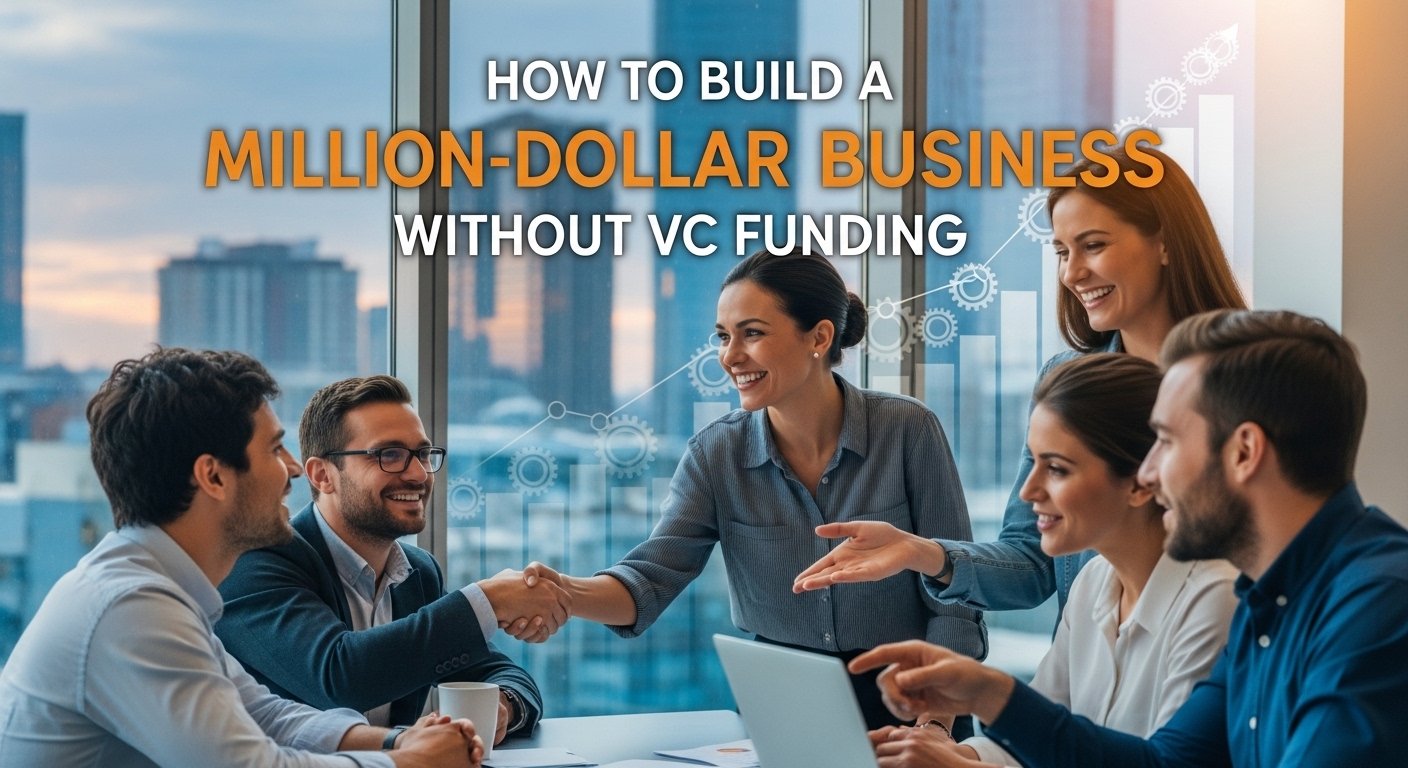
Every week, headlines celebrate the latest startup that raised millions in venture capital. But for every funded startup, hundreds of bootstrapped businesses quietly hit seven figures without taking a single dollar from investors.
Bootstrapping means building your business with your own resources—personal savings, revenue from early sales, and careful financial management. It’s not the glamorous path, but it’s the path that leads to sustainable, profitable companies.
Companies like Mailchimp, Basecamp, Mailgun, Span, and MailerLite all built million-dollar businesses without VC. This guide shows you how they did it—and how you can too.
What is Bootstrapping?
Bootstrapping is the practice of starting and growing a business with personal capital and operating revenue, rather than seeking external investment. The term comes from the phrase “pulling yourself up by your bootstraps”—building something from nothing.
The Bootstrapping Mindset
Bootstrapping isn’t just a financing strategy—it’s a mindset that prioritizes profitability over growth at all costs. Bootstrapped founders:
- Focus on revenue from day one
- Make every dollar count
- Delay gratification for sustainable growth
- Retain full ownership and control
- Build businesses that can survive any market condition
Fundera’s bootstrapping statistics reveal that bootstrapped companies are more likely to survive long-term: 73% of bootstrapped startups are still operating after 10 years, compared to just 4% of VC-backed companies.
Why Founders Choose Bootstrapping
According to Gartner’s research on entrepreneurship, founders choose bootstrapping for various reasons:
- Ownership: Retain 100% equity and all decision-making power
- Focus: Concentrate on customers and profitability, not investor relations
- Speed: Avoid lengthy fundraising processes and due diligence
- Independence: Build the company you want without investor pressure
- Sustainability: Create businesses built to last, not just to exit
Inspiring Bootstrapped Success Stories
Mailchimp: From Side Project to $12 Billion
Mailchimp started in 2001 as a side project by Ben Chestnut and Dan Kurzius. They operated profitably for 15 years before taking any outside funding—and even then, it was a strategic growth investment, not a survival round.
By 2021, Mailchimp was generating over $800 million in annual recurring revenue. They were acquired by Intuit for $12 billion—one of the largest exits ever for a bootstrapped company.
Key lesson: Mailchimp focused on product-market fit and profitability for over a decade before scaling aggressively.
Basecamp: $100 Million+ on $3.5 Million Initial Investment
Basecamp (formerly 37signals) was founded in 1999 by Jason Fried, Ernst Hoogenes, and Carlos Segura with just $3,500 in personal savings. They built the company to profitability through providing web-based project management tools.
By 2015, Basecamp was generating $100 million in annual revenue with only 60 employees. The company never raised a single dollar of external capital.
Founder Jason Fried’s book, Getting Real, became a bible for bootstrapped founders. His philosophy of slow growth and profitability revolutionized how many entrepreneurs approach building companies.
Span: Hardware Without VC
Span, the smart electrical panel company, raised only $10 million in funding but achieved $100 million in revenue within four years. Founder Arch Rao built the company with extreme capital efficiency, proving that hardware startups don’t need hundreds of millions to succeed.
MailerLite: Profitable from Month Three
MailerLite, an email marketing platform, has been profitable since month three of operations. Founded in 2005 by David Banas and Andrius Stikonas, the company reached $50 million in ARR without any external funding.
The founders focused on organic growth through content marketing and word-of-mouth referrals, demonstrating that the flywheel effect can drive sustainable growth without paid acquisition.
Pat Flynn: From Architecture to $2 Million in Passive Income
Pat Flynn didn’t set out to become an entrepreneur. After being laid off from his architecture job in 2008, he started Smart Passive Income as a way to document his journey. He now generates over $2 million annually through digital products, affiliate marketing, and courses—all without external funding.
Pat’s story proves that bootstrapping can start with zero capital and grow into a significant income stream through providing genuine value.
The Bootstrapping Playbook: Core Strategies
Strategy 1: Start with Problem-Solution Fit
Before building anything, validate that you understand the problem deeply. Bootstrapped founders can’t afford to build products nobody wants.
- Identify a specific pain point: Talk to potential customers about their biggest frustrations
- Research existing solutions: Understand what’s already in the market
- Define your unique angle: What will you do differently or better?
- Create a minimum viable offer: Sell before you build
Eric Ries’ Lean Startup methodology emphasizes validated learning. Test your assumptions early and often before investing significant time or money.
Strategy 2: Charge Money Immediately
One of the biggest differences between bootstrapped and VC-backed startups is when they start charging customers. VC-backed startups often prioritize growth over revenue, burning cash to acquire users. Bootstrapped founders can’t afford this luxury.
Nir Eyal’s research on habit formation shows that charging early also creates psychological commitment—both for you and your customers. When people pay, they value the product more and provide better feedback.
Bootstrapping Rule: If you can’t find one person willing to pay for your solution, you don’t have a business—you have a hobby.
Strategy 3: Embrace Slow, Sustainable Growth
Slow growth isn’t a failure—it’s a feature. Bootstrapped companies can:
- Maintain quality as they scale
- Learn from each customer before acquiring the next
- Avoid the growing pains that kill startups
- Remain nimble and responsive to market changes
- Build genuine customer relationships
The growing slowly movement, championed by founders like Jason Fried, advocates for businesses that prioritize sustainability over hypergrowth. Math, not magic—this is the bootstrapped founder’s motto.
Strategy 4: Outsource Strategically
You can’t do everything yourself, but Fiverr, Upwork, and Toptal allow you to access talent without the overhead of full-time employees.
Virtual assistants and contractors can handle:
- Administrative tasks
- Customer support
- Content creation and marketing
- Technical development
- Accounting and bookkeeping
Focus your limited time on high-value activities only you can do—product development, sales, and strategy. Delegate everything else.
Strategy 5: Leverage Free and Low-Cost Tools
Modern software-as-a-service tools have dramatically lowered the cost of starting a business. Key categories and recommended tools:
| Category | Free Options | Paid Options |
|---|---|---|
| Website Building | WordPress, Wix | Webflow, Squarespace |
| Email Marketing | Mailchimp (free tier) | ConvertKit, ActiveCampaign |
| Project Management | Trello, Notion | Asana, Monday.com |
| Accounting | Wave | QuickBooks, Xero |
| CRM | HubSpot CRM | Pipedrive, Salesforce |
| Design | Canva | Adobe Creative Suite, Sketch |
| Payments | Stripe (no monthly fee) | PayPal, Gumroad |
Strategy 6: Master Organic Marketing
Without large marketing budgets, organic marketing becomes your competitive advantage. The most effective channels for bootstrapped businesses:
Content Marketing
Content marketing costs 62% less than traditional marketing but generates three times as many leads. Start with a blog, then expand to:
- YouTube tutorials and explainers
- Medium articles for thought leadership
- Podcasts for building audience
- ebooks and guides for lead generation
SEO (Search Engine Optimization)
SEO is the gift that keeps giving. Once you rank for valuable keywords, traffic flows continuously without additional spend. Tools like Ahrefs, SEMrush, and Moz help you find and target the right keywords.
Community Building
Building an audience before you need it is a classic bootstrapped strategy. Platforms like Facebook Groups, Reddit communities, and Discord servers allow you to connect with potential customers.
Indie Hackers, founded by Courtland Allen, is itself a bootstrapped community that has helped thousands of founders share revenue numbers and strategies.
Email Marketing
Email marketing has an average ROI of $42 for every $1 spent. Build your list from day one using:
- Lead magnets (checklists, templates, mini-courses)
- Newsletter signups on your blog
- Free tools or calculators
- Webinar registrations
Strategy 7: Reinvest Everything
The power of reinvestment is the secret weapon of bootstrapped businesses. Unlike VC-backed companies that face pressure to grow fast and exit, bootstrapped founders can:
- Take modest salaries: Cover basic expenses while preserving capital
- Reinvest profits: Put every dollar of profit back into growth
- Build sustainably: Only hire when absolutely necessary
- Delay perks: Skip fancy offices until the business clearly requires them
Fred Wilson’s analysis of reinvestment shows that compounding profits at even modest rates creates enormous wealth over time. A business reinvesting 50% of profits at 20% annual growth will double every two years.
Financial Milestones for Bootstrapped Companies
The Revenue Journey
Here’s a typical progression for bootstrapped businesses:
| Milestone | Timeline | Key Focus | Common Mistakes |
|---|---|---|---|
| $0 – $1,000/month | Months 1-3 | Product-market fit | Giving away too much for free |
| $1K – $10K/month | Months 3-12 | Repeatable sales process | Over-hiring too quickly |
| $10K – $50K/month | Year 1-2 | Systems and processes | Neglecting customer success |
| $50K – $250K/month | Year 2-4 | Scaling what works | Losing product focus |
| $250K+/month | Year 4+ | Leadership and culture | Complacency |
Stripe Atlas and Y Combinator’s Startup Library provide resources for navigating each stage of growth.
Key Metrics to Track
Bootstrapped businesses should obsess over profitability metrics:
- Monthly recurring revenue (MRR): The heartbeat of subscription businesses
- Net revenue retention (NRR): Are existing customers expanding or churning?
- Gross margin: Are you pricing correctly for profitability?
- Customer acquisition cost (CAC): How much does it cost to acquire customers?
- Customer lifetime value (LTV): What’s the total value of each customer?
- LTV:CAC ratio: Aim for at least 3:1
- Burn rate: How long can you operate at current levels?
When (and If) to Consider External Funding
Bootstrapping doesn’t mean never taking money. Sometimes strategic funding accelerates growth. Consider outside investment when:
- You have product-market fit: Funding to accelerate something already working
- Market timing is critical: A window of opportunity requires speed
- You’ve hit a ceiling: Organic growth isn’t enough for the opportunity
- Strategic value exceeds capital: An investor brings networks, customers, or expertise
Warning: Outside funding comes with strings attached. Investors expect returns, often via acquisition or IPO. Venture capital has a survivorship bias—the media celebrates winners while ignoring the majority of funded companies that fail or barely survive.
Alternative funding options for bootstrapped founders include:
- Kickstarter and Indiegogo for product launches
- Lending Club and Fundbox for business loans
- CircleUp for consumer brands
- Modest for revenue-based financing
- AngelList for angel investment on your terms
Tools and Resources for Bootstrapped Founders
Learning Resources
- Y Combinator Startup Library – Free videos from the world’s top startup program
- Steve Blank’s Entrepreneurship Blog – Customer development methodology
- Signal v. Noise – Basecamp founders’ blog on building sustainable businesses
- Indie Hackers – Revenue sharing, interviews, and community
- The Startup Owner’s Manual – Steve Blank’s comprehensive guide
- The Millionaire Underdog – Larry Kendall’s bootstrap success stories
Business Planning Tools
- Lean Canvas – 1-page business plan template
- Business Model Canvas – Strategyzer’s visual planning tool
- LivePlan – Business planning and forecasting
- SCORE – Free business mentoring
- SBA Business Plan Guide – Official planning resources
Community and Support
- Indie Hackers Forum – Peer support and advice
- Meetup – Local entrepreneur groups
- LinkedIn Groups – Industry-specific communities
- r/Entrepreneur – Reddit community for founders
- Startup School – Y Combinator’s free program
Financial Tools
- Wave – Free accounting software
- QuickBooks Self-Employed – Expense tracking and invoicing
- Patriot Software – Payroll and accounting
- FreshBooks – Cloud accounting for freelancers
- Mint – Personal finance tracking
- IRS Small Business Guide – Tax requirements and deadlines
Common Bootstrapping Mistakes to Avoid
Mistake 1: Building in Stealth Mode Too Long
Waiting for perfection delays validation. Launch early, gather feedback, and iterate. Use LaunchRock or Carrd to create landing pages quickly and start collecting emails.
Mistake 2: Underpricing to Win Customers
Race-to-the-bottom pricing attracts price-sensitive customers and undervalues your work. Bootstrap requires profitability, not just revenue. Price for value, not for volume.
Mistake 3: Trying to Do Everything Alone
Bootstrapping doesn’t mean isolation. Find mentors, peers, and communities for support and accountability. SCORE’s free mentorship program connects founders with experienced business advisors.
Mistake 4: Ignoring Financial Basics
Cash flow kills more bootstrapped businesses than competition. Monitor cash flow religiously. Use projection tools to forecast future needs. Nolo’s cash flow guide offers practical strategies for managing working capital.
Mistake 5: Neglecting Marketing Until Revenue Drops
Marketing is not optional. Even when sales are flowing, invest in brand building and customer acquisition. The best time to build marketing infrastructure is when you don’t desperately need it.
Conclusion
Building a million-dollar business without VC funding isn’t just possible—it’s often the smarter path. The freedom to build exactly what you want, for the customers you choose, with 100% ownership, is worth more than the illusion of fast growth.
Bootstrapping forces discipline, creativity, and focus on what matters: creating genuine value for customers and building a sustainable business. It’s not the easy path, but it’s the path that leads to long-term success.
Remember Mailchimp’s journey: 15 years of profitable growth before the billion-dollar exit. Basecamp’s Jason Fried building a $100 million company on $3,500. These aren’t outliers—they’re proof that patient, principled entrepreneurship wins in the long run.
Your Next Step: Start today. Validate your first customer, set up your accounting, launch a landing page, or write your first piece of content. Bootstrapping begins with the first step—taken with your own resources, on your own terms.
For more bootstrapping strategies and entrepreneurship resources, explore our business articles, learn about side hustle vs full-time business, or dive into our guide on business validation.
Related Articles
- Side Hustle vs Full-Time Business: Which Is Right For You?
- How to Validate Your Business Idea Before Building Anything
- What is Entrepreneurship? A Complete Beginner’s Guide
- Startup Funding: 15 Methods Explained