
You’ve saved up $10,000. Maybe $50,000. You’ve been dreaming about this business idea for months. Your friends say it’s brilliant. You’re ready to invest.
Stop. Before you spend a single dollar, you need to understand something: Most startup failures are preventable. Not with better products or more capital—but with better information.
CB Insights reports that 42% of startups fail due to “no market need.” Another 29% fail because they run out of cash. These aren’t business problems—they’re research problems. They exist because founders invested before they understood.
This guide provides the complete pre-investment checklist and explains exactly why theoretical study and research are non-negotiable prerequisites to startup success.
Why Research Before Investment Matters
Imagine you’re building a house. Would you start hammering nails before checking the foundation? Would you buy lumber before drawing up blueprints?
Of course not. Yet that’s exactly what most startup founders do. They invest money before they invest time in understanding their market.
The Gap Between Idea and Reality
Steve Blank’s research shows that the biggest gap in entrepreneurship isn’t capital—it’s knowledge. Successful founders don’t just have good ideas; they have validated ideas tested against real market conditions.
What Theoretical Study Provides
- Pattern recognition: Learn from the 90% of startups that failed before you
- Risk identification: Discover potential pitfalls before you’re too deep to pivot
- Competitive positioning: Understand where your idea fits in the landscape
- Customer insights: Know who you’re building for before you build
- Financial realism: Understand true costs and revenue timelines
Gartner’s entrepreneurship research confirms that founders who conduct thorough pre-investment research have significantly higher survival rates.
The $100 Rule: Invest $100 in research for every $1,000 you plan to spend. This isn’t procrastination—it’s risk management. The cost of research is always less than the cost of failure.
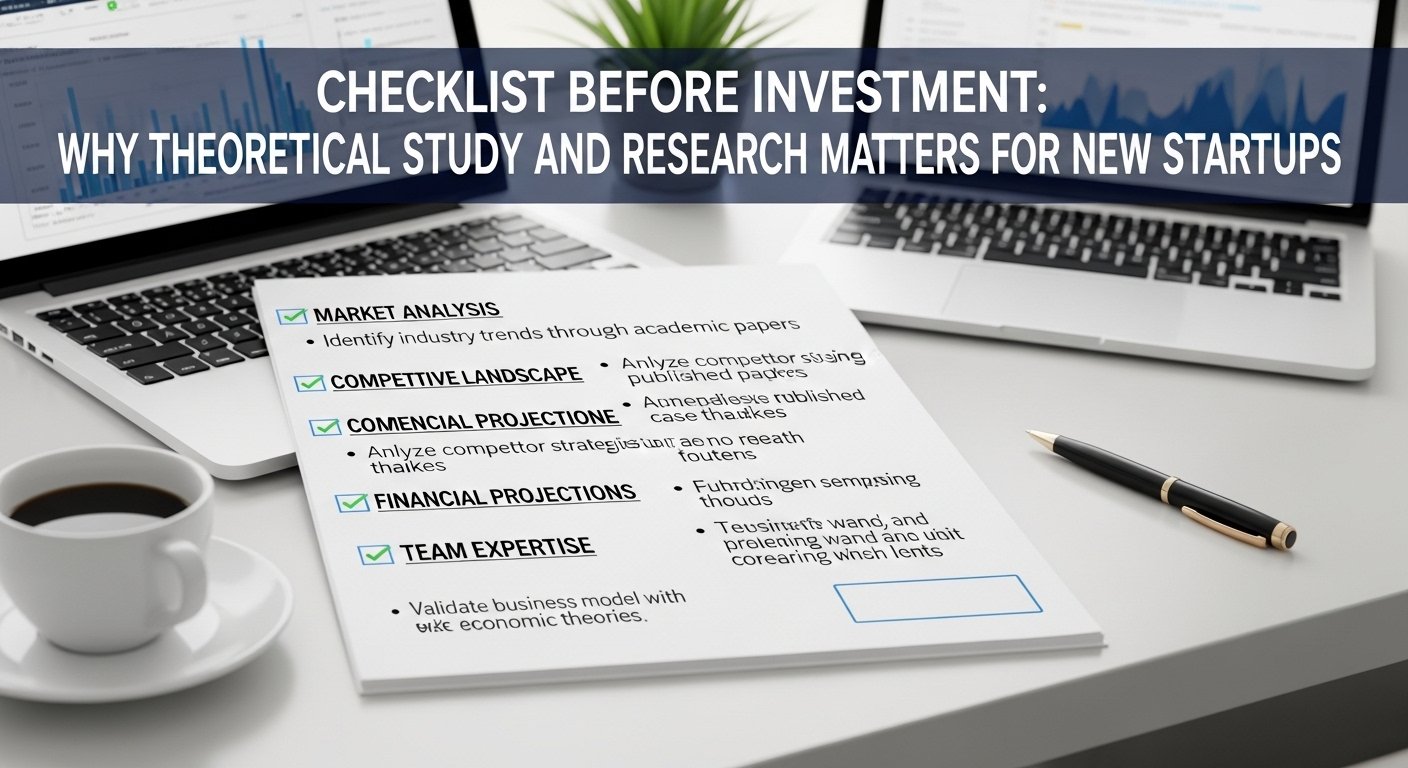
The Complete Pre-Investment Checklist
Before you invest any money in your startup, complete every item on this checklist. Consider it your permission slip to spend capital.
Section 1: Market Research
Market research answers the fundamental question: Does a market exist for what I’m building?
1.1 Define Your Target Market
- Market size calculation: Use Statista or IBISWorld for industry data
- Total Addressable Market (TAM): What would annual revenue look like if you captured 100%?
- Serviceable Addressable Market (SAM): What portion can you realistically reach?
- Serviceable Obtainable Market (SOM): What can you capture in year 1-3?
1.2 Validate Market Trends
- Google Trends: Check search interest over the past 5 years
- Industry reports: Read at least 5 industry analyses
- Demographic shifts: How is your target customer changing?
- Technology disruption: Is technology creating new opportunities—or threats?
1.3 Identify Market Gaps
- Underserved segments: Which customers are ignored by current players?
- Pricing gaps: Are there pricing ranges nobody serves?
- Geographic opportunities: Are there markets with less competition?
- Feature gaps: What do customers want that doesn’t exist?
Section 2: Customer Research
Market research tells you if a market exists. Customer research tells you if your specific solution fits that market.
2.1 Conduct Customer Interviews
Customer interviews are the gold standard for validation:
- Find 15-25 people who match your target customer profile
- Ask open-ended questions about their problems and current solutions
- Listen for patterns—recurring frustrations, workarounds, wish-list features
- Document everything—quotes, observations, surprises
Nielsen Norman Group’s research shows that 15-25 interviews reveal patterns without diminishing returns.
2.2 Analyze Customer Behavior
- Where do they research: Search behavior reveals purchase intent
- Where do they hang out: Online communities, forums, social platforms
- How do they buy: Impulse vs. research-driven decisions
- What influences them: Reviews, recommendations, advertising
2.3 Understand Customer Economics
- Customer lifetime value (LTV): How much will they spend over time?
- Customer acquisition cost (CAC): What will it cost to acquire them?
- LTV:CAC ratio: Should be at least 3:1 for sustainable business
- Payback period: How long until acquisition cost is recovered?
Section 3: Competitive Research
Competition isn’t something to fear—it’s something to understand. Every competitor has already paid for the market research you need.
3.1 Identify All Competitors
- Direct competitors: Companies offering the same solution to the same market
- Indirect competitors: Alternative solutions to the same problem
- Substitute products: Different solutions that fulfill the same need
- Potential competitors: Companies that might enter your space
3.2 Analyze Competitor Strategies
- Traffic analysis: Use SimilarWeb to see their volume and sources
- SEO keywords: Use Ahrefs or SEMrush to see their search rankings
- Social presence: Which platforms are they active on?
- Pricing strategy: What are they charging and why?
3.3 Identify Competitive Advantages
After research, you should be able to answer:
- What can you do better: Better product, price, service, convenience?
- What can you do differently: New audience, new use case, new delivery?
- What can you do faster: Speed to market, customer service, delivery?
- What can you do cheaper: Lower prices, lower minimums, lower overhead?
Section 4: Financial Research
Before investing money, you need to understand where that money goes and when it comes back.
4.1 Calculate True Startup Costs
- One-time costs: Legal, incorporation, branding, website
- Fixed costs: Software subscriptions, rent, insurance
- Variable costs: Marketing, fulfillment, customer support
- COS (Cost of Sales): Direct costs of delivering your product
- Working capital: Money needed before revenue covers costs
LivePlan’s startup cost calculator helps you build comprehensive projections.
4.2 Model Revenue Scenarios
- Conservative scenario: Worst case—what if growth takes twice as long?
- Expected scenario: Most likely case based on research
- Optimistic scenario: Best case—what if everything goes right?
- Break-even analysis: At what revenue level do you stop losing money?
4.3 Understand Funding Requirements
- Runway calculation: How many months until you need revenue?
- Capital efficiency: How much do you need vs. how much can you bootstrap?
- Milestone-based funding: What do you need money for at each stage?
- Exit strategy: How does this business become valuable (or self-sustaining)?
Section 5: Legal and Regulatory Research
Ignoring legal requirements doesn’t make them go away—it makes them more expensive.
5.1 Business Structure Research
The SBA’s business structure guide explains your options:
- Sole proprietorship: Simple but no liability protection
- LLC: Most popular for small businesses—liability protection with flexibility
- C-Corp: Required for VC funding—complex but investor-friendly
- S-Corp: Tax benefits if profitable—strict requirements
5.2 Industry-Specific Regulations
- Licensing requirements: What permits does your industry require?
- Zoning laws: Can you operate from your intended location?
- Data privacy: GDPR, CCPA, or other privacy regulations?
- Industry-specific compliance: Healthcare, finance, food, etc. have special rules
5.3 Intellectual Property Research
- Trademark search: Is your business name available? Check USPTO
- Patent search: Has someone already patented your solution? Check Google Patents
- Domain availability: Is your domain available? Check Namecheap
- Social media handles: Are your handles available across platforms?
Section 6: Product/Service Validation
Before investing in building, you need evidence that people will pay for what you’re building.
6.1 Minimum Viable Product Testing
- Landing page test: Create a page at Carrd describing your offer and measure sign-ups
- Concierge MVP: Deliver your service manually before automating
- Prototype testing: Show mockups to potential customers and gather feedback
- Pre-sales: Ask people to pay before you build
6.2 Pricing Validation
- Willingness to pay: Ask customers directly—and watch what they actually do
- Competitor pricing: What’s the market bearing?
- Value-based pricing: Price based on value delivered, not cost to produce
- A/B testing: Test different price points with real customers
6.3 Distribution Validation
- Channel testing: Where can you reach customers effectively?
- Content marketing: Can you attract customers with valuable content?
- Paid acquisition: What’s your realistic customer acquisition cost?
- Partnership opportunities: Can partners help you reach customers?
Section 7: Personal Readiness Assessment
Research isn’t just about the business—it’s about you.
7.1 Skills Inventory
- What am I good at: Core competencies and strengths
- What skills do I lack: Gaps that need filling (hiring, partners, contractors)
- Who do I know: Network that can help (advisors, potential customers, partners)
- What have I learned: Past experience relevant to this venture
7.2 Commitment Assessment
Self-awareness is critical:
- Time commitment: Can you realistically dedicate 40+ hours weekly?
- Financial commitment: How long can you survive without income?
- Family support: Does your support system understand and support this?
- Risk tolerance: Can you handle the emotional volatility of entrepreneurship?
Section 8: Theoretical Study Resources
Your research phase should include studying what others have learned. Here’s where to start:
8.1 Essential Books for Startup Research
- The Lean Startup by Eric Ries – Validated learning and iterative development
- The Startup Owner’s Manual by Steve Blank – Customer development methodology
- Getting Real by 37signals – Building a business the sustainable way
- Business Model Canvas by Strategyzer – Visual business planning
- The Offer by Patrick Dang – Creating offers that convert
8.2 Online Learning Resources
- Y Combinator Startup Library – Free videos from top startup program
- Startup School – Y Combinator’s free program
- Indie Hackers – Revenue sharing and founder stories
- Coursera Startup Engineering – Stanford course on launching
- Udacity Product Management – Online learning
8.3 Industry Research Sources
- Crunchbase – Funding data and competitor analysis
- CB Insights – Startup research and failure analysis
- Gartner – Technology and market trends
- McKinsey Technology – Industry insights
- Forbes Entrepreneurship – Latest news and strategies
Frequently Asked Questions
How long should I research before investing in my startup?
Most experts recommend 3-6 months of dedicated research and validation before significant investment. This should include market research, customer interviews, competitive analysis, and financial modeling. Rushing this phase leads to expensive pivots later.
What’s the difference between market research and customer research?
Market research asks “does a market exist?” while customer research asks “will my specific solution work in this market?” Market research uses industry data and trends. Customer research uses direct conversations and observations with potential buyers.
How much should I budget for pre-investment research?
Financial experts suggest allocating 5-10% of your total startup budget for research and validation. If you’re planning to invest $20,000, spend $1,000-2,000 on research first. Tools like Statista, IBISWorld, and Crunchbase offer valuable data at various price points.
Can I skip research if I have a great idea?
CB Insights’ data is clear: 42% of startups fail due to “no market need.” An idea without validation is just an assumption. Even brilliant ideas need testing. Steve Blank’s customer development methodology exists because every initial assumption is wrong until proven right by real customers.
What if my research shows the business idea won’t work?
This is the best possible outcome of research. Discovering an unviable idea before investing saves you months of effort and thousands of dollars. Use this information to pivot early. Steve Blank’s research shows that successful startups often pivot multiple times before finding product-market fit. Pivoting isn’t failure—it’s course correction.
Should I hire a professional to do market research?
For early-stage startups, DIY research is usually sufficient. Most research tools are affordable or free, and first-hand customer interviews are more valuable than outsourced reports. However, for highly technical industries or regulated markets, professional research may be worth the investment.
How do I validate pricing before launching?
ConversionXL’s pricing research shows several approaches: survey customers about willingness to pay, test price points with A/B experiments, observe competitor pricing, and most importantly, watch actual purchasing behavior. Pre-sales are the ultimate validation—if people pay before you launch, your price is accepted.
What startup mistakes does research prevent?
Fundera’s analysis identifies these research-preventable failures: building products nobody wants (no customer research), underpricing (no competitive research), running out of cash (no financial modeling), getting outcompeted (no competitive analysis), and legal issues (no regulatory research).
The Complete Pre-Investment Checklist (Print This)
| Category | Item | Complete? |
|---|---|---|
| Market Research | ||
| TAM, SAM, SOM calculated | ___ | |
| 5+ industry reports read | ___ | |
| Market trends analyzed (5-year) | ___ | |
| Market gaps identified | ___ | |
| Customer Research | ||
| 15-25 customer interviews completed | ___ | |
| Customer personas created | ___ | |
| LTV and CAC estimated | ___ | |
| LTV:CAC ratio calculated (target: 3:1+) | ___ | |
| Competitive Research | ||
| Direct competitors identified (5+) | ___ | |
| Indirect competitors identified | ___ | |
| Competitor pricing analyzed | ___ | |
| Competitive advantages documented | ___ | |
| Financial Research | ||
| Complete startup cost list created | ___ | |
| 12-month financial projection completed | ___ | |
| Break-even point calculated | ___ | |
| Runway requirement determined | ___ | |
| Legal Research | ||
| Business structure chosen | ___ | |
| Industry regulations identified | ___ | |
| Trademark search completed | ___ | |
| Domain and social handles verified | ___ | |
| Product Validation | ||
| MVP test completed (landing page or prototype) | ___ | |
| Pricing validated (survey or pre-sales) | ___ | |
| Distribution channel tested | ___ | |
| First paying customers acquired | ___ | |
| Theoretical Study | ||
| 3+ startup books read | ___ | |
| 1+ online course completed | ___ | |
| Startup failure post-mortems studied | ___ | |
| Industry expert interviews conducted | ___ | |
Research isn’t the opposite of action—it’s a prerequisite for it. Every hour you spend researching before investing saves ten hours of correcting mistakes after investing.
The entrepreneurs who succeed aren’t the ones with the most capital or the best ideas. They’re the ones who understood their market before they entered it. They validated assumptions before making commitments. They learned from others’ failures instead of repeating them.
Your research phase is where you separate your idea from reality. Where you discover if customers exist, if they’ll pay, if competitors are vulnerable, and if you have the resources to compete. This isn’t exciting work—but it’s the work that determines whether the exciting work pays off.
Complete this checklist. Then—and only then—invest with confidence.
Your Next Step: Print the checklist above. Start with Section 1: Market Research. Spend one week on each section. After 8 weeks, you’ll have completed your pre-investment research—and you’ll know exactly what you’re getting into before you get into it.
For more guidance on startup preparation, explore our guides on business validation, startup funding methods, and quitting your job to start a business.
Related Articles
- How to Validate Your Business Idea Before Building Anything
- Startup Funding: 15 Methods Explained
- How to Quit Your Job and Start a Business
- The 10 Biggest Mistakes New Entrepreneurs Make