

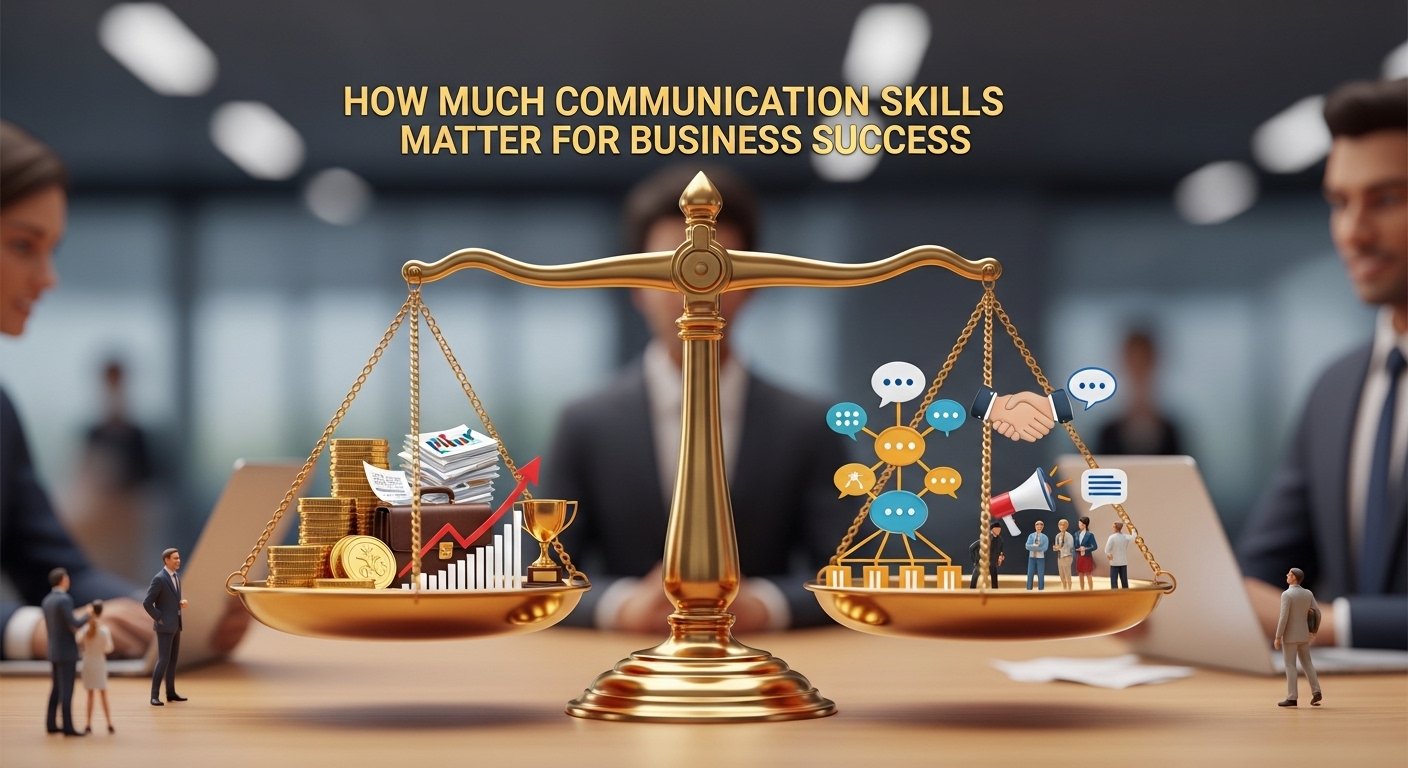
You can have the best product in the world. The most innovative solution. The lowest prices. The strongest team.
And none of it matters if you can’t communicate.
Communication isn’t just a soft skill—it’s the backbone of every business function. McKinsey research shows that effective communication increases productivity by up to 25%. Companies with strong communication practices generate 47% higher returns for shareholders.
This guide explores exactly how much communication skills matter for your business—and how to develop them.
The Business Case for Communication Skills
Let’s start with the numbers. Because in business, what gets measured gets managed.
Communication Impacts Revenue Directly
Salesforce’s research reveals that:
- 86% of buyers say communication skills are the most important factor in vendor selection
- 75% of customers prefer salespeople who educate rather than sell
- 89% of consumers have switched to a competitor due to poor communication
These aren’t soft metrics—they’re revenue numbers. Every miscommunication costs you customers. Every unclear pitch loses deals. Every delayed response drives buyers away.
The Cost of Poor Communication
Research by Economist Intelligence Unit found that poor communication costs businesses an average of $62.4 million per year in lost productivity, errors, and missed opportunities.
For small businesses, even a fraction of that represents significant impact:
- Misunderstood requirements: Rework and delays
- Lost sales: Prospects who didn’t understand your value
- Customer churn: Clients who felt unheard or ignored
- Employee turnover: Staff who quit due to poor management communication
- Missed deadlines: Teams working on wrong priorities
Key Insight: Communication skills aren’t just about being nice—they’re about being effective. Every conversation is an opportunity to advance your business or lose ground to competitors.
Communication Skills in Sales
Sales is communication distilled to its purest form. Your ability to communicate determines whether deals close or die.
Active Listening
HubSpot’s sales research shows that the best salespeople listen 70% of the time and talk only 30%. Most beginners do the opposite.
Active listening means:
- Asking clarifying questions before proposing solutions
- Paraphrasing to confirm understanding
- Not interrupting with your pitch
- Noticing emotional cues and responding to them
- Taking notes and referencing them later
Clear Value Proposition
ConversionXL’s research shows that 95% of visitors to your site won’t remember your value proposition if it takes more than 5-8 seconds to understand.
Your communication must answer:
- What: What do you offer?
- So what: What difference does it make?
- Now what: What should they do next?
Handling Objections
Effective objection handling requires:
- Acknowledge: “I understand your concern about price…”
- Empathize: “Many of our best customers felt the same way initially…”
- Educate: “What they found was that the ROI justified…”
- Transition: “Based on what you’ve shared, I think [solution] would work because…”
Communication Skills in Leadership
Your team can’t execute what they don’t understand. Gallup research shows that managers who communicate effectively have teams with 25% higher productivity.
Giving Clear Direction
Vague instructions create vague results. Effective leaders communicate with clarity:
- Specific goals: Not “improve sales” but “increase Q2 sales by 15%”
- Clear deadlines: Not “soon” but “by Friday at 5pm”
- Defined resources: Not “do your best” but “you have this budget and these tools”
- Measurable outcomes: Not “great work” but “reduce response time by 50%”
Delivering Feedback
Mind Tools’ feedback guide emphasizes the SBI model:
- Situation: “In yesterday’s client call…”
- Behavior: “…you interrupted the client three times…”
- Impact: “…which made them defensive and we lost the upsell opportunity.”
Motivating Through Communication
Psychology Today reports that intrinsic motivation—motivation from within—lasts longer than extrinsic motivation. Effective leaders communicate in ways that inspire intrinsic drive:
- Connecting daily work to larger mission
- Recognizing specific contributions publicly
- Providing autonomy while maintaining accountability
- Sharing transparency about company challenges and wins
Communication Skills in Customer Service
Customer service is where communication skills become your competitive advantage—or your Achilles heel.
The Emotional Component
Harvard Business Review research shows that customers who have emotional connections with brands have 306% higher lifetime value. Emotional connection comes from communication, not from features or prices.
Active Listening in Service
Zendesk’s customer service research identifies these active listening skills:
- Letting customers finish without interrupting
- Asking “Is there anything else?” before resolving
- Reflecting emotions: “I can hear how frustrating this has been for you”
- Summarizing the problem before proposing solutions
- Confirming understanding: “Let me make sure I have this right…”
The Power of Written Communication
Most customer service happens through text—emails, chat, social media. Grammarly’s research shows that 65% of business professionals believe poor writing costs businesses money. Written communication skills directly impact:
- Email response rates: Clear, concise emails get 40% more responses
- Customer satisfaction: Easy-to-understand communication reduces frustration
- Brand perception: Professional writing reflects professional business
- Support ticket resolution: Clear back-and-forth resolves issues faster
Communication Skills in Marketing
Marketing is communication at scale. Your ability to craft compelling messages determines whether your marketing budget generates ROI or goes to waste.
Copywriting Fundamentals
Copyblogger’s copywriting research shows that effective marketing copy follows these principles:
- Clarity over cleverness: If customers don’t immediately understand, they leave
- Benefits over features: Not “4GB RAM” but “work without slowdown”
- Specificity: Not “saves time” but “saves 5 hours per week”
- Emotional triggers: Logic makes arguments; emotion makes sales
Storytelling in Business
Forbes reports that stories are 22x more memorable than facts alone. Effective business communication uses storytelling to:
- Make abstract concepts concrete
- Create emotional connection with prospects
- Differentiate from competitors with similar features
- Build brand identity and loyalty
Social Media Communication
Buffer’s social media research identifies these communication principles for social platforms:
- Consistency: Regular communication builds trust
- Authenticity: People connect with real voices, not corporate-speak
- Responsiveness: 71% of consumers who have positive social media experiences recommend the brand
- Value-first: Lead with value; selling comes second
Communication Skills in Negotiations
Every business interaction is a negotiation. Your communication skills determine outcomes.
The Psychology of Persuasion
Robert Cialdini’s research on persuasion identifies six principles effective communicators use:
- Reciprocity: Give value first; others feel obligated to respond
- Scarcity: Communicate what’s unique or limited about your offer
- Authority: Demonstrate expertise and credentials
- Consistency: Get small commitments before big ones
- Liking: Build rapport before pushing for agreements
- Social proof: Use testimonials, case studies, and examples
Negotiation Language
Harvard Law School’s Program on Negotiation recommends these communication techniques:
- Label emotions: “It seems like you’re concerned about…”
- Ask questions: “Help me understand your position…”
- Avoid “but”: Use “and” to build on statements
- Summarize understanding: “So what I’m hearing is…”
- Create anchor points: “Based on market data, our pricing is…”
Written Communication for Business
In the digital age, more business happens through writing than ever before. Your emails, proposals, and documents are representatives of your business.
Email Communication
McKinsey research shows that professionals spend 28% of their workweek reading and answering emails. Poor email communication wastes this time. Effective email practices:
- Clear subject lines: Summarize the email in 5-7 words
- Actionable openings: State the purpose in the first sentence
- Brevity: Most emails should be 5 sentences or fewer
- Explicit next steps: Tell readers exactly what you need from them
- Professional formatting: Use paragraphs, bullet points, and white space
Business Writing Tools
Grammarly Business and Hemingway Editor help improve your writing clarity. Other essential tools:
- Grammarly – Grammar and style checking
- Hemingway App – Readability improvement
- Merriam-Webster – Dictionary reference
- Thesaurus – Vocabulary enrichment
How to Improve Your Business Communication
Communication skills improve with practice and intention. Here’s how to develop them:
Practice Active Listening
Nielsen Norman Group’s listening research suggests these exercises:
- In your next conversation, spend 70% of time listening
- After someone finishes speaking, wait 2 seconds before responding
- Paraphrase what you heard: “So what you’re saying is…”
- Ask one follow-up question for every statement you make
Study Great Communicators
Learn from the best. Study:
- TED Talks – Observe how experts communicate complex ideas
- Steve Jobs presentations – Master the art of simplicity
- Entrepreneur.com – Study successful business communication
- Medium – Read well-written business articles
Practice Public Speaking
Toastmasters International provides a structured way to build speaking skills. Alternatively:
- Record yourself giving presentations and review critically
- Offer to present at team meetings
- Join local business networking groups with speaking components
- Practice explanations of your business in under 30 seconds
Get Feedback
Mind Tools’ feedback guide recommends:
- Ask colleagues for specific feedback on your communication
- Survey customers about how well you explained products or processes
- Record calls (with permission) and review for improvement areas
- Find a communication mentor or coach
Frequently Asked Questions
Can communication skills really impact my business revenue?
Absolutely. Salesforce research shows that 86% of buyers cite communication skills as the most important factor in vendor selection. Poor communication costs businesses an average of $62.4 million annually in lost productivity and missed opportunities. Better communication leads to higher conversion rates, stronger customer loyalty, and reduced errors.
What if I’m naturally introverted? Can I still communicate effectively?
Introversion is not a communication barrier—it’s a communication style. Many of the world’s best communicators are introverts. Introverts often excel at active listening, thoughtful responses, and written communication. The key is leveraging your natural strengths rather than trying to become an extrovert.
How can I improve communication within my team?
Start with clear expectations and regular check-ins. Implement structured communication practices like daily standups, weekly team updates, and monthly one-on-ones. Use collaboration tools like Slack or Microsoft Teams to keep communication organized and searchable.
How important is written communication compared to verbal?
Grammarly’s research shows that 65% of business professionals believe poor writing costs businesses money. In the digital age, more business communication happens through writing—emails, chat, proposals, social media, documentation. Both verbal and written skills matter, but most professionals have more room for improvement in written communication.
What are the most common communication mistakes in business?
- Assuming understanding: Not confirming the other person got your message
- Too much information: Overwhelming with details when a summary suffices
- Tone mismatches: Written messages that seem harsh or cold
- Passive language: “Mistakes were made” instead of “I made a mistake”
- Not listening: Preparing your response while others are speaking
How do I communicate difficult feedback to employees?
Use the SBI model (Situation-Behavior-Impact) from Mind Tools. Focus on specific, observable behaviors rather than personality traits. Deliver feedback privately, close to the event, and offer constructive next steps. Follow up to show you care about their development.
How can I improve my public speaking skills for business presentations?
Toastmasters International offers the most proven path to better speaking. Start with low-stakes practice: present to your team, record yourself, and gradually take on larger audiences. Focus on clarity over complexity—simplify your message until a 10-year-old could understand it.
Are there communication courses you recommend?
Coursera and Udemy offer excellent communication courses. Specifically:
- Wharton’s Professional Speaking Course – Business presentations
- Udemy Business Communication Masterclass – Comprehensive
- LinkedIn Learning – Various communication topics
- Toastmasters – In-person practice and feedback
Conclusion
Communication skills matter more than almost any other business skill. They’re the thread that connects every business function—sales, marketing, operations, finance, and leadership. They’re how you acquire customers, retain them, motivate employees, and negotiate deals.
The good news? Communication skills improve with practice. Unlike some talents, they’re learnable. Every conversation is an opportunity to practice. Every email is a chance to refine your message. Every presentation is experience that makes the next one better.
Invest in your communication skills as seriously as you invest in your product or marketing. The returns compound across every business interaction.
Your Next Step: Identify one communication skill you want to improve. Is it active listening? Email clarity? Presentation delivery? Pick one and practice it deliberately this week. Track your results and adjust. Small improvements compound into transformational change.
For more business skill development, explore our guides on business validation, quitting your job to start a business, and common startup mistakes to avoid.
Related Articles
- How to Validate Your Business Idea Before Building Anything
- How to Quit Your Job and Start a Business
- The 10 Biggest Mistakes New Entrepreneurs Make
- Pre-Investment Checklist: Why Research Matters