
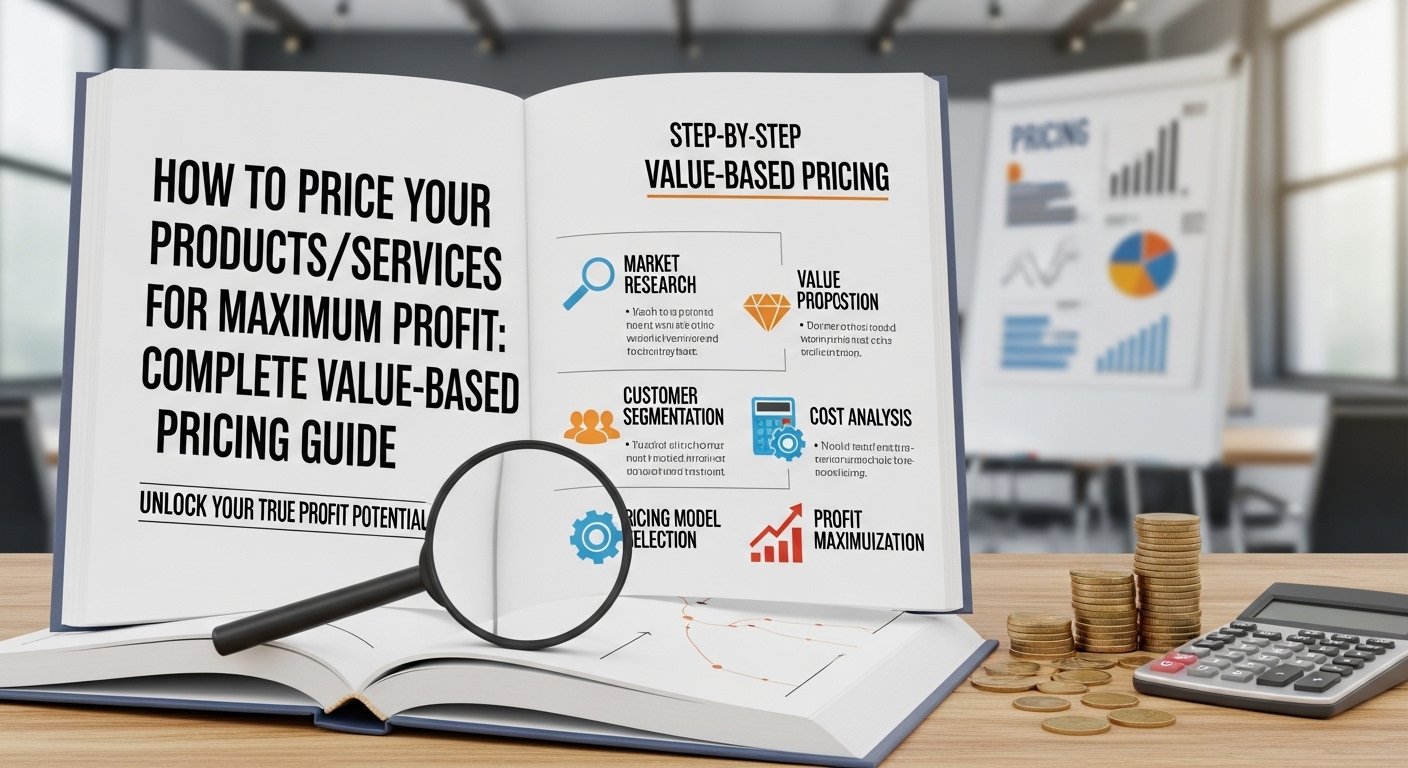
Most entrepreneurs price their products wrong. They look at costs, add a margin, and hope for the best. But the most profitable businesses in the world don’t price based on costs—they price based on value.
A $5 coffee at Starbucks isn’t expensive because of the cost of beans and milk. It’s priced based on the experience, convenience, and social status it provides. A consultant charging $500/hour isn’t overcharging—they’re capturing the value they create for clients.
This guide teaches you value-based pricing: how to understand what your customers truly value, communicate that value effectively, and price accordingly. The result? Higher prices, more profit, and customers who feel they’re getting a bargain even when you’re charging premium rates.
The Key Insight: Price is not a reflection of your costs—it’s a reflection of your customer’s perceived value. Two identical products can have wildly different prices based solely on how they’re positioned, who they’re for, and what problem they solve. Your job isn’t to cover costs; it’s to capture value.
Why Pricing Is Your Most Important Business Decision
Before diving into strategies, let’s understand why pricing matters so much. Many entrepreneurs focus on increasing sales, cutting costs, or launching new products—but pricing has a multiplier effect that nothing else can match.
The Math That Proves Pricing Matters
| Metric | With 10% Price Increase | With 10% Cost Reduction | With 10% Volume Increase |
|---|---|---|---|
| Profit Impact | +100% or more | +25-50% | +10-20% |
| Ease of Implementation | Easy (do it today) | Requires work | Requires marketing spend |
| Customer Perception | Can increase perceived value | May signal lower quality | May require discounts |
| Sustainability | Long-term if value-based | One-time benefit | Requires ongoing effort |
The Brutal Truth About Low Prices
- Low prices attract price-sensitive customers who will leave the moment someone is cheaper
- Low prices create a race to the bottom where only the lowest-cost provider survives
- Low prices signal low value to customers, even if your product is excellent
- Low prices limit your growth because you need volume to compensate for thin margins
- Low prices make it impossible to invest in quality, service, or innovation
The Counter-Intuitive Truth: Raising prices often INCREASES sales. Why? Higher prices signal higher value, attract serious customers, reduce price objections, and give you resources to deliver better products and service. Apple charges premium prices—and dominates its markets.
The Five Pricing Methods: Know Your Options
Before choosing a strategy, understand the five main pricing methods. Each has advantages and drawbacks depending on your business type, market position, and customer base.
Pricing Methods at a Glance
| Method | Description | Best For | Risks |
|---|---|---|---|
| Cost-Plus | Add margin to production costs | Commodity products, manufacturing | Ignores customer value, invites competition |
| Competitor-Based | Price relative to competitors | Markets with established pricing norms | Price wars, no differentiation |
| Value-Based | Price based on customer perceived value | Services, unique products, B2B | Requires understanding customer psychology |
| Penetration | Low initial price to gain market share | New market entry, scaling quickly | Hard to raise prices later, attracts deal-seekers |
| Premium | High price signaling exclusivity | Luxury brands, expert services | Requires consistent high-value delivery |
Why Cost-Plus Pricing Destroys Profit
Most small businesses use cost-plus pricing: calculate costs, add 20-30% margin, done. This approach has fatal flaws:
- It assumes customers care about your costs—they don’t. They care about their own value received
- It caps your profit potential—you can never capture value beyond your margin
- It’s invisible to competitors—if costs are similar, prices will be similar, enabling price wars
- It penalizes efficiency—if you reduce costs, you make less money
The Value-Based Revolution: The most successful companies—Apple, Tesla, Netflix—don’t compete on price. They create and communicate value so effectively that customers happily pay premium prices. Your goal is to do the same.
Understanding Value-Based Pricing
Value-based pricing is the practice of setting prices based on the perceived value to the customer rather than the cost of production or competitor pricing. It sounds simple, but mastering it requires deep understanding of your customer’s psychology.
The Value Equation
Customers make purchase decisions based on this mental calculation:
PERCEIVED VALUE = (Results Achieved + Experience Delivered) - (Cost + Effort Required)Your price should be a fraction of the perceived value—not a multiple of your costs. If you save a customer $100,000, you can charge $25,000 and still be a bargain.
Three Types of Customer Value
- Functional Value: Solving a specific problem or saving time
- Emotional Value: How the purchase makes them feel
- Social Value: Status, identity, or belonging it provides
Value-Based Pricing Examples
| Business | Cost to Deliver | Value to Customer | Value-Based Price |
|---|---|---|---|
| Project management software | $5/user/month | Saves 5 hours/week = $500 value | $29-99/user/month |
| Business consultant | $75/hour (labor) | $50K in saved mistakes | $250-500/hour |
| Organic skincare | $8 to produce | Health, appearance, values | $45-80 |
| CRM system | $2/user/month | $10K in recovered customers | $20-75/user/month |
How to Measure Customer Value
You can’t price based on value if you don’t know what your value is. Here’s how to quantify the value you provide.
The Five Methods to Calculate Value
- Conduct Customer Interviews: Ask what they’d pay, what alternatives cost, what results they achieved. Use tools like Typeform or SurveyMonkey for surveys
- Analyze Customer Lifetime Value: How much revenue does a customer generate over time? Use Mixpanel or Amplitude for analytics
- Calculate Cost of Alternatives: What would it cost them to do without your product or hire someone else?
- Measure Results Achieved: Revenue generated, time saved, costs reduced, problems solved
- Track Willingness to Pay: A/B test prices or use Qualtrics for conjoint analysis
The Value Discovery Questions
Ask these questions in customer interviews to uncover value:
- “What did you do before using our product/service?”
- “What is that costing you in time, money, or stress?”
- “What results have you achieved since using it?”
- “How much is that result worth to you in dollars?”
- “What would you have paid for this solution?”
- “What would you have paid if our product didn’t exist?”
Pro Tip: When customers tell you a result is worth “$50,000” to them, you should be charging $10,000-25,000, not $500. Most entrepreneurs undercharge by 10x because they don’t ask these questions.
Value-Based Pricing Frameworks
Now that you understand value, here are specific frameworks to convert that understanding into prices.
Framework #1: The Value-to-Price Ratio
Calculate your ratio of delivered value to your price:
Value-to-Price Ratio = Customer Value Received / Your Price

Example:
- You save customer $100,000/year
- You charge $20,000
- Value-to-Price Ratio = 5:1 (customer gets $5 for every $1 spent)
Research shows that ratios between 3:1 and 10:1 lead to happy customers who don’t churn. Price at a point where your ratio is compelling but you’re capturing significant value.
Framework #2: Tiered Pricing (The Goldilocks Strategy)
Create three tiers that guide customers to your preferred option:
| Tier | Purpose | Strategy | Example |
|---|---|---|---|
| Entry (Basic) | Attract price-sensitive buyers | Low price, limited features | $29/month |
| Mid (Pro/Popular) | Your preferred option | Best value, most features | $79/month |
| Premium (Enterprise) | Capture high-value customers | No limits, white-glove service | $299/month |
Studies show that 80% of customers choose the middle option when presented with three tiers. Design your middle tier to be your most profitable offering.
Framework #3: Anchoring and Decoys
Present high-priced options first to make your target price seem reasonable:
- Show premium first: “$999/month for enterprise features”
- Position your option second: “$199/month for professional tools”
- Add a decoy if needed: “$149/month for basic features” (makes $199 seem like the sweet spot)
Research from Harvard Business School shows that consumers consistently choose the “middle” option when anchored by higher prices, even if the decoy isn’t compelling.
Framework #4: Penetration vs. Premium Positioning
| Positioning | Starting Price | Strategy | When to Use |
|---|---|---|---|
| Penetration | Low (30-70% below market) | Build volume, raise prices later | First-mover advantage needed, network effects |
| Premium | High (50-200% above market) | Build brand, add value to justify | Unique offering, luxury positioning |
| Market Rate | Industry standard | Compete on other factors | Commoditized market, no differentiation |
How to Price Services
Service pricing is different from product pricing because you’re selling time and expertise. Here’s how to maximize value capture.
Why Hourly Pricing Kills Your Profits
Hourly pricing seems logical—you trade time for money. But it has fundamental problems:
- It caps your income—you can only work so many hours
- It penalizes efficiency—faster workers earn less
- It commoditizes your expertise—clients focus on hours, not results
- It creates adversarial relationships—”You took 3 hours? That’s too expensive!”
The Three Better Service Pricing Models
1. Value-Based Project Pricing
Price based on the value delivered, not time spent:
Example:
- You help a client close $500,000 in sales
- Your fee: $50,000 (10% of results)
- You spend 40 hours on the project
- Effective rate: $1,250/hour

vs. Industry hourly rate of $150/hour
You earned 8x more by pricing the outcome
2. Retainer Pricing (The Preferred Model)
Charge recurring monthly fees for ongoing access:
- Benefits you: Predictable income, deeper client relationships
- Benefits client: Always-on support, priority access
- Typical retainers: $1,000-$10,000/month for consultants, agencies
3. Performance-Based Pricing
Tie your fees to results achieved:
- Success fees: Lower base + percentage of results
- Guaranteed results: Higher price, with performance clauses
- Revenue share: Ongoing percentage of client revenue
Service Pricing by Industry
| Service Type | Entry Level | Mid Level | Expert/Premium |
|---|---|---|---|
| Web Development | $500-2,500/project | $5,000-25,000/project | $50,000-500,000/project |
| Graphic Design | $200-1,000/project | $2,000-10,000/project | $25,000+/project |
| Marketing Consultant | $75-150/hour | $200-500/hour | $1,000-5,000/hour |
| Business Coach | $100-300/month | $500-2,000/month | $5,000-25,000/month |
| Accountant | $50-150/hour | $200-400/hour | $500+/hour |
| Attorney | $200-400/hour | $400-700/hour | $1,000+/hour |
How to Price Products
Product pricing requires balancing production costs, market positioning, and perceived value.
The Golden Rule of Product Pricing
Your product should cost less than 1/3 of the value it delivers:
Customer Value Received: $300
Your Price: $100 or less
Customer ROI: 3:1 or better
Product Pricing Strategies
1. Bundle Pricing
Combine products to increase perceived value and average order value:
- Individual items: $29, $49, $79
- Bundle all three: $129 (vs. $157 individually)
- Result: Customer feels they’re getting a deal, you sell more
Shopify and WooCommerce make bundling easy with native and app-based solutions.
2. Freemium Model
Offer a free version to attract users, charge for premium features:
- Free tier: Basic features, limited usage
- Paid tiers: Advanced features, more capacity, priority support
- Conversion rate: Typically 2-5% of free users convert
Companies like Dropbox, Slack, and Canva built empires with this model.
3. Subscription Pricing
Recurring revenue creates predictable income and higher lifetime value:
Example:
- One-time purchase: $99
- Annual subscription: $49/year ($4.08/month)

Year 1: Customer pays $49
Year 2: Customer pays $49
Year 3: Customer pays $49
Total: $147 (49% more than one-time)

Plus: Higher retention, lower acquisition costs
4. Psychological Pricing
Leverage psychology to make prices feel lower:
| Technique | Example | Why It Works |
|---|---|---|
| Charm pricing | $99 instead of $100 | Perceived as significantly lower |
| Prestige pricing | $500 instead of $499 | Signals premium quality |
| Bundle pricing | Was $200, now $149 | Reference price comparison |
| Decoy pricing | $9/$12/$20 options | Middle option seems best |
How to Communicate Value to Justify Your Price
Value-based pricing only works if customers understand the value they’re receiving. Here’s how to communicate it effectively.
The Value Proposition Canvas
Use this framework to articulate your value:
Customer Profile:
- Jobs to be done: What are they trying to accomplish?
- Pains: What's frustrating, costly, or risky?
- Gains: What outcomes do they want?

Your Value Proposition:
- Products/Services: What do you offer?
- Pain Relievers: How do you eliminate their problems?
- Gain Creators: How do you create the outcomes they want?
Five Ways to Communicate Value
- Lead with outcomes, not features: “Save 10 hours per week” not “Includes automation features”
- Quantify whenever possible: “$50,000 saved annually” not “Saves money”
- Use social proof: Customer testimonials, case studies, before/after results
- Create ROI calculators: Tools like BuzzSumo or custom calculators show tangible value
- Educate before selling: Blog posts, webinars, free guides that demonstrate expertise
The Price Justification Statement
Use this formula to justify your prices:
"[Our Product/Service] helps [Target Customer] achieve [Specific Outcome]
without [Common Problem]. Unlike [Competitor/Alternative], we
[Key Differentiation], which is why our clients see [Quantified Result]."

Example:
"We help B2B SaaS companies reduce churn by 30% without hiring
additional support staff. Unlike generic help desk software, we provide
AI-powered personalization that predicts and prevents churn, which is
why our clients see $500K+ in recovered annual revenue."
How to Raise Prices Without Losing Customers
Raising prices is one of the most effective ways to increase profits—but it requires strategy.
The Optimal Time to Raise Prices
- When launching new features: “We’re adding X, so prices increase”
- At renewal time: Easier to justify for new customers
- When demand is high: Higher demand = higher price tolerance
- With tier changes: Raise prices on old tier, add new premium tier
The Gradual Raise Strategy
For existing customers, raise prices gradually:
| Phase | Action | Timeline |
|---|---|---|
| 1. Announce | Inform customers of upcoming change | 30-60 days before |
| 2. Grandfather | Let existing customers keep old price for X months | 3-12 months |
| 3. Raise | Move everyone to new pricing | After grandfather period |
| 4. Add value | Ensure new price delivers more than old | Ongoing |
Warning: Never apologize for raising prices. If you’ve delivered value, you deserve fair compensation. Apologizing signals that the price increase is unjustified, which encourages customers to push back or leave.
How to Handle Price Objections
When customers resist price increases, don’t negotiate—reframe:
- “That’s too expensive”: “What would it cost to not solve this problem?”
- “I need a discount”: “What value would you need to see to feel this is fair?”
- “Your competitor is cheaper”: “What would it take for our solution to be worth the difference?”
- “I need to think about it”: “What specific information would help you decide?”
The Retention Math: If raising prices 20% causes 10% of customers to leave, you still come out ahead. A 20% price increase with 90% retention is far more profitable than the original price with 100% retention.
Tools and Resources for Smarter Pricing
Use these tools to implement value-based pricing strategies:
Pricing Analytics Tools
- ProfitWell: Track pricing, churn, and revenue metrics
- ChartMogul: Subscription revenue analytics
- Metorik: E-commerce analytics and pricing insights
- Glew: Multi-channel e-commerce intelligence
Survey and Research Tools
- Qualtrics: Advanced survey and pricing research
- Typeform: Beautiful customer surveys
- SurveyMonkey: Easy market research
- Hotjar: Customer behavior analytics
Pricing Page Optimization
- Optimizely: A/B test pricing pages
- VWO: Conversion rate optimization
- Unbounce: Landing page optimization
Pricing Books to Read
- “Pricing Friction” by Scott Cunningham
- “Million Dollar Financial Advisor” by James B. Streater
- “Hybrid Marketing” by Allen Weiss
Price for Profit, Not Survival
The biggest mistake entrepreneurs make is pricing to survive rather than pricing to thrive. They look at their costs, add a modest margin, and hope customers agree. But survival pricing is a race to the bottom.
Value-based pricing flips this script. Instead of asking “What can I charge to cover costs?” you ask “What is this worth to my customer?” The answer—properly researched and communicated—is almost always higher than you think.
The businesses that thrive aren’t the cheapest. They’re the ones that create and communicate the most value. Apple isn’t the biggest smartphone company because it’s cheapest. Rolex doesn’t dominate watches by undercutting competitors. Ferrari sells fraction of Toyota’s volume—but at 50x the price per car.
Your path to maximum profit isn’t working more hours or cutting more costs. It’s understanding what your customers truly value and capturing a fair share of that value with your prices.
Your Action Steps:
1) Calculate the value your business delivers to customers in dollars.
2) Set your prices at 1/3 to 1/10 of that value.
3) Double or triple your current prices if the math supports it.
4) Communicate value relentlessly.
5) Raise prices annually as you deliver more value.
Price confidently. Price profitably. Price based on value.
Frequently Asked Questions
How do I know if my prices are too low?
If you’re constantly busy but struggling to profit, your prices are likely too low. Other signs: customers don’t value your work, you attract only bargain hunters, and you can’t afford to invest in quality. Use customer interviews to discover what they’d pay for your results—and then charge that.
Should I match competitor prices?
Only if you have no differentiation and compete purely on price—which is a race to the bottom. Instead, compete on value. If competitors charge $100 and you can deliver $500 in value, charge $150-200. Customers will pay a premium for superior outcomes, not just lower prices.
How often should I raise prices?
At minimum, annually. Annual price increases (even 5-10%) keep up with inflation and your improving value delivery. Premium brands raise prices 15-30% yearly because their value proposition strengthens over time. The best time to raise prices is when you launch new features, improve outcomes, or see increased demand.
Is value-based pricing only for services?
No—it works for products too. The key is understanding why customers buy. A $200 chair isn’t expensive if it saves someone’s back, lasts 20 years, and makes them feel successful. A $5 coffee is expensive if it’s burnt, served slowly, and tastes worse than home-brewed. Price based on perceived value, not production cost.
How do I raise prices without losing customers?
Use these strategies: 1) Give existing customers a grandfather period at old prices. 2) Raise prices only for new customers initially. 3) Bundle current pricing with new features. 4) Communicate value increases before announcing price increases. 5) Don’t apologize—confidently explain why your solution is worth more.
Related Articles
- Multiple Streams of Income: 20 Ways to Diversify
- How to Validate Your Business Idea Before Launching
- How to Build a Million-Dollar Business Without VC Funding
- Communication Skills Every Entrepreneur Needs